Exploration Review 6: Return to the Moon

In Exploration Review, I collect news from the last couple weeks about the exploration of remote places.

In this edition: return to the Moon, asteroid science, and tiny underwater robots.

Special Note for the few of you who currently subscribe both to my Substack and my history blog at invertingvision.com: This year, I’m going to be experimenting with a content publishing model called POSSE (Publish on Site, Syndicate Everywhere). That means you probably got two copies of this post in your inbox. Feel free to keep your subscription on your preferred platform, and unsubscribe elsewhere. You will still get all of my content.

Return to the Moon

The SLS on the Launchpad for Artemis II. Credit: NASA/Joel Kowsky

Artemis II’s rocket is back on the launchpad after undergoing repairs, and they’re hoping for an April 1 launch. People may be returning to orbit the Moon very soon. The last attempts were delayed for technical issues, and its always possible that more issues or weather will delay the next attempt. But there are several opportunities in April, so it seems likely that we will see a launch in the next month.

https://www.nbcnews.com/science/space/nasa-roll-out-artemis-ii-moon-rocket-launch-pad-rcna264106

Artemis II will be an orbital mission, similar to Apollo 8, which sent astronauts to orbit the Moon for the first time. Apollo 8 launched at the end of 1968, which was a year of major domestic and international turmoil–the assassinations of MLK and RFK, escalation in the Vietnam war, and major protests across the world. The parallels are difficult to miss. I have seen people discussing the difficulties of getting excited for such an event in the current news environment, and writing about what a successful Artemis II launch would mean for NASA and for the US.

https://www.space.com/space-exploration/artemis/nasas-apollo-8-moonshot-saved-1968-could-artemis-2-do-the-same-in-2026

Jared Isaacman, the new NASA administrator, has been making a lot of statements about the future of Artemis and NASA. One of the most significant changes on the horizon is the reorganization of future Artemis missions, which Jeff Foust explains fully here:

https://www.thespacereview.com/article/5171/1

Artemis III would be changed to an earth-orbit rendezvous mission slated for 2027, which also mirrors the Apollo progression. It’s hard to say how likely Artemis changes are to salvage NASA’s chances at a crewed Moon landing in the near future. They don’t have a functional lander yet, which is part of the reason for the reorganization. But historically, nearly every new administration changes the plan to return to the Moon or get to Mars, and it almost always just creates more delays. The ironic thing in this instance is that the current plan came together under Trump I, kept uncharacteristic consistency into the Biden administration, and now the reorganization is happening under Trump II. Since it is not a complete rehaul of the program, however, perhaps it will turn out differently.

Isaacman has also talked about major changes to NASA’s workforce, moving contracted work back in-house. He hopes to accelerate NASA activity in some domains, including robotic Moon missions–Isaacman told Science that he wants to do a robotic “landing on the Moon every month for the next, who know, 3 years.”

https://www.science.org/content/article/nasa-administrator-talks-science-about-studying-moon-mars-and-earth

Staffing cuts at NASA and funding cuts to scientific projects have led to major uncertainty in the planetary science community. Isaacman thinks that maybe signalling demand will stimulate private launch and robotics partners to step up, enabling more missions. Companies currently contracted for CLPS might be interested in responding.

The timeline of CLPS missions. Credit: NASA

But they are all still very early in development, and Isaacman himself simply mentions “science and tech demonstration capabilities” as the possible payloads. None of this would be super encouraging to scientists looking for research opportunities. His nods toward improving the cost and timeline of non-lunar science missions were fairly vague. The people who I could see being encouraged by these remarks: investors interested in industrial uses of lunar robotics, who want the companies developing technology platforms to continue seeing growth.

Asteroid Science

Studies are continuing to come out from recent asteroid missions, including the DART mission that bumped into Dimorphos in 2022. Since then, scientists have been tracking the orbital shifts of Dimorphos and its companion Didymos, and have found a change in their orbit around the sun:

https://arstechnica.com/science/2026/03/nasas-dart-mission-shifted-the-orbits-of-two-asteroids/

A March 16 study on new analysis of asteroid Ryugu has made a splash in the news. The Japanese Hayabusa 2 spacecraft took sample from Ryugu that were returned in 2020. Scientists found organic molecules, which led to headlines indicating Ryugu, along with other asteroids, had “all the ingredients for life.”

https://www.smithsonianmag.com/smart-news/lifes-genetic-code-requires-five-key-ingredients-the-asteroid-ryugu-has-all-of-them-a-new-study-suggests-180988367/

Elise Cutts has a great explanation of exactly how significant this finding is. Basically, we’ve been finding these sorts of molecules in space for a long time, but continuing to confirm their presence in studies like this one is certainly important. But knowing the molecules are out there is just one part of the full story:

https://www.reviewertoo.com/the-asteroid-ryugu-contains-every-letter-of-the-genetic-alphabet/

Setbacks and Success in the Cryosphere

The Ukraine war is making Arctic science more difficult. Scientists studying algal blooms in the Pacific Arctic have been unable to collaborate with Russian scientists since the war. Geopolitics has a nasty habit of getting in the way of science sometimes. Growing scientific internationalism in the late 19th century was

Donald M Anderson writes: “One of the things that makes it hard to study the distribution of these blooms and cysts is the treaty line that separates U.S. and Russian waters. Although algae doesn’t recognize national borders and the Alexandrium population clearly extends beyond our current measurements, we cannot sample west of this boundary.”

https://www.whoi.edu/oceanus/feature/a-scientific-casualty-of-the-russia-ukraine-war/

Down south, however, the Australian Antarctic Program just completed major operations in the Heard and McDonald islands, “the first campaign of its kind in 20 years.”

https://www.antarctica.gov.au/news/2026/heard-island-and-mcdonald-islands-campaign-delivers-key-objectives/

Miscellanea

March 16 was the hundred-year anniversary of Robert Goddard’s first liquid-fueled rocket.

https://www.nasa.gov/image-article/celebrating-100-years-since-goddards-breakthrough-moment-in-modern-rocketry/

The A23a iceberg, which was the largest on Earth for a while, is melting.

https://www.bbc.co.uk/news/resources/idt-20f878f1-f4af-4022-9f62-b0515b9f4b20?utm_campaign=34322705-Ocean%20Insights%202026&utm_medium=email&_hsmi

Knowable Magazine has an overview of recent developments in deep-sea mining.

https://knowablemagazine.org/content/article/physical-world/2026/deep-sea-mining-debate-critical-minerals

We’re seeing more cool tiny undersea-exploring robots.

https://www.raspberrypi.com/news/exploring-the-ocean-with-raspberry-pi-powered-marine-robots/

New Mars rover selfie:

Totally awesome new selfie captured by Percy, with the rim of Jezero Crater at her back, and her latest abrasion patches on the rock to the left.🔍 viewer.gigamacro.com/view/SuO2Osk…#Mars Mar. 11, 2026 – Sol 1797 🧪🔭Credits images: NASA/JPL-Caltech

Daniel Pomarède (@pomarede.bsky.social) 2026-03-11T10:21:00.380Z

The First Time NASA Photographed a Lunar Lander

The Odysseus lunar lander built by Intuitive Machines (IM) recently became the first U.S. robot on the Moon’s surface since the Surveyor landers in the 1960s. Earlier this week, IM worked with NASA to get pictures of the lander from orbit. The resulting image is impressive, showing the lander as a tiny speck in the vast grey landscape near the Moon’s south pole. The image is also an echo of the first time NASA managed this feat, 57 years ago. In 1967, NASA’s third Lunar Orbiter spacecraft snagged a photograph of Surveyor I. The story of how engineers acquired that photograph (and it is a literal analog photograph) is fascinating, and the image itself played an important role in getting Apollo astronauts to the Moon. First, here’s the image of Odysseus along with the historic photograph of Surveyor:

Odysseus in the South Polar region of the Moon. Taken with the Lunar Reconnaissance Orbiter. Credit: NASA/Goddard/Arizona State University
Surveyor I in Oceanus Procellarum on the Moon. Taken with Lunar Orbiter III in 1967. Credit: NASA

It’s a bit easier to see Odysseus in the new image than it is to see Surveyor in the Lunar Orbiter (LO) photograph. But both of them are pretty difficult to spot, beyond the telltale shadow. And making out any detail is impossible. So what’s the point? For NASA in the 1960s, it was all about safety.

At the time, the push toward the Apollo landings was quickly accelerating. One of the top priorities was to find suitable landing sites. Telescopic imagery of the Moon was fairly comprehensive, but had some serious limitations, so NASA initiated the Lunar Orbiter program. Engineers put robots into orbit around the Moon, equipped with Kodak cameras and film, and took high-resolution images of potential Apollo landing sites.1 Meanwhile, they Surveyor robots soft-landed on the surface, took pictures, and used scoops to dig into the soil. Knowledge about the nature of the lunar surface grew rapidly. It began to quell doubts that some scientists held about the potential of landing people on the Moon.2 The imaging of Surveyor landing sites was an important part of this process.

For scientists in the 1960s, seeing the lander wasn’t as important as seeing the area around the it. Images from the ground could help scientists understand what they were seeing from above. At the time, orbital imagery was pretty difficult to interpret. Shadows were used to figure out the height or depth of some features, but other patterns in the orbital imagery were harder to make sense of. Scientists used aerial imagery of Earth to get started, since you could easily compare pictures of mountains and canyons taken from airplanes to the real thing.3 But the forces that shaped features on Earth weren’t necessarily the same as those that shaped features on the Moon, so the Earth-analog method was not always a reliable guide. What they really wanted were images from the lunar surface. That’s what Surveyor landers were able to provide.

If scientists could compare orbital images with ground-based images of the real lunar surface, they could be more confident in their interpretations. This could make it easier to select Apollo landing sites with confidence. And that’s exactly what they did using a combination Surveyor and Lunar Orbiter imaging. The story of Surveyor III gives us a great example of this.

In the same mission that took the photograph of Surveyor I, engineers also took photos of the planned landing area for Surveyor III (which launched while LOIII was still in orbit around the Moon). They hoped that a successful Surveyor III mission would then provide images from the ground that scientists could compare to orbital imagery. The plan was a complete success. Using pictures from Surveyor III, they were able to isolate the exact position of Surveyor III in the orbital imagery.4

An image from Boeing’s contractor report on Lunar Orbiter III photography. The final Surveyor landing site is shown, along with features that later seen in Surveyor pictures, included below. Credit: NASA/Boeing

Scientists got a lot of great data from the robots. Apollo planners analyzed the images and data, and used the information to plan Apollo landing sites. They were able to find places that were both safe for landing, and scientifically interesting. For scientists, that generally meant trying to land Apollo astronauts in places that were geologically distinct.

This wasn’t really something that many of the astronauts were particularly interested in, at least at first. They were something of soldiers in the Cold War, and neither they nor the government officials directing the program thought that science was the main priority. The priority was getting a man to the Moon before the Soviet Union.5 The selection of later Apollo sites based on scientific interest was, at least in part, a concession to the scientists who were integral to the safety and success of the mission’s primary objective. But this isn’t to say that these groups saw no use for science within Apollo. Science itself could also serve Cold War goals, as it became a source of prestige–a pattern in scientific exploration going back centuries.

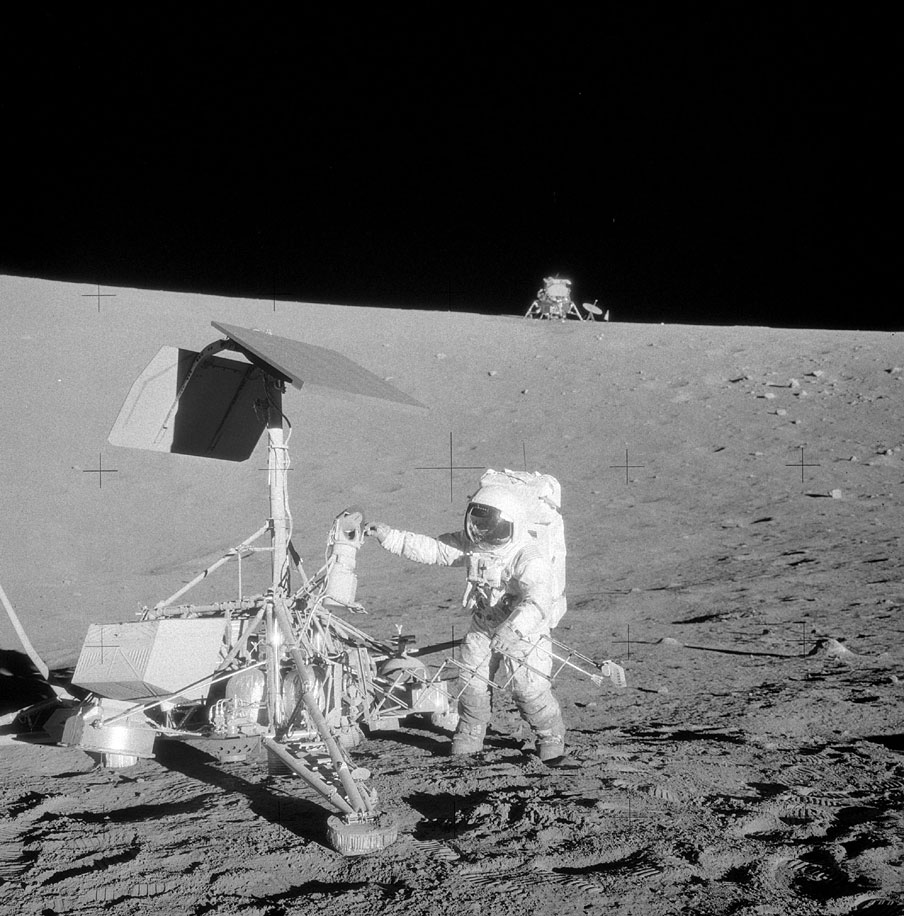
With Apollo 12, the story of Surveyor III came full circle and we got one of the coolest pictures ever taken from the lunar surface. Out of scientific and engineering interest, Apollo 12 landed in the same site as Surveyor III. Al Bean and Pete Conrad got to see the robot up close, which is how we have the image from earlier showing Surveyor sitting on the Moon. They took pictures, and even grabbed pieces of the robot to bring back home for analysis. Right now, the TV camera of Surveyor III sit in the Smithsonian, where you can visit and see actual hardware returned from the Moon. The Apollo astronauts also took what I think are some of the most incredible photographs from the history of exploration–human space explorers interacting directly with their robot counterparts.

Apollo astronaut Pete Conrad “jiggles” the spacecraft to see how firmly it’s rooted to the ground. Credit: NASA

CORRECTION 11/21/2024: The original version of this post identified the astronaut in the last picture as Alan Bean. It’s actually Pete Conrad, and Alan Bean is the one taking the photograph.

Footnotes:

  1. If you want to know more about this, Lunar Orbiter photography was the topic of my master’s thesis, which can be found in the about section. ↩︎
  2. There’s a famous story of how scientists feared the landing vehicle would sink into the soil, an idea that did come from a fairly well-known scientist. But many geologists at the time were pretty dismissive of his claims. There were other potential issues though, including ignorance of the electrostatic properties of the lunar material, which could have led to severe dust build-up on equipment. Bottom line: not a lot was known for sure about the nature of the surface. This was an issue if you wanted to land there. ↩︎
  3. For a description of lunar mapping efforts around this time, see Kopal and Carder, Mapping of the Moon. The difficulty of interpreting the photographs can be seen in a variety of scientific papers from the time. Examples can be found in Interpretation of Lunar Probe Data, ed. Jack Green, 1966. ↩︎
  4. Boeing was the primary contractor on Lunar Orbiter. Images and methods can be found in their contractor reports for NASA. ↩︎
  5. Detailed comments the relative priority of science on the Apollo Mission can be seen in A Review of Space Research, the document that came out of the 1962 Iowa Summer Study. ↩︎