Spectacle on Other Worlds

The first spacecraft from Earth to touch another world carried no people, but it did carry a unique sort of flag. Early on the morning of September 14, 1959, the Soviet space probe Luna 2 impacted the surface of the Moon. Engineers had placed stainless steel spheres aboard the spacecraft, designed to send tiny pentagonal banners across the lunar landscape. The little flags were emblazoned with the hammer and sickle, and Russian script reading: “CCCP, September, 1959.”1

A replica of the Luna 2 pennant on display in the Kansas Cosmosphere. Source: Patrick Pelletier via Wikimedia.

The spheres were made at OKB-1, the Experimental Design Bureau where engineers worked under the leadership of Sergei Korolev to create some of the first space rockets. 2 They were commonly referred to as pennants,3 and you can find more pictures of these pennants on Don P. Mitchell’s excellent website.4 Mitchell speculates that the Luna 2 pennants probably vaporized on impact. On the other hand, the New York Times reported at the time that “[the Soviet Government] said steps had been taken to prevent the destruction of the pennants by the impact.” Regardless of their survival, the pennants accomplished an important objective.

“The day after the historic impact,” historian Asif Siddiqi writes, “[Nikita] Khrushchev triumphantly gave a replica of the ball of pendants to Eisenhower. It was a potent display of the power of politics in the emerging Soviet space programme.”5 This was the point: a spectacle designed to send a message to the United States about the Soviet lead in missile development. There was some (faint) hope on the Soviet side that this spectacle would actually end the Cold War altogether.6

Luna 2’s pennants were just one in a series of such spectacles that constituted the Space Race. From Sputnik to Apollo, visible demonstrations of power replaced nuclear war. In the competition for geopolitical influence that was the Cold War, these projects signaled the strength of competing economic ideologies to worldwide spectators.7 In the 1950s and 1960s, this political impetus for spectacle led humans to explore the solar system up close for the first time. We sent robots to other worlds, and people to the Moon, because of a geopolitical competition. But is that the only reason we went?

I have been fascinated by the reasons people participated in the Space Race–especially the engineers and scientists who worked directly on missions to other celestial bodies. Certainly many of them were Cold Warriors, eager and willing to be recruited to a geopolitical signalling war. But not all of them were, and even those who happily went to nationalistic battle often had priorities that ranked higher in their own minds. In fact, these other motivations may have played a strong role in making the Space Race happen in the first place.

Luna 2 itself may be an example. Siddiqi explains that “contrary to conventional wisdom, it was not the Soviet Party leadership which advocated or called for Soviet pre-eminence in space at this early stage, but Korolev himself who was actualising his intense thirst to claim ‘firsts’ in the new arena of space exploration.” He goes on to say that Korolev was in partly motivated by competition with Wernher von Braun. “One wonders if there would indeed have been a programme at the time if it had not been for Korolev,” Siddiqi writes. The engineers had to convince the Cold Warriors that lunar flights were worth doing.8

Engineering ambitions and personal rivalry were not the only motivations for early space explorers. One of the most interesting examples I have seen comes from Oran Nicks, who was NASA’s director of Lunar and Planetary Programs in the early 1960s. Nicks was an engineer in a department of scientists, and that put him in a unique position. He was also not a Cold Warrior, at least not to the extent of many of his colleagues.

This isn’t to say the political pressures of the Space Race weren’t on his mind. In the early 60s, Nicks was working on the Ranger impact probes to the Moon, which were plagued by a series of early failures. In his book Far Travelers, Nicks recalls that Luna’s successes had made these failures particularly difficult. “Khrushchev had chided us publicly,” Nicks writes, “by quipping that their pennant had gotten lonesome waiting for an American companion.”

But when it came to making an overtly nationalistic response, Nicks took a different attitude. He recounts a disagreement that came up during work on a Mariner probe to Mars. Mariner project manager Jack James had suggested that the spacecraft should have the seal of the United States embossed on a panel, and went to the trouble of mocking it up.9 Nicks was vehemently opposed. Here’s what he wrote (emphasis mine):

His view was understandable; we were competing with the Russians in the race to the planets, and Americans could be proud that our “trademark” would be exhibited for current and future generations to see. My concern was that we might be accused of exhibitionism, something distasteful to me, for I was deadly serious about doing the mission for other reasons. The Russians had bragged about landing a pendant on the Moon, and I wanted no part in that disgusting game.

Oran Nicks, Far Travelers, p 37

Nicks and James compromised, and the seal made it onto the spacecraft. Nicks explains that he “insisted on a low-profile, no-publicity approach,” and was happy that “even after the successful flight there was very little publicity about the seal, and none at all negative.”10
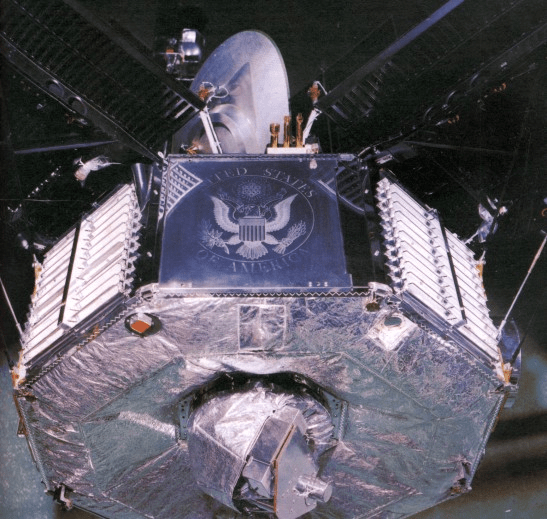
Nicks doesn’t specify which Mariner, but it was likely Mariner IV (1964), shown here. Images comes from Wikimedia, but the original source link is broken. A black-and-white version of this image can be found in NASA Technical Report 32-957 on the temperature control subsystem.

So what were the “other reasons” that Nicks was deadly serious about? To Nicks, the American space program was a project of exploration, pure and simple. He had an expansive definition of the word “explorer” that was rooted in his view of history:

Exploration seems to be in our genes. As they developed the means to do it, men explored the perimeter of the Mediterranean, past the pillars of Hercules, to the sentinel islands off the continent…We tend now to think of exploration in a restricted sense-as a scientific, often geographic, expedition, an athletic activity pursued by specialists dressed in fur parkas like Shackleton’s or in solar topees like Livingston’s. The connotations are overly restrictive if they fail to allow for great tidal movements like the waves of people from Asia that periodically flowed west and south, or for the Scandanavians who crossed the Atlantic in numbers centuries before Columbus. These waves of venturesome people were of a higher order than the random movement of nomads seeking fresh forage…We must conclude that for some of the species, long and perilous passages were no real deterrent to the exploring imperative.

Oran Nicks, Far Travelers, pp 6-7

Nicks is conflating a series of explorations that all occurred for different reasons ranging from survival, to geopolitics, to science. To him, they are part of an innate impulse that all humans have in common. He is situating himself, the United States, and the Soviet Union in a grand tradition that encompasses all of human history.

He was not the only person to do this sort of thing. The space explorers of the 1960s often invoked historical analogy–in the US, this was often the narrative of the American frontier. But these analogies were often related to more specific impulses: colonization, adventure, competition, scientific investigation. Nicks’ framing of exploration as an “instinct” is somewhat distinct. He believes that exploration is something done for its own sake, out of sheer curiosity. The scientific investigations on the missions he managed were an expression of this curiosity, rather than a means to some other end.11

Chertok, in his reflections on the Soviet space program, also remembers people thinking beyond the geopolitics:

Cosmonautics did not arise simply from militarization, and its aims were more than purely propagandistic. During the first post-Sputnik year, the foundations were laid for truly scientific research in space, serving the interests of all humankind…I am not writing about this out of nostalgia for the ‘good old days,’ but because I remember well how people from the most diverse social strata felt about our space successes.

Chertok, Rockets and People, Volume II, pp 435-436

The space programs in both nations were collaborations between people with widely varying motivations. They convinced their governments that pursuing certain objectives in space also served the ends of the state. They competed with each other for funding and for influence over the long-term direction of their programs. In this context, geopolitical competition seems like less of a direct motivation for space exploration, and more of an enabling factor that unlocked resources for would-be explorers.


  1. Siddiqi, Asif A. “First to the Moon,” Journal of the British Interplanetary Society, Vol 51, pp 231-238, 1998, PDF: https://static1.squarespace.com/static/5ef8124031cfcf448b11db32/t/5f1c476085d7250b810190c1/1595688803275/Siddiqi+First+to+the+Moon+1998.pdf ↩︎
  2. Chertok, Boris, ed. Asif Siddiqi, Rockets and People, Volume II: Creating a Rocket Industry, NASA, 2006, pp 446-448 PDF: https://www.nasa.gov/wp-content/uploads/2015/04/635963main_rocketspeoplevolume2-ebook.pdf?emrc=5bed7c ↩︎
  3. Are they called “pennants” or “pendants”? Contemporary newspapers, Mitchell and most other sources say pennants. Siddiqi and Chertok say pendant. Seems to come from a comparison made to ship’s pennant displays (Chertok, in unsourced quote from 447). Wikipedia says pendant is an obsolete spelling of pennant, citing the Dictionary of Vexillology. ↩︎
  4. I’m probably going to link to Mitchell and Sven Grahn a lot on this blog. They have both done amazing work on early Soviet robotics, among other topics, and their work has led me to important sources. You should check out their websites and their books. ↩︎
  5. Siddiqi, p 235-236 The image at the top of this post shows an additional replica, now sitting in the Kansas Cosmosphere. The original replica is held by the Eisenhower Presidential Library and Museum. ↩︎
  6. Chertok, p 447 Certainly it seems like Chertok may have believed this, or believed that Soviet leaders held that hope. “Alas,” he writes, “this did not happen. It was not in our power.” ↩︎
  7. See MacDonald, Alexander, The Long Space Age: The Economic Origins of Space Exploration from Colonial America to the Cold War, 2017, Yale University Press. Especially Chapter 4. https://www.jstor.org/stable/j.ctt1n2tvkx.8 ↩︎
  8. Siddiqi, pp 231-232 ↩︎
  9. Nicks, Oran, Far Travelers: The Exploring Machines, NASA, 1985, https://ntrs.nasa.gov/citations/19850024813 ↩︎
  10. Nicks, p 37 ↩︎
  11. Werner Von Braun, for example, was certainly motivated by colonization and also religious notions. Historian Catherine Newell writes about religious aspects of the American space program in her book Destined for the Stars. Historian Michael Robinson has talked about “true believers” among other types of space explorers. Russian cosmism was a big influence on early Soviet engineers. I plan to do a taxonomy of space explorers at some point, going through various motivations and the historical analogies used to justify and explain them. I see Nicks’ expansive definition of exploration as human instinct most reflected in Carl Sagan’s writings. ↩︎

Studying Eels and the Ocean on Beer Money: The Dana Expeditions

In the rivers of Great Britain and western Europe lives an eel that was once at the center of a great scientific mystery. The European eel was frequently caught in nets or farmed in fisheries for centuries. Cookbooks featured them in a wide variety of dishes. But the origins of the eel were a mystery since no one had observed an example of a young eel. There are records speculating about their spawning and migration patterns going all the way back to Aristotle, who claimed that they came from earthworms (Aristotle, History of Animals 6.16). The mystery wasn’t solved until the 20th century when Danish researchers put together a series of voyages that ended with a circumnavigation of the world.

Illustration by Felice Supino (1916)

Dr. Johannes Schmidt was a Danish biologist who committed much of his career to studying these eels. Historian Bo Paulsen has written an overview of Schmidt’s career, describing him as “a forerunner of Jacques Cousteau.” Schmidt was a dedicated scientist with a keen awareness of public outreach. And in the early 20th century he established a name for himself in the world of biology and marine science.

Around the time Schmidt was building his career, an international community of scientists was flourishing. This community had been cultivated through international journals and direct communication between scientists around the world, and it was infused a spirit of healthy competition through fairs and exhibitions. But the outbreak of World War I threw the international scientific community into disarray. After the war, there was a desire amongst many scientists to rekindle the collaboration and scientific activity. This included prominent Danish scientists, who sought to resume research and collaboration in the post-war years.

It was in this moment that Johannes Schmidt began working with collaborators on a project to resolve the mystery of the European eel life cycle. Schmidt was a committed nationalist, however. He kept the prestige of Denmark in mind, which may have been part of his motivation for suggesting a circumnavigation project reminiscent of the Challenger expedition fifty years earlier. And so while one of his partners suggested making the project an international endeavor through the International Council for the Exploration of the Sea, it remained primarily a Danish endeavor.

Schmidt and his partners planned their expeditions with backing from the Danish government, the East Asiatic Company, and funding from the Carlsberg Foundation. The founder of the Carlsberg Brewery, J.C. Jacobsen was a prolific patron of science. He established the Carlsberg Research Laboratory with the goal of leveraging science to produce the best beer possible. It was (and continues to be) a dedicated research facility studying chemistry and biology that might have applications to the brewing process. He also founded the Carlsberg Foundation, Denmark’s first commercial foundation, to support the development of science more generally.

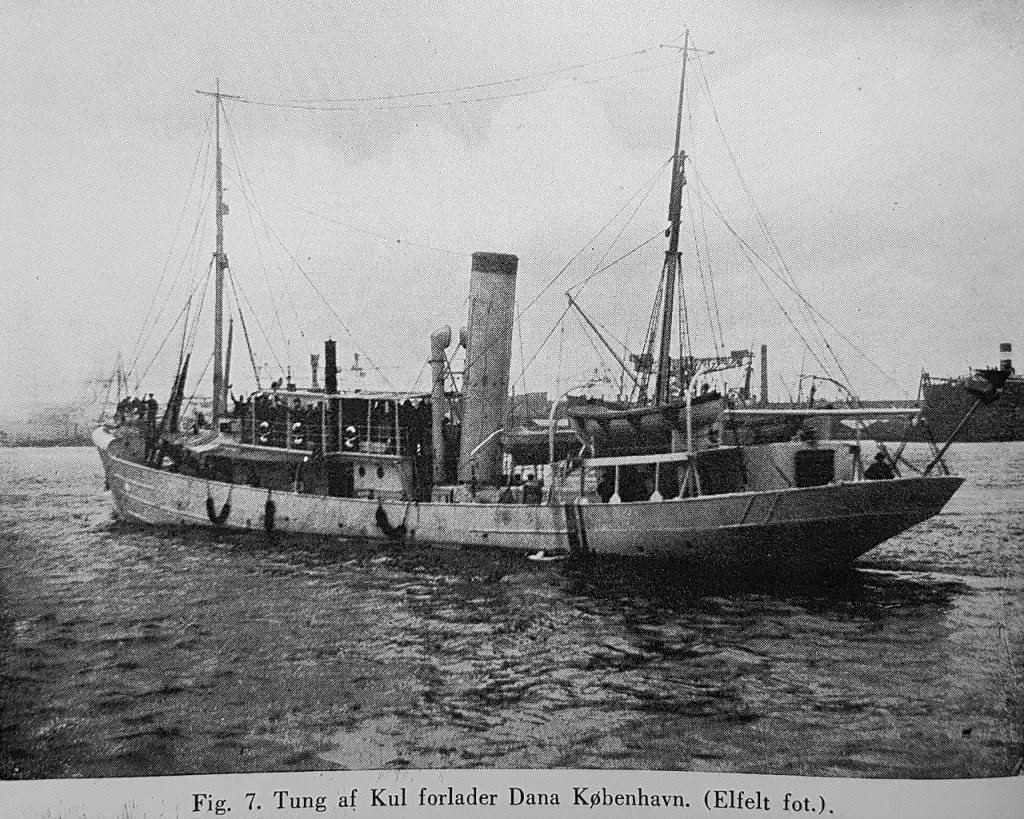
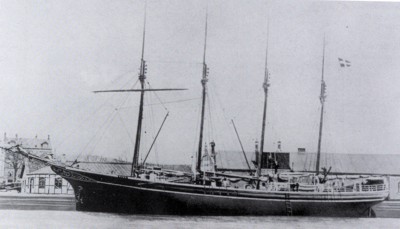
Johannes Schmidt had developed deep ties with the Carlsberg scientific network, which proved useful in funding the eel expeditions. With the support of the East Asiatic Company, Schmidt and his team were able to secure a motor schooner, the M/S Dana, equipped with an engine and four masts. The vessel was outfitted with winches and scientific instruments for collecting samples from deep ocean waters. The M/S Dana was used for the first two expeditions in the Atlantic allowing its crew to collect information about the distribution of eels. A second ship, the R/V Dana, was built for a third expedition and specifically designed for scientific research. The vessel was equipped with an electric winch driving a special phosphor-bronze wire rope 10 kilometers long, making it easier to collect samples from deep waters. To make depth measurements the ship with outfitted with echo sounding equipment, which was a relatively new technology at the time.These early Dana missions successfully recovered eel larvae and plotted their positions in the Atlantic–necessary data for solving the age-old puzzle of the European eel.

The M/S Dana, via Wikimedia
The R/V Dana, via Wikimedia

It turned out that the eels spawned deep in an area of the Atlantic Ocean known as the Sargasso Sea. This is an area of the Atlantic with strange properties that were first recorded by Christopher Columbus. The Sargasso Sea is encircled by four different ocean currents, leaving it effectively isolated from the rest of the ocean. Over time it has collected an enormous amount of seaweed (and now trash), which along with its position in the horse latitudes contributed to legends of ships disappearing in its waters. After spawning in the Sargasso, eels migrate to western Europe where they live out most of their lives.

A map from “The Breeding Places of the Eel” by Dr. Johannes Schmidt in Philosophical Transactions of the Royal Society of London, 1923

The Dana expeditions were a massive success for Schmidt and for Denmark, and eventually led to funding for further exploration. As is often the case, the new information led to more questions. The population of eels in other parts of the world could now be studied with a greater understanding of the eel life cycle. In a 1929 summary of the expeditions in Nature, these question were laid out:

“Why are eels plentiful throughout the western Pacific, but absent from all the eastern half of that ocean? Why are they present on both sides of the North Atlantic ocean, but absent from both sides of the South Atlantic? Why are they plentiful on one side of Australia and absent from the other?”

Nature, No. 3087, Vol. 122, Dec 19 1929 “The Dana Expedition”

In 1928 Schmidt’s vision of a circumnavigation became a reality. The final scientific voyage on the R/V Dana collected more information about eel spawning behavior in the Atlantic, bolstering Schmidt’s theory about the Sargasso sea spawning patterns. The expedition traveled through the Panama Canal into the Pacific Ocean, eventually finding eel larvae near Tahiti and providing insight into Pacific spawning patterns. The crew of the Dana then charted the distribution of eel species in the Indian Ocean before returning to Europe. Along their way they took a number other oceanographic measurements, including water temperatures and other oceanic conditions. A write-up in Nature even suggested that the strange spawning patterns of European eels lent support to the theory of continental drift (referred to as “Wegener’s theory of continental shifting”).

The technology used by the Dana reflects a transitional period in the history of oceanography. The sample collection methodology they used was in principle the same as those used in the 19th centuries–nets, cables, and winches. But they were also equipped with echo-sounding machines and short-wave radios for communication. The Dana expeditions had a lasting impact through their contributions to science and their public outreach–they are one part of a rich history of Danish marine science and the broader history of modern scientific research practices.

History Highlights 2: FLIP, Challenger, Demons, and Kepler

FLIP in vertical orientation for research on waves.

FLIP, Laboratory at Sea

Stefan Helmreich writes about FLIP (FLoating Instrument Platform), a  fascinating vessel designed for oceanographic research. First launched in 1962, it has the unique ability to change orientation, immersing most of its structure into the ocean to become a buoy. This provides a relatively stable platform for research, and the ability to do semi-controlled experiments on waves. It is an example of how the distinction between the laboratory and the field is sometimes blurred, in part due to technology.


You can read more of Helmreich’s analysis in Media+Environment and ISIS.

Looking Back on InSight and Phoenix on Mars

Mars InSIght is gathering dust on Mars, and its days are numbered. The robotic mission has been an enormous success, contributing to our understanding of Martian geology and natural history. NASA has an excellent retrospective on the major scientific achievements of the InSight lander.

Around this time of year in 2008, the last signals were received from the Phoenix lander. Like the InSight mission, Phoenix lasted beyond its mission parameters, and eventually succumbed to the elements. NASA also has a short history of the Phoenix lander. 

Photographs From the HMS Challenger

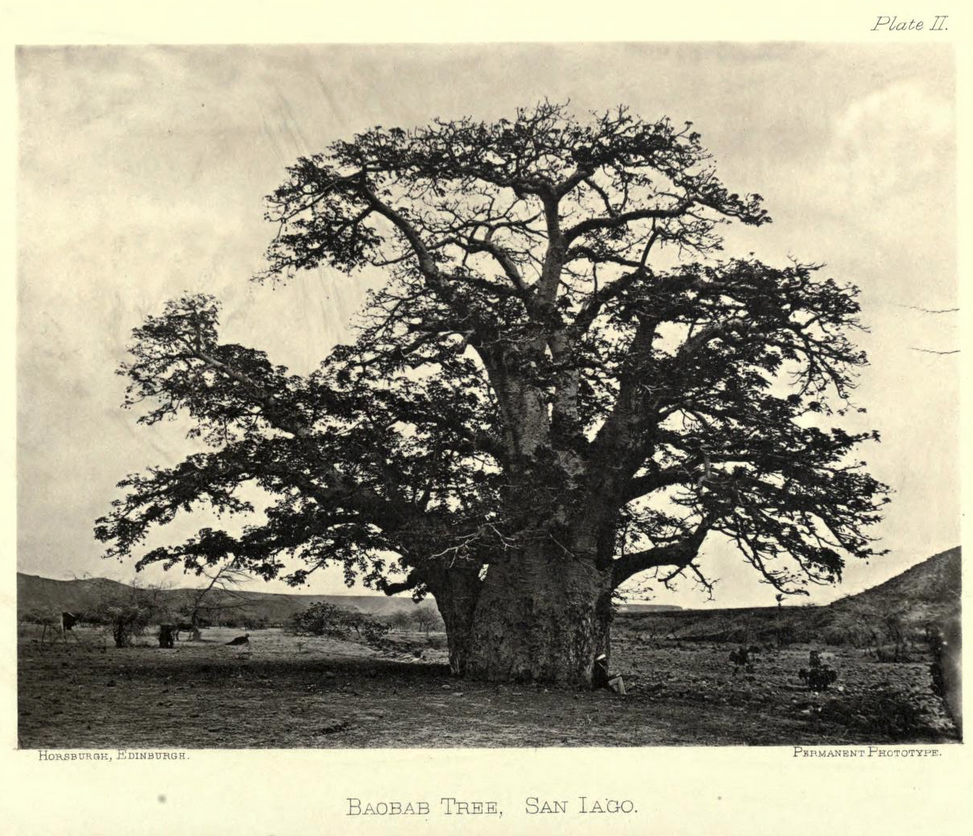
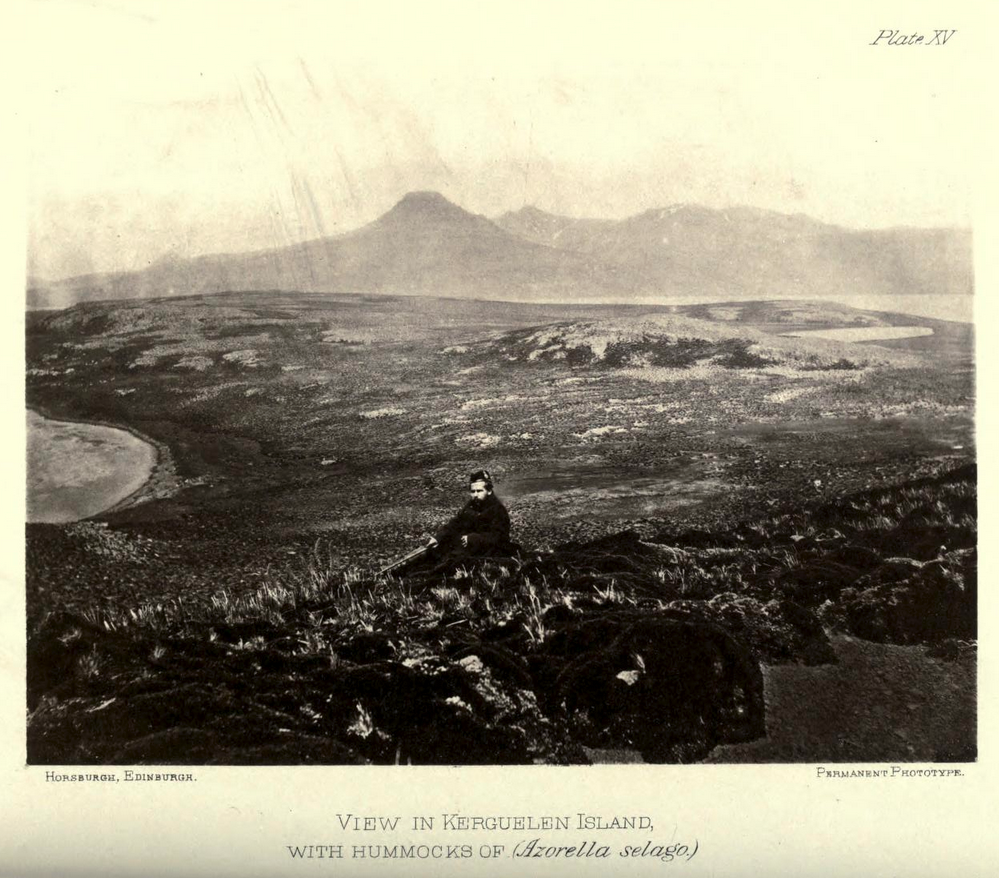
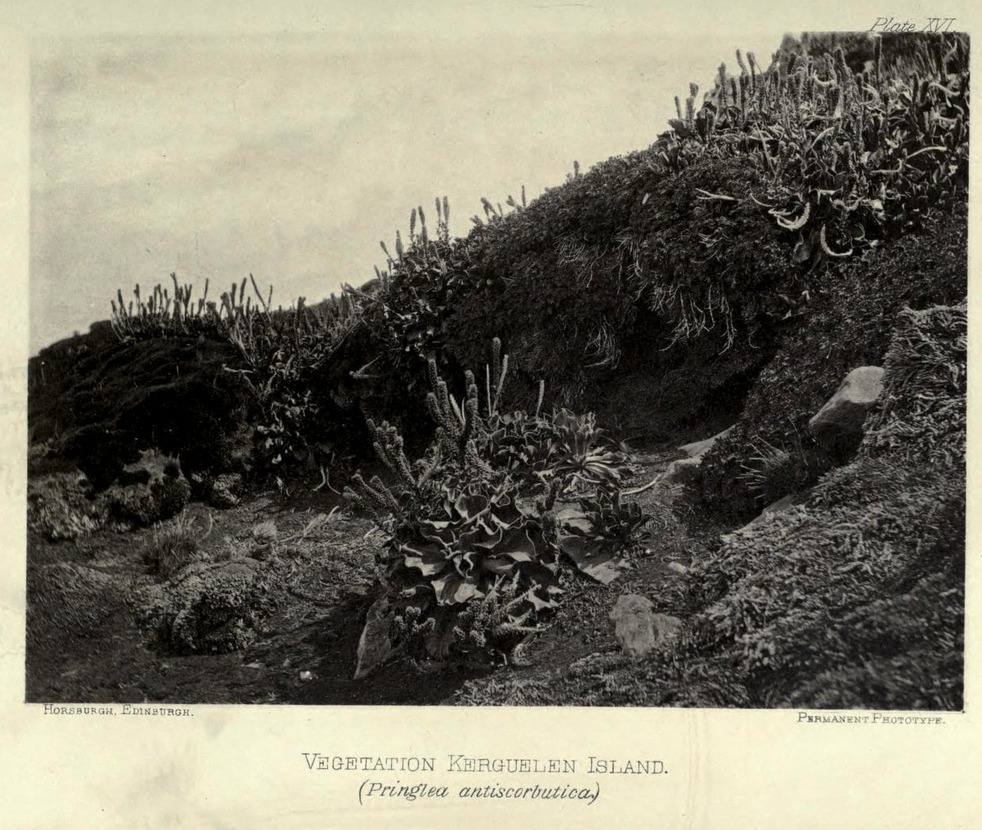
The HMS Challenger expedition helped kickstart the discipline of oceanography. The voyage is a monumental saga in the history of science and the history of exploration. It also played an important role in the history of photography. Not much is known about the photographers and the equipment they used. I was able to find a letter to the editor in an 1875 issue of Nature, referencing a new type of dry photographic plate. The letter was written by Henry Stuart Wortley, and seems to imply that a collodion process was used, including a combination of wet and dry plates. I want to investigate this further, but for now, here are a few of my favorite photographs from the official narrative of the expedition:

The Place of All the Demons

In the 1940s and 1950s, scholars were starting to think seriously about how to create artificial intelligence. They wrote papers and met regularly to discuss things like neural networks and machine learning. Oliver Selfridge was an important part of this conversation, and contributed to a number of early breakthroughs in thinking about artificial intelligence. One of these was a pattern recognition model that laid the foundations for computer image processing.

He imagined each node in the network as a hierarchical group of “demons” each assigned to recognize certain patterns, and to shout out when they recognize something like their assigned pattern. He wrote that each demon might “be assigned one letter of the alphabet, so that the task of the A-demon is to shout as loud of the amount of ‘A-ness’ that he sees in the image.” Then a demon at the top of the hierarchy listens to all the shouting and picks out the loudest shout as the best interpretation of the image.

He called the model “Pandemonium.”

Additional Links:

The original paper.

The Quest for Artificial Intelligence, by Nils J. Nilsson

“A Waste Land of Famine and Despair”: Kepler’s Tortured Personal Life

I want to do a review of The Sleepwalkers by Arthur Koestler at some point. Until then, here’s a short bit about Kepler. Kepler’s personal life was just so absurdly tragic that it stood out to me.

According to Koestler, we get this stuff from Kepler himself, who wrote an incredibly detailed family history. Koestler dwells on it at length, providing a detailed glimpse into the background and mindset of his subject. Here’s a brief outline of Kepler’s life. All quotes here are from Koestler, and I think some of them reveal his talent for colorful description.

  • “Johannes Kepler’s father was a mercenary adventurer who narrowly escaped the gallows. His mother, Katherine, … was brought up by an aunt who was burnt alive as a witch, and Katherine herself, accused in old age of consorting with the Devil, had as narrow an escape from the stake as the father had from the gallows.”
  • When Kepler was about three years old, his parents both left to fight Protestants in the Netherlands, despite being Protestant themselves. Kepler was left with his grandparents. His father went on two more trips, then disappeared.
  • He had six siblings, “of whom three..died in childhood, and two became normal, law-abiding citizens. But Heinrich, the next in age to Johannes, was an epileptic and a victim of the psychopathic streak running through the family.”
  • “Johannes was a sickly child, with thin limbs and a large, pasty face surrounded by dark curly hair. He was born with defective eyesight…his stomach and gallbladder gave constant trouble; he suffered from boils, rashes, and probably from piles, for he tells us that he could never sit still for any length of time and had to walk up and down.”
  • When he was four, he contracted smallpox and nearly died.
  • He compared himself to a dog constantly, even saying he had an aversion to bathing.
  • “Kepler belonged to the race of bleeders, the victims of emotional haemophilia, to whom every injury means multiplied danger, and who nevertheless must go on exposing himself to stabs and slashes. But one customary feature is conspicuously absent from his writings: the soothing drug of self-pity, which makes the sufferer spiritually impotent, and prevents his suffering from bearing fruit.”
  • Kepler’s first wife “resented her husband’s lowly position as a stargazer and understood nothing of his work.” He describes her in extremely bitter terms after she died at thirty-seven. Three of their five children died very young.
  • He had seven children with his second wife, “of whom three died in infancy.” Koestler presumes that his relationship with her was better than with his first wife, since he doesn’t write about her very much.
  • He was forced into virtual itinerancy in his last years, while trying to get some of his works printed. He spent ten months away from his family, and “was again plagued by rashes and boils; he was afraid that he would die before the printing of the Tables was finished; and the future was a waste land of famine and despair.”
  • After the struggles with publishing, he had difficulty obtaining payment for his work and accessing money owed to him. “He had money-deposits in various places, but he was unable to recover even the interests due to him. When he set out on that last journey across half of war-torn Europe, he took all the cash he had with him, leaving Susanna and the children penniless.”
  • He ended up in Ratisbon to try to get payment from the Emperor, but contracted a fever and died there in 1630.


And then there’s this quote from Kepler’s self-description that I quite identify with:

“In this man there are two opposite tendencies: always to regret any wasted time, and always to waste it willingly.”

Links:

The Sleepwalkers: A History of Man’s Changing Vision of the Universe, by Arthur Koestler

History Highlights 1

File:SS Sirius (1837).jpg
The SS Sirius, an early steamship

Math and Mining in the Ore Mountains

Deep in the heart of Central Europe, near the border of Saxony and Bohemia, lie the Ore Mountains. Rich in minerals, the Ore Mountains played a central role in the development of European metallurgy. They are home to some of the first European mining operations, and the inhabitants have been mining tin and silver there since the Pre-Classical Era.

For millennia, the region has attracted people looking to make a living. In the 16th century, as truly large-scale mining operations were underway, Georg Agricola arrived in the mining town of Chemnitz. He had just completed his university education, and took on a job as the town physician. He was somewhat out of place–an educated humanist living in a town of people who worked with their hands.

Agricola became deeply involved in the town, eventually becoming the mayor. And during that time, he attempted to apply his university education to the mining industry, writing on geology and mineralogy. He left us with De Re Metallica, a detailed account of metallurgy in the 16th century. It delves into geometry, and the applications of mathematics to planning and executing mining operations.

How much did this mathematical theory influence the actual mining practices of the time? According to historian Thomas Morel, not much. 

I think many people, including myself, have a tendency to think of the Scientific Revolution and the Industrial Revolution as connected. To some extent they were related, but Morel does a fantastic job of disentangling the theoretical from the practical, the scholar from the practitioner. 

It’s a difficult job, because the practitioners unfortunately don’t leave us a lot of direct descriptions of their work. To figure out the real-world practices at the time of Agricola, Morel looks to sources like mining laws and sermons in mining towns. These are indirect evidence, but are much closer to the daily lives and practicalities of mining than the writings of a Humanist physician.

In De Re Metallica, Agricola focuses on theoretical ideas about practices like determining where to dig a vertical shaft so that it intersects with a tunnel. These descriptions are complete with diagrams showing similar triangles.

Morel suggests that the actual topography of the Ore Mountains makes this idealized case impractical. He looks to diagrams from actual surveyors, and eventually to a sermon about why Martin Luther was awesome. 

This is a phenomenal piece of history. Apparently, a sermon by Cyriacus Spangenberg “included a detailed description of this specific surveying procedure that took up four pages.” If you’ve ever been to a Lutheran church, long sermons and extended religious analogies will be familiar. Apparently they have a long tradition, and thankfully for historians, can provide a glimpse into the actual lives of common people.

Morel argues that the practices revealed by these sources differ significantly from those described in De Re Metallica. “Taking Agricola’s words for granted,” Morel writes, “confuses his literary production with the practices of underground surveyors and hinders our understanding of both.” Surveying and mining practices were indeed advancing at this time, but not because the surveyors were reading Humanists and applying their theory.

So to some extent, the intellectual and practical worlds of 16th century mining were advancing along parallel, but non-intersecting paths. To me, this raises the question of how well this case study can be applied to other fields of science and engineering. But this case study was strong enough that I think it helps shift the burden of proof onto claims that scholarship influenced practice. 

Morel suggests that as far as any interaction happened between these two worlds, it was a subtle cross-fertilization. According to him, scholars and practitioners were always most interested in the task right in front of them. For Agricola, that may have been introducing new mathematical ideas to his audience (who were specifically not the miners he was writing about). For the surveyor, that was getting the job done efficiently. 

The extent and nature of this cross-fertilization is still something that is being explored in the History of Science. The perspective of the practitioners is more difficult to source, and has been somewhat neglected until recently. The relationship between these two worlds is a somewhat open question, and I think it’s one of the more interesting areas of research. If you know of other attempts to tackle this topic, let me know in the comments.

Source:

Thomas Morel, “De Re Geometrica: Writing, Drawing, and Preaching Mathematics in Early Modern Mines,” Isis, Volume 111, no. 1 (2020) https://doi.org/10.1086/707640


The Incredible Power of Steamships

I recently read Neptune’s Laboratory: Fantasy, Fear, and Science at Sea by Antony Adler. In addition to having a fantastic title, it provides a wonderful overview of oceanography as a scientific discipline.

I might do a longer review on this book in the future, but Adler describes the reception of steam ships by 19th century journalists and the public, and I had to share it:

“…it was only upon the arrival of the first commercially viable transatlantic steamship, Sirius, in New York in April of 1838, that newspapers declared the successful ‘annihilation of space and time.’ When soon thereafter some early passenger steamships exploded, at great loss of life, journalists blamed these accidents on ‘a public mind’ that had become ‘completely infatuated with a wish to be borne in the twinkling of an eye’ from place to place.”

I love these glimpses into the perception of new tech throughout time. You see attitudes that seem very persistent across time periods and groups of people.

Source:
Antony Adler, Neptune’s Laboratory: Fantasy, Fear, and Science at Sea


Grey Flag Pirates

Sometimes the history of exploration blends with maritime history. This more general history provides essential context for the history of exploration, so sometimes I might succumb to the temptation to include something not strictly within the confines of the blog’s stated topics. In this case: the pirate officials of the Song Dynasty.

China had problems with piracy along their coast for a good deal of their history. Maritime trade has a tumultuous history in China, partly due to their geography. In The Boundless Sea: A Human History of the Oceans, David Abulafia describes the interesting and controversial way that the Song Dynasty dealt with pirates, by giving them cushy government jobs:

“As more traffic crossed the sea, the temptation to pirates grew exponentially, and convoy escorts were sometimes provided to protect merchant ships; a navy came into being…the corsair Zhu Cong, defeated in 1135, merged his fleet of fifty ships and 10,000 sailors into the Song navy; he was rewarded with the rank of admiral, and others followed the same course. A brief poem circulated:’if you wish to become an official, kill and burn and accept a pardon.’”

Of course, this sparked debate over whether such a policy actually encouraged more piracy. It reminds me a little about the distinction between white hat, black hat, and grey hat hackers.

Source:
David Abulafia, The Boundless Sea: A Human History of the Oceans


Ice Melt Archaeology

A complicating factor in the history of technology is the fact that people don’t always write about the technology they use. This means that a lot of tech is lost to us, unless we actually find physical examples.

An odd side-effect of climate change is that melting ice is revealing archeological treasure troves. One instance, reported in the Smithsonian Magazine, is the Lendbreen route in Norway. Melting ice in the mountain passes has uncovered sleds, skis, clothing and other artifacts from multiple eras.

You can follow the progress of the archeologists at the website Secrets of the Ice, and get updates on Twitter here.

Historical Preservation and the Wright Brothers

I visited Dayton, Ohio in the summers of 2016 and 2017. It felt like a pilgrimage of sorts, because in many ways Dayton is the Mecca of the aerospace history world. Recently, news emerged of the plan to demolish the Wright Brothers’ first bike shop. I figured it would be a good opportunity to write a little about Dayton, and in the process develop my thoughts on historical preservation in general.

To approach the question of historical preservation in Dayton, we need to understand why Dayton is significant in the history of aviation. Kitty Hawk, seemingly more so than Dayton, is inextricably linked in the public imagination with the Wright Brothers and the dawn of human flight. North Carolina even put it on their license plate. They’re “First in Flight!”

Kitty Hawk gets a lot of press, but in many ways the work that went on in Ohio was more important. Dayton was the hometown of the Wright brothers, and is where they sold bikes. It’s where they first played with toy helicopters that helped spark their interest in flight. It’s where they developed and tested the first heavier-than-air flying machines. And at least in my estimation, Dayton is where the most significant moment in early aviation history took place.

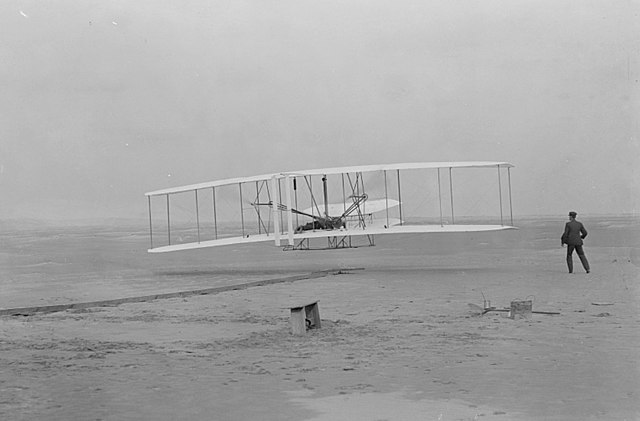
The test of the Wright Flyer I at Kitty Hawk was an incredibly important proof-of-concept for sustained, powered flight. They chose Kill Devil Hills because the strong winds made it easier to achieve the levels of lift they needed. They took off into the wind, meaning less work for the engines in generating the necessary air speed on the wings. But the brief distance covered by the Wright Flyer I, and the short amount of time it stayed in the air, does not distinguish it all that much from the other tests performed by the Wrights and their competitors.

The Wright Flyer I was in many ways a modified glider, given a bit of a distance boost by an engine, but unable to actually remain in the air for a long period. The Wright Flyer II gained more distance and air time. But to me, both vehicles were more like motor-gliders than anything else. They were incapable of staying in the air under their own power for sustained periods. Sustained flight is what humans dreamed about for millennia.

Sustained flight was first achieved in Dayton, Ohio. On an October day in 1905, Wilbur took to the skies in the Wright Flyer III. He circled around Huffman Prairie for almost 40 minutes, and most importantly — he landed on purpose, and only because he ran out of fuel. This was the first time humans really flew. And it happened in Dayton. When you read their descriptions of these flights, it becomes clear that the brothers only felt they had truly accomplished their goal with the Flyer III.

Whether or not you agree with me about the Huffman Prairie flight being more significant than Kitty Hawk, this is certainly a story worth preserving. The City of Dayton has a responsibility to this history.

Preservation is important, but it has limits. And before I dive into this, I have a confession – I’m an artifact hoarder. If there is some token of an event, some odd trinket or symbol of an experience, I hold on to it. I keep a lot of things that would normally be considered trash. For example, I keep a lot of receipts when I go on trips. These sorts of things are fascinating and valuable to me. A receipt holds a wealth of information and captures memories and moments that pictures can’t. 

If I could hold on to all of these things, I would. I realized pretty early that this could potentially be a problem, so I limited myself to one large box of artifacts. I have three boxes now. But despite this proclivity, I have forced myself to become more and more selective. Some artifacts actually represent important experiences or spark real memories of formative events, and those are the ones I try to prioritize. I’ve learned to let go of the merely interesting.

I come home from trips with a handful of receipts. But my artifact boxes contain maybe two or three in total. And the ones I kept have particular significance beyond just being interesting.

So although it pains me a bit to write–we don’t have to preserve every last piece of history. The world moves on, things change. If we never demolished a historic building, we wouldn’t have made new ones, we wouldn’t have made new stories and created new histories. We need to be thoughtful about what we preserve. Dayton is a great example of how to accomplish that, and the limits of those efforts.

There is a large collection of Wright Brothers sites in Dayton. I spent two summers there, and visited most of them. They have done a phenomenal job of preserving important aspects of the story that played out in Dayton, and providing the public with a way to explore that history. And it’s more than enough. 

You can spend entire days going from site to site, reading through the information, getting to spend time in the presence of Orville and Wilbur’s tools, prototypes, and personal effects. You can go to the Dayton Aviation Heritage National Historic Park. They have a number of incredible artifacts, including one of their cycle shops (they had six locations in total). You can even go to the library at Wright State University, and access a treasure trove of their personal journals and photographs (I did this and it was a spiritual experience). You can go to Huffman Prairie, and trace the path Wilbur took around the big, thorny honey locust tree. And you can go to Carillon Historical Park, and see the Wright Flyer III.

The Wright Flyer III was almost lost. An enormous effort went into preserving it and restoring it, led by Orville himself. To me, this preservation effort was absolutely worth it. That particular artifact is representative of one of the most monumental steps in human history. Being able to actually see it in person adds something ineffable to the story of flight. Walking into the large room that houses it feels like stepping into a temple.

The barely-standing remains of their first bike shop that moved after a year, before their work on flight really began, is an interesting place. It’s physical existence isn’t crucial to telling their story.

I would love to have a brick from the building though. I would even start a new box for it.