The Echoes of Apollo

Last week, people flew around the Moon. It feels surreal to be able to type those words.

When I talk to people who witnessed the Apollo program, I like to ask them what they remember. Most were children at the time, and their answer is often some version of: “Oh, I wanted to be an astronaut.”

Some of the children who witnessed Apollo did become astronauts, while others became engineers and scientists. But the power of Apollo transcended generations, the stories and images from the missions creating new witnesses decades after Apollo 17.

There is Artemis II astronaut Christina Koch, who experienced Apollo as a poster of Earthrise on her wall–and then brought back her own spectacular imagery from the Moon. There is the director of Artemis landing and recovery, Liliana Villarreal, who experienced Apollo at a museum–and then brought astronauts home from the Moon.

They are the echoes of Apollo. They will create echoes of their own.


“Welcome to my old neighborhood.” – Jim Lovell

On the morning of their lunar flyby, the crew of Artemis II was greeted by the voice of Apollo 8 astronaut Jim Lovell, giving them words of welcome. Lovell had passed away the year before, but had recorded this message for the crew. “So, Reid, and Victor, and Christina, and Jeremy,” he said, “and all the great teams supporting you–good luck and godspeed from all of us here on the good Earth.”

The Lovell family had also sent them an artifact from Apollo 8: Jim Lovell’s mission patch from 1968.

As they approached the Moon, I was glued to the stream. I will always remember the Moon getting larger and larger, seeing more and more detail revealing itself on the lunar surface. Hearing them talk about the craters that mark the westward limit of what we can see from Earth, like Grimaldi, getting larger and more detailed. And slowly, the far side of the Moon becoming the dominant view from the capsule.


There were other types of echoes. Not ones that came from inspiration, but echoes that were more structural, part of the share nature of their missions.They were a consequence of the fact that achieving something of that magnitude entails certain values and qualities in the people involved: curiosity, kindness, and a drive to collaborate.

Some of the most memorable things from both Apollo and Artemis were the conversations between the teams on the ground and the teams at the Moon. It was connection. It was Moon joy.

In fact, some of the first words spoken on the surface of the Moon in 1969 were reports back to home: “Contact Light. Okay, engine stop…Houston…”

On Artemis II, the conversations between the Moon and Earth were fascinating to listen to. The astronauts had been trained to give vivid descriptions of what they saw: the textures, the details, the aspects that different from what they had see in photographs.

The astronauts discussed these observations amongst themselves before making calls back home, which we got to listen in on. Victor Glover gave the first of their situation reports directly from the Moon, a part of the mission that was his idea:

“…from Integrity, we have a sit-rep. The targets that are being discussed right now, it’s the farside-nearside comparison, and hearing some great discussion of browns and greens in the Aristarchus plateau, and how those disappear as you go toward the north pole, and then over to the far side, you lose the color…”

And later

“I also heard a discussion about the albedo of Grimaldi being a 10, and how many of us, when we were a little farther away, saw that as the darkest albedo, and that the bigger mare of to the west, sorry–to the east–was still dark, but maybe a 7-8. We still think that, but you are seeing color variation, albedo variation, inside of Grimaldi as well. And that even on the west side, there’s still a very dark part of it. But it is still the darkest, it is just not as uniform as it looked when we were farther away…”

Victor Glover, near the Moon. From NASA Broadcast.

And the reply from Earth, NASA scientist Kelsey Young maintained a dialogue with them in real time.

“Copy all, Victor, and you read our minds. Superlatives like ‘darkest,’ ‘biggest,’ are really helpful for us, so keep those coming.”

Kelsey Young, in Houston. From NASA Broadcast.

There were moments that captured their rapidly changing views from the capsule.

“When I went back to the window just now, the view has completely changed. Our trajectory is taking us to a new view, and I’m looking more into Vavilov, so I’ve got a nice great view into Vavilov…wow, yeah, I wish I had some more time to just sit here and describe what I’m seeing, but the terminator right now is just fantastic. It is the most rugged that I’ve seen it. From a lighting perspective, there are little islands, there are islands of terrain out there that are completely surrounded by darkness…”

Victor Glover. From NASA Broadcast.

Victor and the crew continued their collaboration with the science team. Trying to get on the same page with the team back at home, they described the position of a feature they were seeing by drawing intersecting lines from other prominent craters.

Glover at one point described the texture the astronauts saw in Hertzprung and the surrounding area.

“Christina described it earlier, around Hertzprung, and then from Hertzprung toward Ohm, I’m sorry, toward Orientale, There appears to be a frozen, a rippling pond, but frozen, or like choppy waves, when it’s windy out, choppy water, and then it freezes instantly. That’s the texture. If you walk down there barefoot, it looks like it would be hard on your feet, like hot lava after its cooled…except for right there in the center of Hertzprung, it looks paved, like a paved road, nice and smooth.”

Victor Glover. From NASA Broadcast.

It reminded me of reports from the Apollo 8 astronauts. One of Jim Lovell’s first reports was that the texture he saw from the capsule looked like “plaster-of-paris.” And in the photographic report written by Lovell, Frank Borman, and Bill Anders, they wrote this:

“The surface of the mare materials in the southern part of the Sea of Tranquility on the approach to landing site 1 and the terminator resembled the surface of a frozen sea with a broad, but irregular, swell.”

Jim Lovell, Frank Borman, and Bill Anders. From Analysis of Apollo 8 Photography and Visual Observations.

Christina Koch described their efforts to discuss and evaluate what they saw, along with an intense moment she experienced.

“We really enjoyed our discussion time…we sort of were able to bounce ideas off of each other and come to new conclusions.”

and then

“I just had an overwhelming sense of being moved by looking at the Moon…something just drew me in suddenly to the lunar landscape, and it became real. And the truth is, the Moon really is its own body in the universe, it’s not just a poster in the sky that goes by. It is a real place. And when we have that perspective, and we compare it to our home of the Earth, it reminds us of how much we have in common…”

Christina Koch. From NASA Broadcast.

Then Victor Glover re-emphasized the value of teamwork.

“Science, Integrity…it was hard to speak, looking through the zoom, because I went straight where Christina went. And I was walking around down there on the surface, climbing and off-roading on an amazing terrain.

I also want to underscore something that she said. As we continue to explore, when we actually do go down there on the surface, I know for safety reasons that we would never send someone alone. But I just want to really emphasize how important the discussion time was. When we started to talk, we not only got better science discussion, we got better human connection. And so, doing this as a pair, we just learn and grow together, and that’s just super important, so thank you for adding that to this plan.”

From NASA Broadcast.

Back on Earth, you could see the scale of the teamwork involved in making something like this happen. We got to watch the teamwork in the science room, as they talked directly with people flying around the Moon. On display were some of the best moments that come from exploration. Like the moment the science officers heard reports of impact flashes on the dark portion of the lunar surface as the passed through an eclipse.

The teamwork involved goes far beyond the people in those rooms. Another theme that comes up in my conversations with people who witnessed Apollo: someone in their family worked on some aspect of the program. That isn’t surprising, given the sheer number of people involved in making missions like this into reality. My grandmother told me that someone in our family worked on one of the scoops used to pick up samples on the lunar surface.

Projects like these are, by necessity, massive collaborations. They may be, on some level, signals of economic and military strength that serve geopolitical purposes. But they are also much more than that. They are signals of the ability to muster the enthusiasm and effort of untold numbers of like-minded people toward a common goal. Underscoring this was the fact that Artemis II, unlike Apollo, was an international mission. The European Space Agency built the service module that carried the Orion capsule to the Moon, and one of the crew was Canadian.

The people in that capsule were connected to their friends and colleagues back on Earth through tenuous radio signals. And from their conversations, it was clear that geopolitical competition was the farthest thing from their minds. They were thinking about science, about our place in the universe, about each other, and about us.

When Christina Koch returned safely, she had a message she wanted to convey to all of us:

Planet Earth, you are a crew.


When I was in college, the United States had no way to send human beings into space. The Space Shuttle had just been canceled, and the prospect of a replacement was speculative and far off. Looking back on the Apollo program during that liminal period, I got the strange feeling that the past seemed more futuristic than the present.

I wanted to know why.

I wanted to understand how space travel began, why we lost our ability, and how we might one day get it back. This isn’t the usual sort of way that Apollo inspires a passion for space exploration. But in my own way, I am an echo of Apollo.

One of the things I realized very early is that we never really lost our ability to travel into space. In the decades after Apollo, intrepid explorers using robotic spacecraft revealed our solar system to us, in staggering image after staggering image. And in the data they collected that increased our awareness and understanding of the other worlds in our neighborhood.

I will continue to repeat, as often as people will listen, Oran Nicks‘ sentiment that there is no such thing as uncrewed space mission–only a difference in where the crew is standing to conduct them.1 I still believe in the magic of robotic space missions, and I will continue trying to get others to see that magic. Robotic space exploration is human space exploration.

But Artemis reaffirms that there is something truly special about humans sitting inside the spacecraft itself. Telepresence is not presence. Our eyes capture things that cameras cannot, and they create subjective experiences impossible by other means. And it is worth doing, in part because it inspires entire generations of people to create, and collaborate, and dare mighty things.

I look forward to the echoes of Artemis.

  1. Full quote: “The truth is that there were no such thing as unmanned mission; it was merely a question of where man stood to conduct them.” From his book Far Travelers, pg 245 ↩︎

Exploring the Far Side of the Moon: A Visual History

Lunar exploration has always held a strange position in the history of exploration. For all of human history, people have been staring up at the Moon, and for centuries astronomers used telescopes to study the lunar surface. The telescopic surveying and mapping of the Moon by astronomers can (and should, I think) be considered a form of exploration. From this perspective, the Moon had been thoroughly explored far before the dawn of the Space Age. But on the other hand, because of the nature of the Moon’s orbit, the Moon also possessed some of the most mysterious and inaccessible terrain that ever taunted exploration-minded humans.

The Moon is tidally locked, meaning that only one side of the Moon ever faces the Earth. And so for all those millennia of Moon-gazing, there was an entire half of our natural satellite that no human had ever seen before. We would only get our first look at the end of the 1950s, and it would take even longer for us to complete a full map of the Moon. Here is a visual history of how we did it, designed to guide you through the process, even if you aren’t yet familiar with any lunar features.

First, let’s look at the near side of the Moon. The dark parts are the maria, Latin for “seas.” The brighter parts are, generally, called the highlands.

Needs no introduction. From NASA

The maria provide helpful landmarks for understanding how the far side of the Moon was revealed, and I have highlighted a few helpful maria below. In red you can see the Sea of Tranquility, probably the most famous mare, since that’s where Apollo 11 landed. But the other ones I have marked will be the most helpful landmarks for this history. We will especially be tracking Grimaldi, really a crater on the western limb (edge) of the Moon with a mare floor. Over on the eastern limb, highlighted in green, is the Mare Humboldtianum. I’ve highlighted Mare Crisium in blue, since it is large and distinctive. But mainly keep your eye on Grimaldi and Humboldtianum.

ORANGE: Grimaldi Crater, RED: Sea of Tranquility (Mare Tranquillitatis) , BLUE: Mare Crisium, GREEN: Mare Humboldtianum

Oddly, even though the moon is tidally locked, we have been able to see small portions of the far side, due to a wobbling motion called lunar libration. You can see libration happening in the animation below. You might be able to notice that Humboldtianum actually disappears over the limb at certain times. Because of libration, we have actually been able to see more than fifty percent of the lunar surface for a long time. In the 17th century, astronomers began using telescopes to study the extent of libration, and to extend lunar maps slightly.1

File:Lunar libration with phase Oct 2007 HD.gif
Lunar Libration, from Wikimedia

William Gilbert and Galileo were some of the first astronomers to detect and measure libration, and to attempt mapping the Moon in detail.2 Over time, astronomers began depicting the effects of libration on their maps, which can be seen very well in Johannes Hevelius‘ 1647 map from his Selenographia. The slivers on the northern and southern edges of the map show which areas come in and out of view through libration, and you can see that the effect is slightly more pronounced near the poles. You might even be able to find Humboldtianum on this map.

Hevelius was using some traditional astronomical measuring devices, but he was also using telescopes of his own construction.3

We also see libration depicted on the map below, made by Giovanni Battista Riccioli in collaboration with Francesco Maria Grimaldi in 1651. Riccioli’s naming scheme was one of the most influential, and our maps today retain many of his names. You can see Mare Tranquillitatus and Mare Crisium on this map, for example. You can also see that Riccioli named the crater Grimaldi after his illustrator. He also named a nearby crater after himself, and yet another in the vicinity after Hevelius. Humboldtianum, however, is named Zoroaster on Riccioli’s map.

Below, you can see the effects of libration on the visibility of Zoroaster/Humboldtianum. It’s helpful to note the positions of Aristotle, Hercules, Atlas, and Endymion. They can help you orient yourself around the northeastern limb.

This view was the one that astronomers had for the next several centuries. Better telescopes allowed observers to add a little more detail near the limbs, but observing features there would always prove extremely difficult. For the time being, the far side of the Moon would remain obscured. We can get a decent idea of the extent of our knowledge using John Russell’s Selenographia, an amazing lunar globe from 1797.4

John Russell’s Selenographia, a lunar globe made in 1797. All images of globe from Science Museum Group. This image is released under a CC BY-NC-SA 4.0 Licence

On the back of the globe, you can see the blank spots on our map. You can also see clever mechanisms Russell devised to display the movement of the Moon caused by libration.

The back of Russell’s globe, showing blank space with inscriptions, and mechanisms for displaying libration.

If we take a closer look at the western limb, we can see Grimaldi clearly, with Riccioli and Hevelius nearby. We can also see that Russell has filled in a lot of the area sometimes hidden through libration to the west of that area. This is where his map became more difficult to align with real features on the lunar surface. This is partly because that area is heavily cratered, and gives us a tantalizing glimpse at one of the largest and most complex surface features on the Moon.

The western edge of Russell’s globe, with Grimaldi highlighted in orange.

If we look really closely at the western limb as libration brings more westward features into view, we see what looks like some layered mountains, interspersed with dark surfaces. Russell looks to be depicting some of these mountains, and the darker areas between them. These seemed to go unnoticed by other astronomers until the late nineteenth century, when Russell’s darker areas begin to appear on maps again. But there is another dark mare beyond those mountains, and in the early twentieth century, German astronomer Julius Franz gave it the name Mare Orientale.5

We wouldn’t be able to get a better look at the far side of the Moon until we invented a way to send cameras there. At the dawn of the Space Age, rockets gave us the ability to do just that. In 1959, Soviet engineers created a series of robotic probes, and launched them toward the Moon. One of these managed a lunar flyby, and was named Luna 3. Engineers equipped Luna 3 with a film camera, capable of developing the exposed film, scanning the images, and transmitting them back to Earth by radio. For a fantastic look at the technology involved here, and some of the images, check out Don P. Mitchell’s website. You should also read Sven Grahn’s work on how Jodrell Bank radio observatory in England intercepted the images as they returned.

In October of 1959, in a cramped room on the Crimean Peninsula, Russian engineers Boris Chertok, Sergei Korolev, and colleagues watched as images materialized slowly on heat-sensitive paper.6 Here is the first image we have of the far side of the Moon:

File:Luna 3 moon.jpg
The first photograph of the far side of the Moon (1959). From Wikimedia.

It is not the highest quality, but it is fairly amazing that it was possible at all in 1959, given the early state of the technology. Below, I’ve highlighted our landmark maria for reference–we’re seeing around the eastern limb. While distinct craters are hard to make out, we can easily see some new maria. The ones to the right and south of Mare Crisium are Mare Smythii and Mare Marignis (we had some glimpses of them on the eastern limb before Luna). But way out there on the right hand side of the image are two entirely new, entirely distinctive maria. The large one in the north was named Mare Moscoviense. The one in the south with the peak in the middle is the crater Tsiolkovskiy, named for the pioneering Russian rocket scientist.

Russian astronomer Yuri Naumovich Lipsky led the effort to interpret the images and begin a map of the lunar far side. His efforts led to the following maps:

Schematic chart. You can probably spot Crisium and Humboldtianum. From Zdeněk Kopal’s Mapping of the Moon: Past and Present.

This globe was produced, which is a fantastic glimpse at how much of the surface Luna 3 managed to add to our map. But you can clearly see the massive blank spot, and Mare Orientale remains frustratingly in mystery.

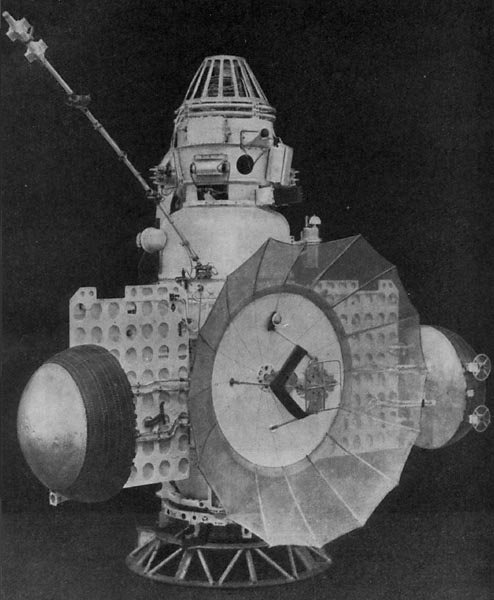
It would remain that way until 1965, when Soviet engineers sent another robotic spacecraft past the Moon. Zond 3, which may have been destined for Mars, flew by the Moon equipped with another film-based system, and captured a handful of images. To see more about the technical details of Zond 3 and its flight, you should check out Andrew LePage’s website. And once again, Don P. Mitchell has an incredible collection of Soviet lunar photographs.

undefined
Zond 2 – Zond 3 was part of the same series of spacecraft. From Wikimedia.

And, for the first time, we see Mare Orientale in its entirety:

Zond 3, Frame 3, the first full look at Mare Orientale, originally processed by Yu. N. Lipsky (1965). From Don P. Mitchell’s excellent website.

Here’s a reminder of where we are, to orient ourselves. Zond 3 is giving us a glimpse over the western limb, past Grimaldi:

Zond 3, frame 18. From Don P. Mitchell (seriously, go check out his website).

And once again, Lipsky went to work putting all this new data on the map. You should be able to see Crisium, Humboldtianum, and Grimaldi for reference. We can now see Orientale, Muscioviense, and Tsiolkovskiy in their proper positions. But notice, there are still blank spots on the map.

Then, in 1966 and 1967, NASA sent five robotic probes to the Moon: the Lunar Orbiters. The Eastman Kodak company adapted camera systems they had designed for the CIA to the task of mapping the Moon in preparation for the Apollo program. The teams behind Lunar Orbiter took thousands of incredibly high resolution images of the lunar surface. The first several Lunar Orbiters were mainly used to scout out landing sites for Apollo on the near side. But even on Lunar Orbiter I, they managed to capture some images of the far side. One of them was this shot, with Tsilkovskiy sitting in the foreground of the first “Earthrise” image ever captured.

What made Lunar Orbiter distinct from the Soviet efforts was not only the number of images, but the level of detail that each image contained. Two lenses allowed the simultaneous capture of both medium-resolution and high resolution images, like this one showing the central peak of Tsiolkovsky and its inner walls.

On Lunar Orbiter IV and V, scientists got the opportunity to play a more direct role in target selection. In the shot below from Lunar Orbiter IV, you can see Grimaldi, and down there near the edge, coming into full view: Mare Orientale. Just a few shot later…

Mare Orientale.

Between all the Lunar Orbiters, we gained imagery of 99 percent of the lunar surface. This allowed cartographers to create a fully detailed map of the lunar far side.7

Apollo astronauts orbiting around the Moon would add to our imagery and understanding of the far side, as would more Soviet probes. Later robotic probes would fill in the few remaining gaps, which were mainly near the poles. Over those years, our knowledge and understanding of the lunar surface would only continue to grow. For centuries, the far side of the Moon had been one large blank spot on a map. Then, in less than ten years, largely due to the hard work of engineers and scientists working with robotic probes, we filled in blank spots. We have become more fully acquainted with our Moon, but we still have more to learn.

Special note for posterity:
This post was written the day before the crew of Artemis II flew around the Moon. One reason for the focus on Mare Orientale in this history is a quirk in the history of direct observation of the lunar far side by astronauts. On all the Apollo missions, their orbits and the lighting conditions never allowed them to view Mare Orientale under sunlight. The closest they got was an image of Orientale under Earthsine on Apollo 17. Tomorrow, people will see Mare Orientale in fully glory for the first time.

Mare Orientale in Earthshine on Apollo 17. From NASA/LPI.

Update 4/12/2026:
On Monday, April 6 – they did it.

“The Moon’s Great Scar,” from NASA.

  1. There are a lot of great histories of the early mapping of the Moon, but I won’t linger long on the details in this post. One of the most definitive is Ewen Whitaker’s Mapping and Naming of the Moon. There is also a good section on the topic in Mapping of the Moon: Past and Present by Zdeněk Kopal and Carder. Much of the information in this post comes from these sources. ↩︎
  2. Stephen Pumfrey argues Gilbert was definitively first: https://adsabs.harvard.edu/full/2011JHA….42..193P ↩︎
  3. Janet Vertesi takes a look at where Hevelius’ instruments fit into the technological culture of the time: https://www.jstor.org/stable/40731030 ↩︎
  4. The Linda Hall Library has a digital copy of Russell’s pamphlet, in which he describes the workings of the device: https://catalog.lindahall.org/permalink/01LINDAHALL_INST/1oon2h5/alma99455413405961 ↩︎
  5. Mare Orientale means “Eastern Sea,” which is confusing, considering it is on the western limb. The name was correct at the time Franz observed it–the directions changed in 1961. Ewen Whitaker and Richard Baum have a great history of Mare Orientale, which highlights the contributions of Russell, and explains the shift in directions. ↩︎
  6. See Boris Chertok’s Rockets and People, Volume II (PDF), translated by Asif Siddiqi. 519-538 ↩︎
  7. For more on Lunar Orbiter, you can find my master’s thesis on the about page, which focuses especially on the Kodak camera systems and the role of science in Lunar Orbiter. There is also NASA’s official history by Bruce Byers, and Farouk El-Baz’s The Moon as Viewed by Lunar Orbiter. The Lunar and Planetary Institute has an amazing page hosting images from Lunar Orbiter. ↩︎

“Standing By”: Science Communication on Apollo 8

This morning, as I sipped my coffee, I took in the view of a crescent Earth from the perspective of astronauts heading toward the Moon. It’s the first time this has been possible in over 50 years. Yesterday, as I awaited the launch of Artemis II, I watched the CBS broadcast of Apollo 8, in which Walter Cronkite guided America through the very first journey around the Moon in 1968.

Throughout the broadcast, Cronkite regularly broke away from the action to talk to leading scientists. Viewers were taken to Jodrell Bank observatory in England, where the eminent astronomer Bernard Lovell sat with a CBS reporter, a radio telescope looming behind them. Then to the Jet Propulsion Laboratory, where American geologist Eugene Shoemaker sat beside a giant lunar globe, excitedly answering questions.

Scientists had a complex relationship with Apollo. Many scientists at the time looked at the price tag for the “man-in-space” program, and couldn’t help but imagine how many scientific robots could have been constructed and sent across the solar system with those dollars. Some were extremely vocal about this, to the frustration of NASA officials. Many scientists were concerned that science was being misused to legitimize missions that had dubious scientific value. But others agreed with NASA’s arguments that Apollo was an important part of selling a space program and enabling long-term access to space. And others still were genuinely excited about the possibility of doing field work on the Moon.

Apollo 8 in particular had limited scientific value, but science featured heavily in the broadcast nevertheless. This may have been exactly the sort of “science-washing” that worried so many scientists. But Lovell and Shoemaker had the opportunity to explain the exact limitations of Apollo 8 to the CBS audience themselves. In doing so, they highlighted the work of lunar robotics teams that preceded the Apollo missions, and explained the questions that future Apollo missions might help to answer. Missions that Apollo 8 would enable.

Below, you will find quotes from these interviews, with my quick analysis. To keep this post short(ish), I have tried to limit my descriptions to things I find most interesting or relevant. If you’re interested, I highly recommend watching the entire clips. They are a fascinating look back at science communication during our first trip around the Moon.

Note: Many thanks you to the anonymous person who uploaded all this archival footage. I’m not linking all of it in this post–in part to avoid clutter and limit length, but you can find the clips by a search (for CBS Apollo 8 footage), or find the links here: https://bsky.app/profile/inverting-vision.bsky.social/post/3mihebmpves23


Being interested in lunar robotics, I was looking to see how the robots would show up, especially Lunar Orbiter. Not long after the launch, Cronkite cut to Terry Drinkwater reporting from the Jet Propulsion Laboratory (JPL) in California, which built and operated some of the robots.

Drinkwater reports that people watching the launch at JPL are “thinking back to all that has gone on here in unmanned exploration of the Moon.” Then he takes the audience on a whirlwind tour of the Pioneer, Ranger, Surveyor, and Lunar Orbiter spacecraft. They show models of each vehicle, and images they produced, discussing how each contributed to science and Apollo planning.

An illustration of the three major lunar robots sent to the Moon by NASA. From a 1966 NASA press kit (PDF)

Later, they cut to an interview with Bernard Lovell. Lovell was director of the Jodrell Bank observatory in England, which had a fascinating role in early lunar exploration. They used their telescope to track the first robotic lunar missions, even intercepting image transmissions from Soviet lunar probes. Lovell was very straightforward about the limited scientific value of Apollo 8. “The orbiters and the landers have already given us a very great deal of scientific information about the nature of the lunar terrain and the constitution of the surface,” he said, explaining that “for a really significant addition to that knowledge, we will have to wait until the Apollo ship actually lands men on the Moon, and that really would be terribly exciting…”


When Apollo 8 arrived at the Moon, astronaut Jim Lovell began narrating what he saw from the spacecraft. He described a grey lunar surface that looked like plaster-of-paris. After their report, Cronkite brought in “Doc Shoemaker,” who sat in JPL next to a massive lunar globe, wearing his bolo tie. Shoemaker was one of the foremost of the new generation of geologists interested in taking their field work to the Moon.

Cronkite replayed Lovell’s description, inviting Shoemaker to “point to those spots on the Moon” as Lovell described them. Shoemaker silently points to the Sea of Tranquility as Lovell says that the mare “doesn’t stand out as well here as it does back on Earth.” Doc Shoemaker then points to the surrounding craters as Lovell begins talking about them. It’s really delightful, and having a human expert directly point out these features on a map adds something that animations don’t quite capture. I know that there were people watching at the time who still remember Shoemaker’s appearance, and it influenced their career direction.

“You did that one so well, you won your audition,” Cronkite says to Shoemaker. Then he starts asking Shoemaker about orbits, discussing gravitational pull and its relationship to orbital speeds. They introduce the ideas of “pericynthion”–the part of a lunar orbit passing closest to the Moon–and “apocynthion,” the point of an orbit farthest from the Moon. Cronkite mentions that the “Cynthus” part of those terms refers to an old name for the Moon. Shoemaker corrects him, claiming that those terms are actually more generalized, for the orbit of any smaller body around a larger body.

Today, the generalized terms usually used are periapsis and apoapsis. But Cynthus is an interesting Greek term. Appropriately, it was sometimes used as a name for Artemis, because the Greek goddess was by legend born on Mount Cynthus. Artemis was very much associated with Selene, goddess of the Moon. Any satellite of another body can be considered a “moon,” and the term “moon” was used that way even into the 60s, so its usage as a general term is also plausible. But Shoemaker was a geologist who was relatively new to spaceflight, so he could have been mistaken. My understanding is that these terms did in fact primarily refer to lunar orbits during Apollo, and that Cronkite was right here.

Regardless, Cronkite concedes. “Well I had one correct fact out of four there, that’s not bad, batting .250 on the apo…pericynthion.”


As the astronauts flew around the Moon, they cut back to Bernard Lovell again. This interview is particularly charming. While Lovell, a very distinguished scientist, was fairly even-keeled in earlier interviews, he is now visibly excited. Or at least, I think, as visibly excited as an old English astronomer can get.

He was apparently repeating “fantastic, utterly fantastic,” according to CBS reporter Morley Safer. Then Lovell gives his reflection:

“I must confess this is really one of the great moments…it’s very hard to believe that there are human beings actually flying around the Moon and giving this description of what they see. I don’t know if other people are like I am over this, but although as a scientist I have seen the photographs of the Moon so often, through so many telescopes, and more recently, these marvelous photographs sent back by the cameras. It still really almost bewilders me to try to understand that now at this moment we’ve been listening to a human being there giving these descriptions of what the volcanoes look like…”


There are several points at which Shoemaker talks Cronkite and the audience through things that the astronauts are seeing. At one point, they get confused by the fact that astronauts are talking about craters with names that are suspiciously familiar.

“I don’t find [those craters] on my Moon map here: Carr, Miller, Borman, Houston, Collins,” Cronkite reports. “They sound like they’re named after a bunch of people at the Houston manned space center to me, and I wonder how they do get these names, and how long they’ve been named that, and whether or not these fellas are going to name a few for the first time…”

Shoemaker was also befuddled. The astronauts were near the far side of the Moon, and he realizes what happened:

“[they] actually were just off the edge…of the globe…this is Mare Smythii, which was mentioned…a number of the craters they mentioned have no formal names yet–they’re back around the edge of this model, and cannot be seen from the Earth. They have been recorded on the unmanned Lunar Orbiter photographs, but no formal names have been attached. Since they have to have some kind of handle to be talked about, the astronauts have just given them names, and of course it’s fun to use the names that are most familiar, the names of your comrades in this kind of work. So I was a little puzzled too, I didn’t know what those names were, but it soon became apparent that these were the ones that had just been adopted for the mission.”

Mare Smythii and surrounding craters, as seen from Apollo 16. From Wikimedia.

Then he gets to describe the International Astronomical Union, and their naming processes, to the audience, bringing them into the world of space nomenclature.

He mentioned the Lunar Orbiter photographs there, which get a lot of air time. In other portions of the broadcast, they cut back to pre-recorded videos with the astronauts talking about their mission. In one, Bill Anders, the primary photographer on the mission, talks about their photographic objectives.

“The Orbiter photography was very good,” he explains, “but where the Orbiter photography was not so good, because the Orbiter was in  highly elliptical orbit…we hope to improve on that…”

Then Shoemaker talks Lunar Orbiter, holding up a far-side image. Unfortunately, the recording on Youtube cuts out here.

But my favorite part is a recording of Jim Lovell talking about their flight path, using a Lunar Orbiter photograph of the Sea of Tranquility. He describes landmarks in detail, making analogies to explain the scale to the audience, like the length of the runway at Ellington Air Force base. 

Jim Lovell holds up a Lunar Orbiter photograph

“You already talk like you’ve flown it and seen it,” the reporter interviewing him says.

“Yeah, this area has become quite familiar to me…I know it quite well,” Lovell replies.

Then Cronkite cuts in: “Jim Lovell, who ‘knows it quite well.’ He hadn’t been to it before, but such is the study and the training of these astronauts that he felt he did.”

To me it speaks to the power of the Lunar Orbiter images. I think a lot about the telepresence sometimes created by the use of remote sensing technology for exploration. While a visceral sense of telepresence was fairly limited in early lunar robotics, there are often little moments where you catch a glimmer of it. This is one of them. 

Lunar Orbiter V, Frame 52M. From LOIRP in National Archives.

I am reasonably certain that Lovell is holding a cropped and annotated annotated version of the Lunar Orbiter photograph above, taken on Lunar Orbiter V. If so, he gets some of the details wrong. For example, he mentions a “half-hidden” crater that he refers to as “Maskelyne B” off the edge of the picture. It’s really Maskelyne F, seen just to the right of the rectangular artifact in the middle of the full image. Maskelyne B is actually visible in the image he’s holding (in the upper central portion of the frame, behind the large crater, which is Maskelyne).

Honestly, I don’t fault him for making mistakes. The astronauts spent time under the guidance of scientists studying these images, but it was a pretty wild crash course. For Apollo 8, the goal was for them to be able to identify photographic targets. It was more important to visually recognize targets than to be able to accurately name them. But this was all part of the show–using science to convey a sense of exploration and to legitimize the project. The astronauts had to become something like amateur science communicators themselves.

And in fact, the Apollo 8 astronauts produced many spectacular images, like this one showing the central peak of the far side crater Tsiolkovsky:

The central peak of Tsiolkovsky from Apollo 8. From Wikimedia.

Later in the clip, they cut to Shoemaker again, who describes their flight path and some of these photographic objectives. There was real science to be done here, however limited. Science communication like this, even if it is flawed, can often serve very important ends for a community hoping to create excitement and support for their research.


Robert Jastrow, an astronomer and NASA official, also makes a couple appearances. He does a good job of explaining some of the overall scientific objectives of lunar exploration, and the findings of the robotic missions thus far. One of the biggest questions that needed answering was the age and origin of the Moon.

“The information returned by spacecraft has answered some questions in that connection,” Jastrow explains, “but raised as many as it’s answered…”

Robert Jastrow. From Wikimedia.

They talk about the scientific return of Apollo 8, and Jastrow, like Bernard Lovell, frames it as a stepping stone towards the real scientific return expected from a landing.

Jastrow then talks through some Lunar Orbiter photographs with Cronkite.  “It’s a fairly new crater,” he says, holding up an Orbiter photo, “an expert like Gene Shoemaker would have to tell us exactly how old it is…” He mentions Meteor Crater in Arizona, talking about how scientists identify the difference between new and old craters. Shoemaker had done extensive work at Meteor Crater in his attempt to understand lunar cratering.

In one appearance with Jastrow, Cronkite asks jokingly whether the Moon is made out of green cheese, teeing up Jastrow to talk about Surveyor and its findings about lunar composition. 

At the beginning of the video after this one, Jastrow and Cronkite talk about the capabilities of astronauts vs. robots. Jastrow makes the claim that a robot would be more expensive, but I think this probably relies on the assumption of a robot that could match the generalized capabilities of a human. Certainly the capabilities of robots in the 60s meant that humans had a bigger advantage over robots than nowadays–but even then, a great deal could be done with robots for a relatively low cost, which is exactly the source of much Apollo skepticism in the scientific community.

At the end, Jastrow and Cronkite talk about Mars.


Of course, this was happening in 1968, amid a great deal of turmoil across the country and the world. In a special report summarizing Apollo 8, Cronkite framed the contrast with characteristic eloquence:

“A year of trouble and turbulence, anger and assassination, is now coming to an end in incandescent triumph…”

https://www.c-span.org/clip/reel-america/user-clip-cronkite-introduction-to-apollo-8/5198544


Many scientists weren’t above seeing Apollo’s significance beyond science, as seen in some of the videos above. In the special report, they included more interviews with Bernard Lovell, Harold Urey, and Eugene Shoemaker:

https://www.c-span.org/clip/reel-america/user-clip-scientific-perspectives-on-apollo-8/5198546

History Highlights 5: Air Age Maps, Nukes in the Sky, and the Tao Te Ching

In Highlights, I share a collection of interesting history things I’ve come across recently. In this edition: an interesting map, an atmospheric nuclear detonation, and Ursula le Guin’s version of the Tao Te Ching.


I was recently gifted The Library of Lost Maps by James Cheshire. One of the maps he uses to introduce the book is this 1945 “Air Age Map of the World.” By the end of WWII, air travel was becoming more accessible, and the people who made maps like this were looking forward to widespread air travel in peace time. The map is centered on London, and uses a map projection that shows straight-line routes to major destinations.

The Air Age Map of the World (1945) by Edward Stanford Ltd. From Wikimedia.

It’s a great example of how modes of travel can literally reshape maps. The nice thing about planes is that you can fly straight from one city to another–but because the Earth is roughly spherical, that direct route appears curved on our usual map projections. Pilots use a technique called great-circle navigation to take the shortest route between two place (see the illustration below). “Air Age” maps often use an azimuthal equidistant projection, which shows the great circle routes as straight lines emanating from the center of the map.

This fantastic illustration by Bruce Morser is a great demonstration of great circle routes. Source: National Air and Space Museum, Smithsonian Institution.

The map reminds me of the Tabula Peutingeriana (TP), which shows the Roman road system. The TP is a medieval map that may have roots in classical sources. It’s shape was partly due to the technology it was produced with: parchment scrolls. But also, its aim wasn’t necessarily to produce an accurate physical description, but to show important sites in the empire and their connections with each other. This could aid the reader in imagining the relevant geography of the region. (More from Michael Rathmann: PDF).

One part of the TP, showing the tip of Italy and Sicily. From Wikimedia. If you’re interested, you should check out the whole image, which is quite large. It’s fun to explore.

These maps sacrifice geographic fidelity for the sake of displaying the relationship between places. In these cases, that relationship is defined by specific transportation technologies. The classic example of this that many people today are familiar with are subway maps.


In 1962, the United States detonated a thermonuclear warhead in the atmosphere above Hawaii. Part of a project called Starfish Prime, the detonation impacted communications on the ground and the telecommunications satellites in orbit at the time. It provided opportunities for scientists to study the effects (both at the time: PDF, and decades later), reaffirmed the dangers of testing nuclear weapons in the atmosphere, and preceded bans of atmospheric nuclear weapons testing.

A shot of the Starfish Prime test from a plane. From Wikimedia.

Finally, I’ve been reading a collection of poems by Ursula Le Guin. I was delighted to find that the collection includes her own rendition of the Tao Te Ching. She calls it a rendition, rather than a translation, since she wrote through comparing different English translations of the text, looking at differences in translation for specific characters. She used the Paul Carus translation as a “touchstone,” since it included details on each Chinese character used. Le Guin writes:


“If I could focus on which word the translators were interpreting, I could begin to understand why they made the choice they did. I could compare various interpretations and see why they varied so tremendously; could see how much explanation, sometimes how much bias, was included in the translation; could discover for myself that several English meanings might lead me back to the same Chinese word. And, finally, for all my ignorance of the language, I could gain an intuition of the style, the gait and cadence, of the original, necessary to my ear and conscience if I was to try to reproduce it in English.”

Ursula Le Guin, Collected Poems, Page 290

She compiled it over decades, eventually receiving support and guidance from Dr. J.P. Seaton, a professor and translator. Le Guin’s rendition is interesting to me not so much as an authoritative translation, but as a way to access the meaning Le Guin found in the text. That meaning, regardless of accuracy or connection to the original, was enormously influential on who she was as an author and as a human being. In that a way, it’s a bit like the maps at the beginning of this post. Reading it has been a way to ground myself lately. I wanted to end with a couple chapters that hit particularly hard:

30
Not Making War


A Taoist wouldn’t advise a ruler
to use force of arms for conquest;
that tactic backfires.

Where the army marched
grow thorns and thistles.
After the war
come the bad harvests.
Good leaders prosper, that’s all,
not presuming on victory.
They prosper without boasting,
or domineering, or arrogance,
prosper because they can’t help it,
prosper without violence.

Things flourish then perish.
Not the Way.
What’s not the Way
soon ends.

31
Against War


Even the best weapon
is an unhappy tool,
hateful to living things.
So the follower of the Way
stays away from it.

Weapons are unhappy tools,
not chosen by thoughtful people,
to be used only when there is no choice,
and with a calm, still mind,
without enjoyment.
To enjoy using weapons is to enjoy killing people,
and to enjoy killing people
is to lose your share in the common good.

It is right that the murder of many people
be mourned and lamented.
It is right that a victor in war
be received with funeral ceremonies.

Exploration Review 6: Return to the Moon

In Exploration Review, I collect news from the last couple weeks about the exploration of remote places.

In this edition: return to the Moon, asteroid science, and tiny underwater robots.

Special Note for the few of you who currently subscribe both to my Substack and my history blog at invertingvision.com: This year, I’m going to be experimenting with a content publishing model called POSSE (Publish on Site, Syndicate Everywhere). That means you probably got two copies of this post in your inbox. Feel free to keep your subscription on your preferred platform, and unsubscribe elsewhere. You will still get all of my content.

Return to the Moon

The SLS on the Launchpad for Artemis II. Credit: NASA/Joel Kowsky

Artemis II’s rocket is back on the launchpad after undergoing repairs, and they’re hoping for an April 1 launch. People may be returning to orbit the Moon very soon. The last attempts were delayed for technical issues, and its always possible that more issues or weather will delay the next attempt. But there are several opportunities in April, so it seems likely that we will see a launch in the next month.

https://www.nbcnews.com/science/space/nasa-roll-out-artemis-ii-moon-rocket-launch-pad-rcna264106

Artemis II will be an orbital mission, similar to Apollo 8, which sent astronauts to orbit the Moon for the first time. Apollo 8 launched at the end of 1968, which was a year of major domestic and international turmoil–the assassinations of MLK and RFK, escalation in the Vietnam war, and major protests across the world. The parallels are difficult to miss. I have seen people discussing the difficulties of getting excited for such an event in the current news environment, and writing about what a successful Artemis II launch would mean for NASA and for the US.

https://www.space.com/space-exploration/artemis/nasas-apollo-8-moonshot-saved-1968-could-artemis-2-do-the-same-in-2026

Jared Isaacman, the new NASA administrator, has been making a lot of statements about the future of Artemis and NASA. One of the most significant changes on the horizon is the reorganization of future Artemis missions, which Jeff Foust explains fully here:

https://www.thespacereview.com/article/5171/1

Artemis III would be changed to an earth-orbit rendezvous mission slated for 2027, which also mirrors the Apollo progression. It’s hard to say how likely Artemis changes are to salvage NASA’s chances at a crewed Moon landing in the near future. They don’t have a functional lander yet, which is part of the reason for the reorganization. But historically, nearly every new administration changes the plan to return to the Moon or get to Mars, and it almost always just creates more delays. The ironic thing in this instance is that the current plan came together under Trump I, kept uncharacteristic consistency into the Biden administration, and now the reorganization is happening under Trump II. Since it is not a complete rehaul of the program, however, perhaps it will turn out differently.

Isaacman has also talked about major changes to NASA’s workforce, moving contracted work back in-house. He hopes to accelerate NASA activity in some domains, including robotic Moon missions–Isaacman told Science that he wants to do a robotic “landing on the Moon every month for the next, who know, 3 years.”

https://www.science.org/content/article/nasa-administrator-talks-science-about-studying-moon-mars-and-earth

Staffing cuts at NASA and funding cuts to scientific projects have led to major uncertainty in the planetary science community. Isaacman thinks that maybe signalling demand will stimulate private launch and robotics partners to step up, enabling more missions. Companies currently contracted for CLPS might be interested in responding.

The timeline of CLPS missions. Credit: NASA

But they are all still very early in development, and Isaacman himself simply mentions “science and tech demonstration capabilities” as the possible payloads. None of this would be super encouraging to scientists looking for research opportunities. His nods toward improving the cost and timeline of non-lunar science missions were fairly vague. The people who I could see being encouraged by these remarks: investors interested in industrial uses of lunar robotics, who want the companies developing technology platforms to continue seeing growth.

Asteroid Science

Studies are continuing to come out from recent asteroid missions, including the DART mission that bumped into Dimorphos in 2022. Since then, scientists have been tracking the orbital shifts of Dimorphos and its companion Didymos, and have found a change in their orbit around the sun:

https://arstechnica.com/science/2026/03/nasas-dart-mission-shifted-the-orbits-of-two-asteroids/

A March 16 study on new analysis of asteroid Ryugu has made a splash in the news. The Japanese Hayabusa 2 spacecraft took sample from Ryugu that were returned in 2020. Scientists found organic molecules, which led to headlines indicating Ryugu, along with other asteroids, had “all the ingredients for life.”

https://www.smithsonianmag.com/smart-news/lifes-genetic-code-requires-five-key-ingredients-the-asteroid-ryugu-has-all-of-them-a-new-study-suggests-180988367/

Elise Cutts has a great explanation of exactly how significant this finding is. Basically, we’ve been finding these sorts of molecules in space for a long time, but continuing to confirm their presence in studies like this one is certainly important. But knowing the molecules are out there is just one part of the full story:

https://www.reviewertoo.com/the-asteroid-ryugu-contains-every-letter-of-the-genetic-alphabet/

Setbacks and Success in the Cryosphere

The Ukraine war is making Arctic science more difficult. Scientists studying algal blooms in the Pacific Arctic have been unable to collaborate with Russian scientists since the war. Geopolitics has a nasty habit of getting in the way of science sometimes. Growing scientific internationalism in the late 19th century was

Donald M Anderson writes: “One of the things that makes it hard to study the distribution of these blooms and cysts is the treaty line that separates U.S. and Russian waters. Although algae doesn’t recognize national borders and the Alexandrium population clearly extends beyond our current measurements, we cannot sample west of this boundary.”

https://www.whoi.edu/oceanus/feature/a-scientific-casualty-of-the-russia-ukraine-war/

Down south, however, the Australian Antarctic Program just completed major operations in the Heard and McDonald islands, “the first campaign of its kind in 20 years.”

https://www.antarctica.gov.au/news/2026/heard-island-and-mcdonald-islands-campaign-delivers-key-objectives/

Miscellanea

March 16 was the hundred-year anniversary of Robert Goddard’s first liquid-fueled rocket.

https://www.nasa.gov/image-article/celebrating-100-years-since-goddards-breakthrough-moment-in-modern-rocketry/

The A23a iceberg, which was the largest on Earth for a while, is melting.

https://www.bbc.co.uk/news/resources/idt-20f878f1-f4af-4022-9f62-b0515b9f4b20?utm_campaign=34322705-Ocean%20Insights%202026&utm_medium=email&_hsmi

Knowable Magazine has an overview of recent developments in deep-sea mining.

https://knowablemagazine.org/content/article/physical-world/2026/deep-sea-mining-debate-critical-minerals

We’re seeing more cool tiny undersea-exploring robots.

https://www.raspberrypi.com/news/exploring-the-ocean-with-raspberry-pi-powered-marine-robots/

New Mars rover selfie:

Totally awesome new selfie captured by Percy, with the rim of Jezero Crater at her back, and her latest abrasion patches on the rock to the left.🔍 viewer.gigamacro.com/view/SuO2Osk…#Mars Mar. 11, 2026 – Sol 1797 🧪🔭Credits images: NASA/JPL-Caltech

Daniel Pomarède (@pomarede.bsky.social) 2026-03-11T10:21:00.380Z

Spectacle on Other Worlds

The first spacecraft from Earth to touch another world carried no people, but it did carry a unique sort of flag. Early on the morning of September 14, 1959, the Soviet space probe Luna 2 impacted the surface of the Moon. Engineers had placed stainless steel spheres aboard the spacecraft, designed to send tiny pentagonal banners across the lunar landscape. The little flags were emblazoned with the hammer and sickle, and Russian script reading: “CCCP, September, 1959.”1

A replica of the Luna 2 pennant on display in the Kansas Cosmosphere. Source: Patrick Pelletier via Wikimedia.

The spheres were made at OKB-1, the Experimental Design Bureau where engineers worked under the leadership of Sergei Korolev to create some of the first space rockets. 2 They were commonly referred to as pennants,3 and you can find more pictures of these pennants on Don P. Mitchell’s excellent website.4 Mitchell speculates that the Luna 2 pennants probably vaporized on impact. On the other hand, the New York Times reported at the time that “[the Soviet Government] said steps had been taken to prevent the destruction of the pennants by the impact.” Regardless of their survival, the pennants accomplished an important objective.

“The day after the historic impact,” historian Asif Siddiqi writes, “[Nikita] Khrushchev triumphantly gave a replica of the ball of pendants to Eisenhower. It was a potent display of the power of politics in the emerging Soviet space programme.”5 This was the point: a spectacle designed to send a message to the United States about the Soviet lead in missile development. There was some (faint) hope on the Soviet side that this spectacle would actually end the Cold War altogether.6

Luna 2’s pennants were just one in a series of such spectacles that constituted the Space Race. From Sputnik to Apollo, visible demonstrations of power replaced nuclear war. In the competition for geopolitical influence that was the Cold War, these projects signaled the strength of competing economic ideologies to worldwide spectators.7 In the 1950s and 1960s, this political impetus for spectacle led humans to explore the solar system up close for the first time. We sent robots to other worlds, and people to the Moon, because of a geopolitical competition. But is that the only reason we went?

I have been fascinated by the reasons people participated in the Space Race–especially the engineers and scientists who worked directly on missions to other celestial bodies. Certainly many of them were Cold Warriors, eager and willing to be recruited to a geopolitical signalling war. But not all of them were, and even those who happily went to nationalistic battle often had priorities that ranked higher in their own minds. In fact, these other motivations may have played a strong role in making the Space Race happen in the first place.

Luna 2 itself may be an example. Siddiqi explains that “contrary to conventional wisdom, it was not the Soviet Party leadership which advocated or called for Soviet pre-eminence in space at this early stage, but Korolev himself who was actualising his intense thirst to claim ‘firsts’ in the new arena of space exploration.” He goes on to say that Korolev was in partly motivated by competition with Wernher von Braun. “One wonders if there would indeed have been a programme at the time if it had not been for Korolev,” Siddiqi writes. The engineers had to convince the Cold Warriors that lunar flights were worth doing.8

Engineering ambitions and personal rivalry were not the only motivations for early space explorers. One of the most interesting examples I have seen comes from Oran Nicks, who was NASA’s director of Lunar and Planetary Programs in the early 1960s. Nicks was an engineer in a department of scientists, and that put him in a unique position. He was also not a Cold Warrior, at least not to the extent of many of his colleagues.

This isn’t to say the political pressures of the Space Race weren’t on his mind. In the early 60s, Nicks was working on the Ranger impact probes to the Moon, which were plagued by a series of early failures. In his book Far Travelers, Nicks recalls that Luna’s successes had made these failures particularly difficult. “Khrushchev had chided us publicly,” Nicks writes, “by quipping that their pennant had gotten lonesome waiting for an American companion.”

But when it came to making an overtly nationalistic response, Nicks took a different attitude. He recounts a disagreement that came up during work on a Mariner probe to Mars. Mariner project manager Jack James had suggested that the spacecraft should have the seal of the United States embossed on a panel, and went to the trouble of mocking it up.9 Nicks was vehemently opposed. Here’s what he wrote (emphasis mine):

His view was understandable; we were competing with the Russians in the race to the planets, and Americans could be proud that our “trademark” would be exhibited for current and future generations to see. My concern was that we might be accused of exhibitionism, something distasteful to me, for I was deadly serious about doing the mission for other reasons. The Russians had bragged about landing a pendant on the Moon, and I wanted no part in that disgusting game.

Oran Nicks, Far Travelers, p 37

Nicks and James compromised, and the seal made it onto the spacecraft. Nicks explains that he “insisted on a low-profile, no-publicity approach,” and was happy that “even after the successful flight there was very little publicity about the seal, and none at all negative.”10

Nicks doesn’t specify which Mariner, but it was likely Mariner IV (1964), shown here. Images comes from Wikimedia, but the original source link is broken. A black-and-white version of this image can be found in NASA Technical Report 32-957 on the temperature control subsystem.

So what were the “other reasons” that Nicks was deadly serious about? To Nicks, the American space program was a project of exploration, pure and simple. He had an expansive definition of the word “explorer” that was rooted in his view of history:

Exploration seems to be in our genes. As they developed the means to do it, men explored the perimeter of the Mediterranean, past the pillars of Hercules, to the sentinel islands off the continent…We tend now to think of exploration in a restricted sense-as a scientific, often geographic, expedition, an athletic activity pursued by specialists dressed in fur parkas like Shackleton’s or in solar topees like Livingston’s. The connotations are overly restrictive if they fail to allow for great tidal movements like the waves of people from Asia that periodically flowed west and south, or for the Scandanavians who crossed the Atlantic in numbers centuries before Columbus. These waves of venturesome people were of a higher order than the random movement of nomads seeking fresh forage…We must conclude that for some of the species, long and perilous passages were no real deterrent to the exploring imperative.

Oran Nicks, Far Travelers, pp 6-7

Nicks is conflating a series of explorations that all occurred for different reasons ranging from survival, to geopolitics, to science. To him, they are part of an innate impulse that all humans have in common. He is situating himself, the United States, and the Soviet Union in a grand tradition that encompasses all of human history.

He was not the only person to do this sort of thing. The space explorers of the 1960s often invoked historical analogy–in the US, this was often the narrative of the American frontier. But these analogies were often related to more specific impulses: colonization, adventure, competition, scientific investigation. Nicks’ framing of exploration as an “instinct” is somewhat distinct. He believes that exploration is something done for its own sake, out of sheer curiosity. The scientific investigations on the missions he managed were an expression of this curiosity, rather than a means to some other end.11

Chertok, in his reflections on the Soviet space program, also remembers people thinking beyond the geopolitics:

Cosmonautics did not arise simply from militarization, and its aims were more than purely propagandistic. During the first post-Sputnik year, the foundations were laid for truly scientific research in space, serving the interests of all humankind…I am not writing about this out of nostalgia for the ‘good old days,’ but because I remember well how people from the most diverse social strata felt about our space successes.

Chertok, Rockets and People, Volume II, pp 435-436

The space programs in both nations were collaborations between people with widely varying motivations. They convinced their governments that pursuing certain objectives in space also served the ends of the state. They competed with each other for funding and for influence over the long-term direction of their programs. In this context, geopolitical competition seems like less of a direct motivation for space exploration, and more of an enabling factor that unlocked resources for would-be explorers.


  1. Siddiqi, Asif A. “First to the Moon,” Journal of the British Interplanetary Society, Vol 51, pp 231-238, 1998, PDF: https://static1.squarespace.com/static/5ef8124031cfcf448b11db32/t/5f1c476085d7250b810190c1/1595688803275/Siddiqi+First+to+the+Moon+1998.pdf ↩︎
  2. Chertok, Boris, ed. Asif Siddiqi, Rockets and People, Volume II: Creating a Rocket Industry, NASA, 2006, pp 446-448 PDF: https://www.nasa.gov/wp-content/uploads/2015/04/635963main_rocketspeoplevolume2-ebook.pdf?emrc=5bed7c ↩︎
  3. Are they called “pennants” or “pendants”? Contemporary newspapers, Mitchell and most other sources say pennants. Siddiqi and Chertok say pendant. Seems to come from a comparison made to ship’s pennant displays (Chertok, in unsourced quote from 447). Wikipedia says pendant is an obsolete spelling of pennant, citing the Dictionary of Vexillology. ↩︎
  4. I’m probably going to link to Mitchell and Sven Grahn a lot on this blog. They have both done amazing work on early Soviet robotics, among other topics, and their work has led me to important sources. You should check out their websites and their books. ↩︎
  5. Siddiqi, p 235-236 The image at the top of this post shows an additional replica, now sitting in the Kansas Cosmosphere. The original replica is held by the Eisenhower Presidential Library and Museum. ↩︎
  6. Chertok, p 447 Certainly it seems like Chertok may have believed this, or believed that Soviet leaders held that hope. “Alas,” he writes, “this did not happen. It was not in our power.” ↩︎
  7. See MacDonald, Alexander, The Long Space Age: The Economic Origins of Space Exploration from Colonial America to the Cold War, 2017, Yale University Press. Especially Chapter 4. https://www.jstor.org/stable/j.ctt1n2tvkx.8 ↩︎
  8. Siddiqi, pp 231-232 ↩︎
  9. Nicks, Oran, Far Travelers: The Exploring Machines, NASA, 1985, https://ntrs.nasa.gov/citations/19850024813 ↩︎
  10. Nicks, p 37 ↩︎
  11. Werner Von Braun, for example, was certainly motivated by colonization and also religious notions. Historian Catherine Newell writes about religious aspects of the American space program in her book Destined for the Stars. Historian Michael Robinson has talked about “true believers” among other types of space explorers. Russian cosmism was a big influence on early Soviet engineers. I plan to do a taxonomy of space explorers at some point, going through various motivations and the historical analogies used to justify and explain them. I see Nicks’ expansive definition of exploration as human instinct most reflected in Carl Sagan’s writings. ↩︎

Updates

It’s been a while since my last post, so I wanted to get back to the blog with an update on what I’ve been working on, and what’s next in 2025.

The USS Nautilus resurfacing. From U.S. Navy/Wikimedia.

This summer I was lucky enough to start working with JSTOR Daily as a regular contributor. JSTOR is a large digital repository of academic journals, and a valuable research tool. I was fortunate to have high school teachers who taught us how to use JSTOR and similar resources, and I used them extensively in college.

It was always exciting for me. These journals contain an ongoing conversation between the brightest minds in nearly every academic field. In some cases, those conversations stretch back centuries. On JSTOR, historical documents live side-by-side with cutting edge research.

Generally you get access to JSTOR through affiliation with an educational institution–college students usually get access with their university email. But there are also subscription options for independent scholars and individuals.

JSTOR Daily is an effort to both show off and share the treasures contained in their repositories. Every day, they post very short summaries of fascinating articles. They strive to make these relevant to current events, or to provide essential context to help understand the significance of the research. Each summary contains a link that provides free access to that article.

I’ve been covering a history of science and technology “beat” for JSTOR Daily. So far, it has been an incredibly fulfilling and instructive experience. Summarizing and contextualizing detailed academic articles in 500 words or less is an intriguing writing puzzle. Every time I sit down to write one, I remember a particular conversation with my dad about writing. He shared a famous remark that stuck with me: “I would have written a shorter letter, but I did not have the time.” (From Mark Twain? Now that I’m googling –  Blaise Pascal? Seems like a lot of writers have shared the same feeling.)

It’s helping me accomplish one of my main goals: to highlight and share the incredible work being doing by historians all the time.

You can find my author page here. I’m going to try to start posting on my Bluesky when a new post goes up, but I will also include links in future History Highlights. Here are a few of my favorites so far:

Additional update 2/13/2025:

Since this post, I have been primarily focused on my teaching, JSTOR writing, and other articles, including a new one in Aeon Magazine. However, I have also been doing research for some planned 2025 blog posts. If you’re interested in learning more about early lunar robotics (and musings on the history of scientific exploration and technology), let me know by subscribing to Inverting Vision below:

The First Time NASA Photographed a Lunar Lander

The Odysseus lunar lander built by Intuitive Machines (IM) recently became the first U.S. robot on the Moon’s surface since the Surveyor landers in the 1960s. Earlier this week, IM worked with NASA to get pictures of the lander from orbit. The resulting image is impressive, showing the lander as a tiny speck in the vast grey landscape near the Moon’s south pole. The image is also an echo of the first time NASA managed this feat, 57 years ago. In 1967, NASA’s third Lunar Orbiter spacecraft snagged a photograph of Surveyor I. The story of how engineers acquired that photograph (and it is a literal analog photograph) is fascinating, and the image itself played an important role in getting Apollo astronauts to the Moon. First, here’s the image of Odysseus along with the historic photograph of Surveyor:

Odysseus in the South Polar region of the Moon. Taken with the Lunar Reconnaissance Orbiter. Credit: NASA/Goddard/Arizona State University
Surveyor I in Oceanus Procellarum on the Moon. Taken with Lunar Orbiter III in 1967. Credit: NASA

It’s a bit easier to see Odysseus in the new image than it is to see Surveyor in the Lunar Orbiter (LO) photograph. But both of them are pretty difficult to spot, beyond the telltale shadow. And making out any detail is impossible. So what’s the point? For NASA in the 1960s, it was all about safety.

At the time, the push toward the Apollo landings was quickly accelerating. One of the top priorities was to find suitable landing sites. Telescopic imagery of the Moon was fairly comprehensive, but had some serious limitations, so NASA initiated the Lunar Orbiter program. Engineers put robots into orbit around the Moon, equipped with Kodak cameras and film, and took high-resolution images of potential Apollo landing sites.1 Meanwhile, they Surveyor robots soft-landed on the surface, took pictures, and used scoops to dig into the soil. Knowledge about the nature of the lunar surface grew rapidly. It began to quell doubts that some scientists held about the potential of landing people on the Moon.2 The imaging of Surveyor landing sites was an important part of this process.

For scientists in the 1960s, seeing the lander wasn’t as important as seeing the area around the it. Images from the ground could help scientists understand what they were seeing from above. At the time, orbital imagery was pretty difficult to interpret. Shadows were used to figure out the height or depth of some features, but other patterns in the orbital imagery were harder to make sense of. Scientists used aerial imagery of Earth to get started, since you could easily compare pictures of mountains and canyons taken from airplanes to the real thing.3 But the forces that shaped features on Earth weren’t necessarily the same as those that shaped features on the Moon, so the Earth-analog method was not always a reliable guide. What they really wanted were images from the lunar surface. That’s what Surveyor landers were able to provide.

If scientists could compare orbital images with ground-based images of the real lunar surface, they could be more confident in their interpretations. This could make it easier to select Apollo landing sites with confidence. And that’s exactly what they did using a combination Surveyor and Lunar Orbiter imaging. The story of Surveyor III gives us a great example of this.

In the same mission that took the photograph of Surveyor I, engineers also took photos of the planned landing area for Surveyor III (which launched while LOIII was still in orbit around the Moon). They hoped that a successful Surveyor III mission would then provide images from the ground that scientists could compare to orbital imagery. The plan was a complete success. Using pictures from Surveyor III, they were able to isolate the exact position of Surveyor III in the orbital imagery.4

An image from Boeing’s contractor report on Lunar Orbiter III photography. The final Surveyor landing site is shown, along with features that later seen in Surveyor pictures, included below. Credit: NASA/Boeing

Scientists got a lot of great data from the robots. Apollo planners analyzed the images and data, and used the information to plan Apollo landing sites. They were able to find places that were both safe for landing, and scientifically interesting. For scientists, that generally meant trying to land Apollo astronauts in places that were geologically distinct.

This wasn’t really something that many of the astronauts were particularly interested in, at least at first. They were something of soldiers in the Cold War, and neither they nor the government officials directing the program thought that science was the main priority. The priority was getting a man to the Moon before the Soviet Union.5 The selection of later Apollo sites based on scientific interest was, at least in part, a concession to the scientists who were integral to the safety and success of the mission’s primary objective. But this isn’t to say that these groups saw no use for science within Apollo. Science itself could also serve Cold War goals, as it became a source of prestige–a pattern in scientific exploration going back centuries.

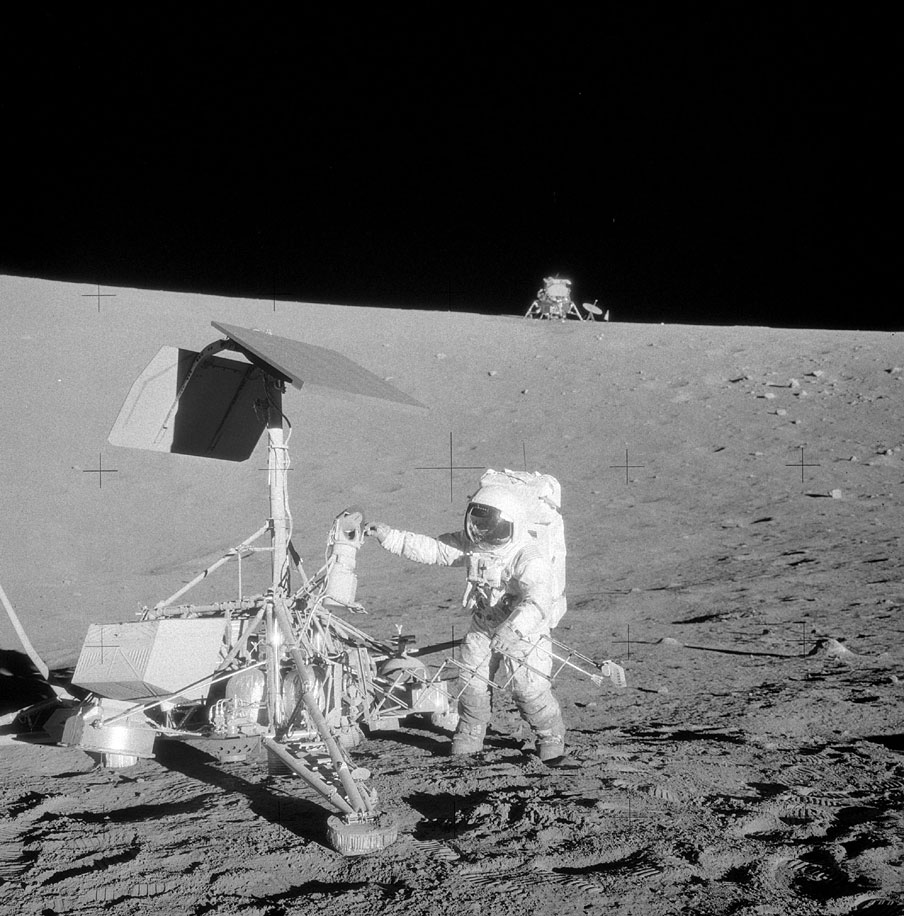
With Apollo 12, the story of Surveyor III came full circle and we got one of the coolest pictures ever taken from the lunar surface. Out of scientific and engineering interest, Apollo 12 landed in the same site as Surveyor III. Al Bean and Pete Conrad got to see the robot up close, which is how we have the image from earlier showing Surveyor sitting on the Moon. They took pictures, and even grabbed pieces of the robot to bring back home for analysis. Right now, the TV camera of Surveyor III sit in the Smithsonian, where you can visit and see actual hardware returned from the Moon. The Apollo astronauts also took what I think are some of the most incredible photographs from the history of exploration–human space explorers interacting directly with their robot counterparts.

Apollo astronaut Pete Conrad “jiggles” the spacecraft to see how firmly it’s rooted to the ground. Credit: NASA

CORRECTION 11/21/2024: The original version of this post identified the astronaut in the last picture as Alan Bean. It’s actually Pete Conrad, and Alan Bean is the one taking the photograph.

Footnotes:

  1. If you want to know more about this, Lunar Orbiter photography was the topic of my master’s thesis, which can be found in the about section. ↩︎
  2. There’s a famous story of how scientists feared the landing vehicle would sink into the soil, an idea that did come from a fairly well-known scientist. But many geologists at the time were pretty dismissive of his claims. There were other potential issues though, including ignorance of the electrostatic properties of the lunar material, which could have led to severe dust build-up on equipment. Bottom line: not a lot was known for sure about the nature of the surface. This was an issue if you wanted to land there. ↩︎
  3. For a description of lunar mapping efforts around this time, see Kopal and Carder, Mapping of the Moon. The difficulty of interpreting the photographs can be seen in a variety of scientific papers from the time. Examples can be found in Interpretation of Lunar Probe Data, ed. Jack Green, 1966. ↩︎
  4. Boeing was the primary contractor on Lunar Orbiter. Images and methods can be found in their contractor reports for NASA. ↩︎
  5. Detailed comments the relative priority of science on the Apollo Mission can be seen in A Review of Space Research, the document that came out of the 1962 Iowa Summer Study. ↩︎

History Highlights 4: Darwin’s Wild Ride, Losing Lenses, Finding Lunar Landers

My schedule has become highly variable due to grad school and freelance work. I’m currently working on a series of posts about scientific photography on the British Antarctic Expedition–so far you can read a short introduction, and a post about Herbert Ponting’s early photographs of animals and ice. I’m still working on the next post in that series, which will focus more on the scientists of the Terra Nova expedition and their work, as seen through Ponting’s lens. Until then, here’s a new History Highlights–a periodic collection of new work and other interesting things in the history of science, exploration, and technology.

Recent History

News and new work in science, exploration, and technology.
Newly Digitized Antarctic Photography

Speaking of photography in Antarctica, the National Archives of Australia recently uploaded a number of photographs from Antarctic expeditions to their online system. Their records are a little difficult to navigate, but here’s a link to the site. I’m planning to look through these images for my research, and to see if there’s anything useful for the Herbert Ponting series I’m working on.

Raymond Priestly was a geologist who participated in both the Nimrod and Terra Nova expeditions to Antarctica under Shackleton and Scott. Here he is on the Nimrod expedition in 1908. He would go on to co-found the Scott Polar Research Institute. From NAA A14518 H7622.
Reconceptualizing the History of Science

Eric Moses Gurevitch shares an excellent article he wrote covering books by James Poskett and Pamela H. Smith. These works are part of an effort to broaden the history of science beyond the conventional narratives that have roots in nineteenth century chauvinisms. This re-conceptualization opens up new research possibilities in the history of science, and draws attention to the myriad ways humans have produced and shared knowledge about nature.

Miscellanea

Various highlights from my research, readings, and internet rabbit holes
Mr. Darwin’s Wild Ride

While Charles Darwin was in the Galapagos studying the rocks, plants, and animals, he used a wide variety of observational techniques. One of these apparently involved riding the tortoises:

I was always amused, when overtaking one of these great monsters as it was quietly pacing along, to see how suddenly, the instant I passed, it would draw in its head and legs, and uttering a deep hiss fall to the ground with a heavy sound, as if struck dead. I frequently got on their backs, and then, upon giving a few raps on the hinder part of the shell, they would rise up and walk away; but I found it very difficult to keep my balance.

Charles Darwin, Voyage of the Beagle
Sunken Treasure at the Bottom of McMurdo Sound

There is apparently a small treasure waiting to be recovered from the sea floor near Antarctica. As he was trying to photograph orcas from the deck of the Terra Nova, Herbert Ponting lost his favorite camera lens:

I leant over the poop rail…waiting for the whales to draw nearer, when, as I was about to release the shutter, the view disappeared from the finder, and light flooded the camera; at the same moment I heard something splash in the water. On examining the camera, what was my consternation to find that the lens-board had dropped into the sea, carrying with the the finest lens of my collection–a nine-inch Zeiss double protar, worth about £25, which had been presented to me some years ago by the Bausch and Lomb Optical Company of Rochester, U.S.A.

Herbert Ponting, The great white South; being an account of experiences with Captain Scott’s South pole expedition and of the nature life of the Antarctic

He sent a letter to Bausch and Lomb, and they sent him a new lens. But the old lens must still be there, two hundred fathoms (as Ponting claimed) under the surface of McMurdo Sound. I tried to find the lens he used, and came across a catalog from 1904 with a listing of Bausch and Lomb lenses. From Ponting’s description of the lens and his uses for it–both whales and scenic views–I think the lens below is probably the closest. I would love it if anyone with more expertise in historical photographic equipment would be able to provide some more insight.

This probably isn’t the same exact lens Ponting dropped into McMurdo Sound, but it may be similar. Catalog found in the reference library of Pacific Rim Camera.
First Lunar Rover found through “Space Archaeology”

Lunokhod was a Soviet spacecraft that became the first rover on another planetary body in 1970. The rover’s solar cells deployed using a unique clamshell design, and used cameras on each side of the vehicle for navigation.

Lunokhod mission outline. From Wikimedia.
Model of the rover in the Museum of Cosmonautics. From Wikimedia.

In 2010, Lunokhod 1 was found, and was even capable of being used again for scientific experiments. The rover was equipped with retroreflectors like the one left by Apollo astronauts. This is actually how its final resting site was accidentally identified, when astrophysicist Tom Murphy was using a pulsed laser to study the lunar surface. The Lunar Reconnaissance Orbiter was able to use those coordinates to take new images of the Lunokhod landing site and lander forty years after its original mission.

Luna 17 lander, from NASA/GSFC/Arizona State University.
Discourse on Things that Float

Galileo apparently got into a debate with a contemporary over dinner about why things float in water. This turned into an entire treatise on how things float, in which Galileo drew from preceding work by Archimedes. He also talks about some of his astronomical work. Here are a few quotes, with an example of the type of principles he discusses in the treatise:

This sufficeth me, for my present occasion, to have, by the above declared Examples, discovered and demonstrated, without extending such matters farther, and, as I might have done, into a long Treatise: yea, but that there was a necessity of resolving the above proposed doubt, I should have contented my self with that only, which is demonstrated by Archimedes, in his first Book De Insidentibus humido: where in generall termes he infers and confirms the same Of Natation (a) Lib. 1, Prop. 4. (b) Id. Lib. 1. Prop. 3. (c) Id. Lib. 1. Prop. 3. Conclusions, namely, that Solids (a) less grave than water, swim or float upon it, the (b) more grave go to the Bottom, and the (c) equally grave rest indifferently in all places, yea, though they should be wholly under water.

But, because that this Doctrine of Archimedes, perused, transcribed and examined by Signor Francesco Buonamico, in his fifth Book of Motion, Chap. 29, and afterwards by him confuted, might by the Authority of so renowned, and famous a Philosopher, be rendered dubious, and suspected of falsity; I have judged it necessary to defend it, if I am able so to do, and to clear Archimedes, from those censures, with which he appeareth to be charged….

The diversity of Figures given to this or that Solid, cannot any way be a Cause of its absolute Sinking or Swimming.

So that if a Solid being formed, for example, into a Sphericall Figure, doth sink or swim in the water, I say, that being formed into any other Figure, the same figure in the same water, shall sink or swim: nor can such its Motion by the Expansion or by other mutation of Figure, be impeded or taken away.

Galileo Galilei, Discourse on Floating Bodies

For more History Highlights from past weeks, click here. Follow the Inverting Vision Twitter account for updates on posts and other history of exploration and science content. Subscribe to get update in your inbox:

Photography and Science in Antarctica – Orcas and Ice

This is part two of a series of posts about photography and science on the Terra Nova expedition of 1910-193. You can read the introduction here. This week we find Ponting arriving in Antarctica, and beginning to get acquainted with the environment.

The Terra Nova. Ponting was a fan of icicles, and tried to include them in his shots whenever possible. From the Scott Polar Research Institute (SPRI).

Scientific curiosity drew photographer Herbert Ponting to Antarctica. Before his journey with the British Antarctic Expedition in 1910, the great southern continent was already a place of growing scientific interest. Early encounters in the late 18th and early 19th centuries had revealed ice shelves, animals, and mountains that encouraged dedicated missions to chart and understand the continent. James Weddel, Jules Dumont d’Urville, Charles Wilkes, and James Clark Ross revealed the contours of Antarctica, and returned to Europe and the United States with tantalizing information for biologists and geologists. 

Herbert Ponting was particularly interested in the animals of the Antarctic. Several years before Ponting climbed aboard the Terra Nova, his crew mates Robert Falcon Scott and Edward Wilson had made a landing on Ross Island during the Discovery expedition. In his diaries, Wilson vividly described the smells and sounds that greeted them when they made landfall at Cape Crozier–they had found one of the largest colonies of Adelie penguins. Ponting fantasized about being able to make camp at Cape Crozier and photograph the penguins there, but Scott chose Cape Evans on the other side of the island for their base of operations. 

Once they arrived, the crew used their tracked motor sledges to unload shelter materials and supplies. Ponting still had plenty of opportunity to observe and photograph wildlife. There was a colony of Adelie penguins near their camp, and the birds were not shy about greeting the visitors. “They strolled about,” Ponting wrote, “for all the world like a party of tourists taking in the sights.”1 This delighted the photographer, and he took photographs of their interactions with the crew, who liked to play games with the penguins.

An Adelie penguin pecks Ponting. From SPRI.
Henry Rennick and Francis Drake meet the penguins. From SPRI.

Later in the expedition, the scientific team would learn more about the life cycle and behaviors of the penguins. In the meantime, the crew at Cape Evans spent time studying other examples of marine life. The biologist Denis Lillie collected as many samples as possible with nets. These included an example of cephalodiscus, which are wormlike animals that live in colonies. They also caught “crustacea, star-fish, sea-urchins, great worms, anemones, molluscs,” and large glass sponges.

Denis Lille and his net. From SPRI.
Denis Lille and a glass sponge. From SPRI.

But Ponting was more interested in the animal that had accompanied their ship on the way to their temporary home: the orca. Ponting was keen to capture animal behaviors with his camera, in an effort to make his own contributions to the scientific work of the expedition. The orca and the blue whales were his first opportunity, but he found them exceedingly difficult to capture on film. It was difficult to predict when they would surface, so setting up a camera to capture things like their ‘spout’ was almost impossible. But he managed to capture some of their surfacing and hunting behavior with the cinematograph.

The top two images show orcas surfacing. The bottom pictures supposedly shows them hunting. From SPRI.

Ponting even tried to use his equipment to document and understand whale behavior, to the extent that he could. He used the frame rate of his camera (sixteen frames a second) to measure the duration of the orca’s spout. He tried to capture their grouping and hunting patterns, but was frustrated by the challenges of catching them at the right time. He never did get a film of the blue whales spouting. He also never got a film of whales breaching, despite sitting for nine hours at a spot where he saw one of the  “sportive monsters” perform the spectacular maneuver. 

The intelligence of the whales impressed both Ponting and the crew, and they were amazed by the hunting ability of the orcas. Ponting himself claimed to have been hunted while trying to get just the right shot of an orca, and included a fantastical illustration of the encounter. 

Ponting claimed that this was a very accurate portrayal of the attack. From his book.

The illustration demonstrates some of Ponting’s editorial inclinations. Ponting was an excellent photographer but he was an equally good salesman who was constantly searching for the spectacular and the picturesque. This made him well-suited to his role on the expedition. Photographs and books were a way to make some money from exploration, and they would be in high demand back home.2 Ponting’s photographs have to be viewed with this fact in mind–he was interested in science, but the picturesque held priority. 

Especially early on in the expedition, Ponting’s shots of crew members were often very carefully posed, and his shots of scientific subjects were as controlled as he could make them. His photographs of the whales are interesting in part because of the relative lack of control he had over his subjects.

Ponting found some degree of control in the ice, along with some of the most picturesque scenery he would encounter. The icebergs and ice floes of Antarctic waters captivated and frightened European explorers from the earliest days of Antarctic exploration. Edmond Halley (of comet fame) described encounters with Antarctic ice on his voyage to map magnetic variation in 1699. At first he first thought they were white mountains, and he compared them to white cliffs found in Great Britain. Later expeditions grappled with the ice, and some fell prey to it.

For mariners the ice represented unpredictability, but for the photographer they were relatively static (although still temporary) pieces of natural beauty. Ponting relished the long periods of daylight that he could use to capture the ice in different light conditions. He didn’t want to lose this opportunity, and slept very little for four days on end, working as long as “human endurance would permit.”

His most famous photograph captures the Terra Nova from within a grotto of ice. In his book, he described taking the picture:

A fringe of long icicles hung at the entrance of the grotto, and passing under these I was in the most wonderful place imaginable. From outside, the interior appeared quite white and colourless, but, once inside, it was a lovely symphony of blue and green. I made many photographs in this remarkable place–than which I secured none more beautiful the entire time I was in the South…I found that the colouring of the grotto changed with the position of the sun; this, sometimes green would predominate, then blue, and then again it was a delicate lilac. When the sun passed round to the west–opposite the entrance to the cavern–the beams that streamed in were reflected by myriads of crystals, which decomposed the rays into lovely prismatic hues, so that the walls appeared to be studded with gems.

Herbert Ponting, The Great White South: being an account of experiences with Captain Scott’s South pole expedition and of the nature life of the Antarctic
Grotto in an Iceberg, by Ponting. From Wikimedia.

The elegant formations of icebergs had often been described by explorers in architectural terms, and Ponting’s photographs are some of the most successful at capturing this perspective.3 One of his most frequent subjects was the “Castle berg.”

Caslte Berg, with a dog team in the foreground. From SPRI.

Ponting also documented the formation of “pancake ice,” describing how small crystals coalesced into larger discs of ice. These discs grew very quickly into large sheets of ice that became ice floes. He managed to take a series of photographs showing the formation of these ice features.

The various stages of pancake ice. From SPRI.

The ice, the whales, seals, and penguins took up most of Ponting’s attention in the early days of the expedition. Teams of scientists had been dispatched in various directions, while Ponting stayed behind with the rest of the crew. In the next post, we will catch up with these teams, who investigated emperor penguin colonies and Antarctic geology. 

Footnotes

  1. Quotes and information on Herbert Ponting comes primarily from his book The Great White South: being an account of experiences with Captain Scott’s South pole expedition and of the nature life of the Antarctic
  2. For more, see James R. Ryan, Photography and Exploration
  3. Kirsten Hastrup, “The Ice as Argument: Topographical Mementos in the High Arctic,” The Cambridge Journal of Anthropology, Vol 31, No 1 (2013), pp. 51-67