History Highlights 4: Darwin’s Wild Ride, Losing Lenses, Finding Lunar Landers

My schedule has become highly variable due to grad school and freelance work. I’m currently working on a series of posts about scientific photography on the British Antarctic Expedition–so far you can read a short introduction, and a post about Herbert Ponting’s early photographs of animals and ice. I’m still working on the next post in that series, which will focus more on the scientists of the Terra Nova expedition and their work, as seen through Ponting’s lens. Until then, here’s a new History Highlights–a periodic collection of new work and other interesting things in the history of science, exploration, and technology.

Recent History

News and new work in science, exploration, and technology.
Newly Digitized Antarctic Photography

Speaking of photography in Antarctica, the National Archives of Australia recently uploaded a number of photographs from Antarctic expeditions to their online system. Their records are a little difficult to navigate, but here’s a link to the site. I’m planning to look through these images for my research, and to see if there’s anything useful for the Herbert Ponting series I’m working on.
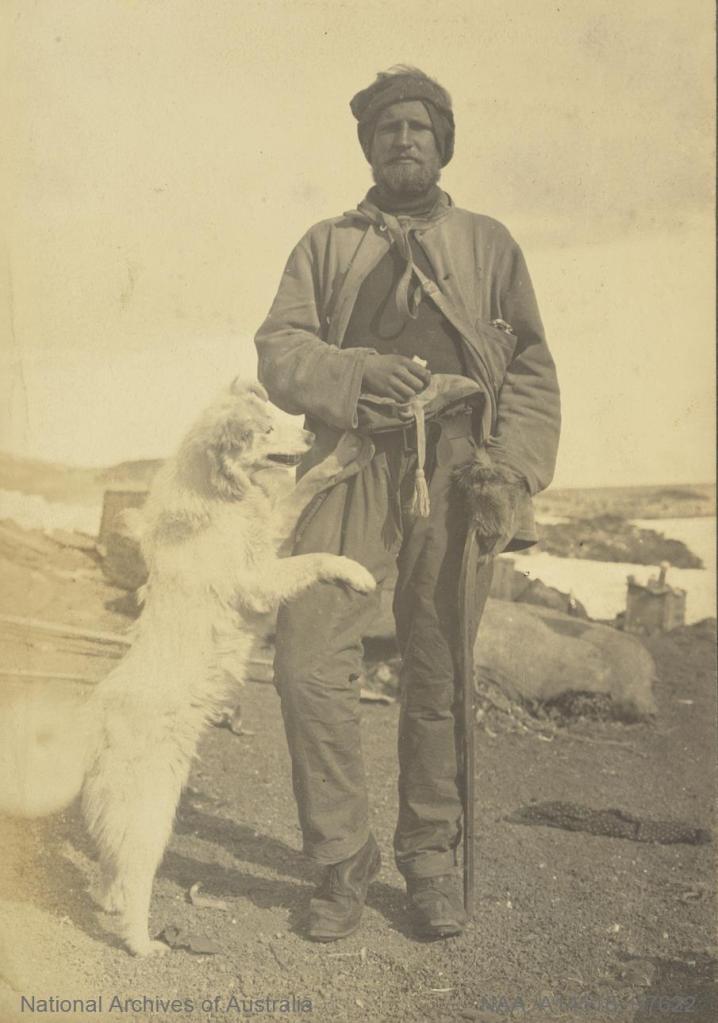
Raymond Priestly was a geologist who participated in both the Nimrod and Terra Nova expeditions to Antarctica under Shackleton and Scott. Here he is on the Nimrod expedition in 1908. He would go on to co-found the Scott Polar Research Institute. From NAA A14518 H7622.
Reconceptualizing the History of Science

Eric Moses Gurevitch shares an excellent article he wrote covering books by James Poskett and Pamela H. Smith. These works are part of an effort to broaden the history of science beyond the conventional narratives that have roots in nineteenth century chauvinisms. This re-conceptualization opens up new research possibilities in the history of science, and draws attention to the myriad ways humans have produced and shared knowledge about nature.

Miscellanea

Various highlights from my research, readings, and internet rabbit holes
Mr. Darwin’s Wild Ride

While Charles Darwin was in the Galapagos studying the rocks, plants, and animals, he used a wide variety of observational techniques. One of these apparently involved riding the tortoises:

I was always amused, when overtaking one of these great monsters as it was quietly pacing along, to see how suddenly, the instant I passed, it would draw in its head and legs, and uttering a deep hiss fall to the ground with a heavy sound, as if struck dead. I frequently got on their backs, and then, upon giving a few raps on the hinder part of the shell, they would rise up and walk away; but I found it very difficult to keep my balance.

Charles Darwin, Voyage of the Beagle
Sunken Treasure at the Bottom of McMurdo Sound

There is apparently a small treasure waiting to be recovered from the sea floor near Antarctica. As he was trying to photograph orcas from the deck of the Terra Nova, Herbert Ponting lost his favorite camera lens:

I leant over the poop rail…waiting for the whales to draw nearer, when, as I was about to release the shutter, the view disappeared from the finder, and light flooded the camera; at the same moment I heard something splash in the water. On examining the camera, what was my consternation to find that the lens-board had dropped into the sea, carrying with the the finest lens of my collection–a nine-inch Zeiss double protar, worth about £25, which had been presented to me some years ago by the Bausch and Lomb Optical Company of Rochester, U.S.A.

Herbert Ponting, The great white South; being an account of experiences with Captain Scott’s South pole expedition and of the nature life of the Antarctic

He sent a letter to Bausch and Lomb, and they sent him a new lens. But the old lens must still be there, two hundred fathoms (as Ponting claimed) under the surface of McMurdo Sound. I tried to find the lens he used, and came across a catalog from 1904 with a listing of Bausch and Lomb lenses. From Ponting’s description of the lens and his uses for it–both whales and scenic views–I think the lens below is probably the closest. I would love it if anyone with more expertise in historical photographic equipment would be able to provide some more insight.

This probably isn’t the same exact lens Ponting dropped into McMurdo Sound, but it may be similar. Catalog found in the reference library of Pacific Rim Camera.
First Lunar Rover found through “Space Archaeology”

Lunokhod was a Soviet spacecraft that became the first rover on another planetary body in 1970. The rover’s solar cells deployed using a unique clamshell design, and used cameras on each side of the vehicle for navigation.
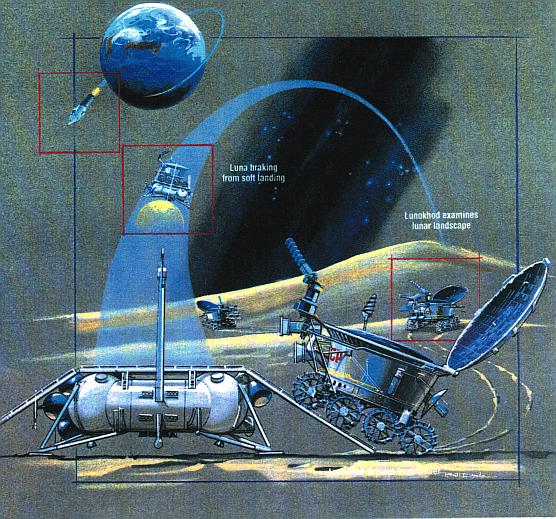
Lunokhod mission outline. From Wikimedia.
Model of the rover in the Museum of Cosmonautics. From Wikimedia.

In 2010, Lunokhod 1 was found, and was even capable of being used again for scientific experiments. The rover was equipped with retroreflectors like the one left by Apollo astronauts. This is actually how its final resting site was accidentally identified, when astrophysicist Tom Murphy was using a pulsed laser to study the lunar surface. The Lunar Reconnaissance Orbiter was able to use those coordinates to take new images of the Lunokhod landing site and lander forty years after its original mission.
Luna 17 lander, from NASA/GSFC/Arizona State University.
Discourse on Things that Float

Galileo apparently got into a debate with a contemporary over dinner about why things float in water. This turned into an entire treatise on how things float, in which Galileo drew from preceding work by Archimedes. He also talks about some of his astronomical work. Here are a few quotes, with an example of the type of principles he discusses in the treatise:

This sufficeth me, for my present occasion, to have, by the above declared Examples, discovered and demonstrated, without extending such matters farther, and, as I might have done, into a long Treatise: yea, but that there was a necessity of resolving the above proposed doubt, I should have contented my self with that only, which is demonstrated by Archimedes, in his first Book De Insidentibus humido: where in generall termes he infers and confirms the same Of Natation (a) Lib. 1, Prop. 4. (b) Id. Lib. 1. Prop. 3. (c) Id. Lib. 1. Prop. 3. Conclusions, namely, that Solids (a) less grave than water, swim or float upon it, the (b) more grave go to the Bottom, and the (c) equally grave rest indifferently in all places, yea, though they should be wholly under water.

But, because that this Doctrine of Archimedes, perused, transcribed and examined by Signor Francesco Buonamico, in his fifth Book of Motion, Chap. 29, and afterwards by him confuted, might by the Authority of so renowned, and famous a Philosopher, be rendered dubious, and suspected of falsity; I have judged it necessary to defend it, if I am able so to do, and to clear Archimedes, from those censures, with which he appeareth to be charged….

The diversity of Figures given to this or that Solid, cannot any way be a Cause of its absolute Sinking or Swimming.

So that if a Solid being formed, for example, into a Sphericall Figure, doth sink or swim in the water, I say, that being formed into any other Figure, the same figure in the same water, shall sink or swim: nor can such its Motion by the Expansion or by other mutation of Figure, be impeded or taken away.

Galileo Galilei, Discourse on Floating Bodies

For more History Highlights from past weeks, click here. Follow the Inverting Vision Twitter account for updates on posts and other history of exploration and science content. Subscribe to get update in your inbox:
History Highlights 2: FLIP, Challenger, Demons, and Kepler

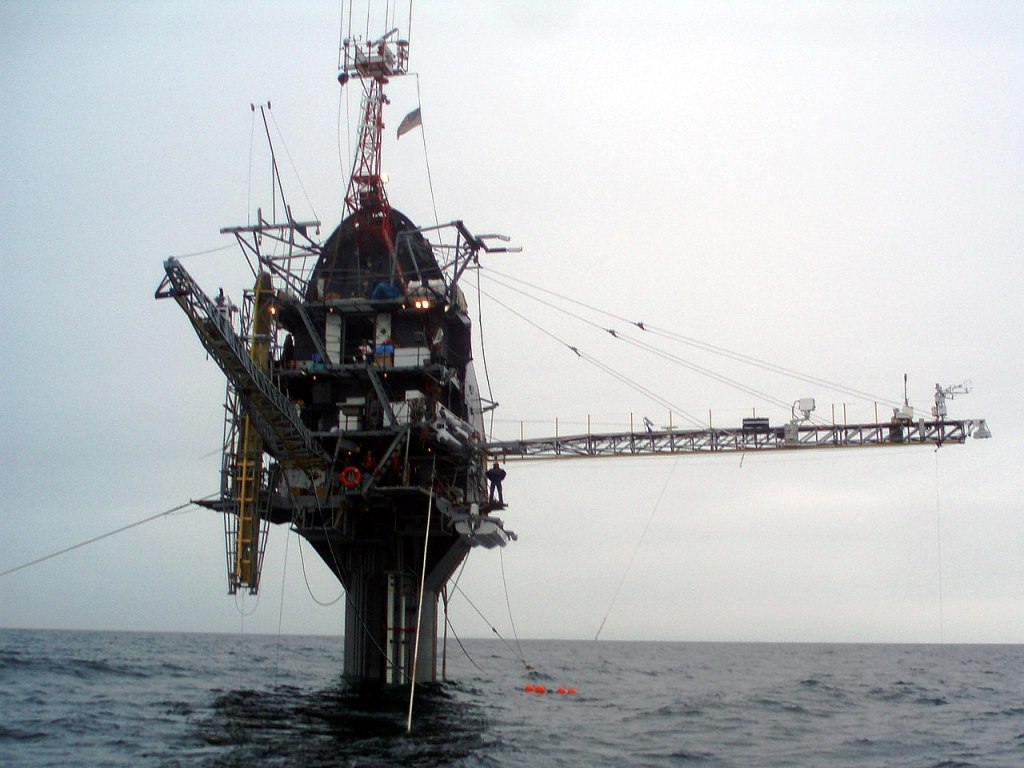
FLIP in vertical orientation for research on waves.

FLIP, Laboratory at Sea

Stefan Helmreich writes about FLIP (FLoating Instrument Platform), a  fascinating vessel designed for oceanographic research. First launched in 1962, it has the unique ability to change orientation, immersing most of its structure into the ocean to become a buoy. This provides a relatively stable platform for research, and the ability to do semi-controlled experiments on waves. It is an example of how the distinction between the laboratory and the field is sometimes blurred, in part due to technology.


You can read more of Helmreich’s analysis in Media+Environment and ISIS.

Looking Back on InSight and Phoenix on Mars

Mars InSIght is gathering dust on Mars, and its days are numbered. The robotic mission has been an enormous success, contributing to our understanding of Martian geology and natural history. NASA has an excellent retrospective on the major scientific achievements of the InSight lander.

Around this time of year in 2008, the last signals were received from the Phoenix lander. Like the InSight mission, Phoenix lasted beyond its mission parameters, and eventually succumbed to the elements. NASA also has a short history of the Phoenix lander. 

Photographs From the HMS Challenger

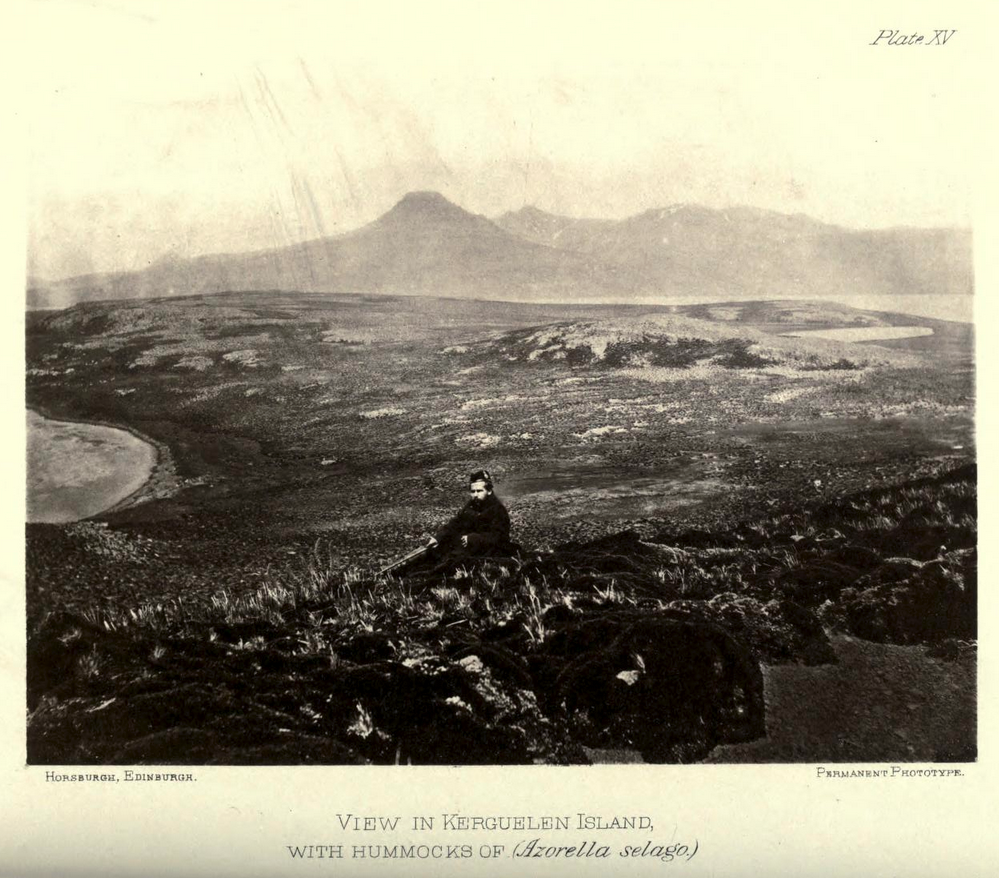
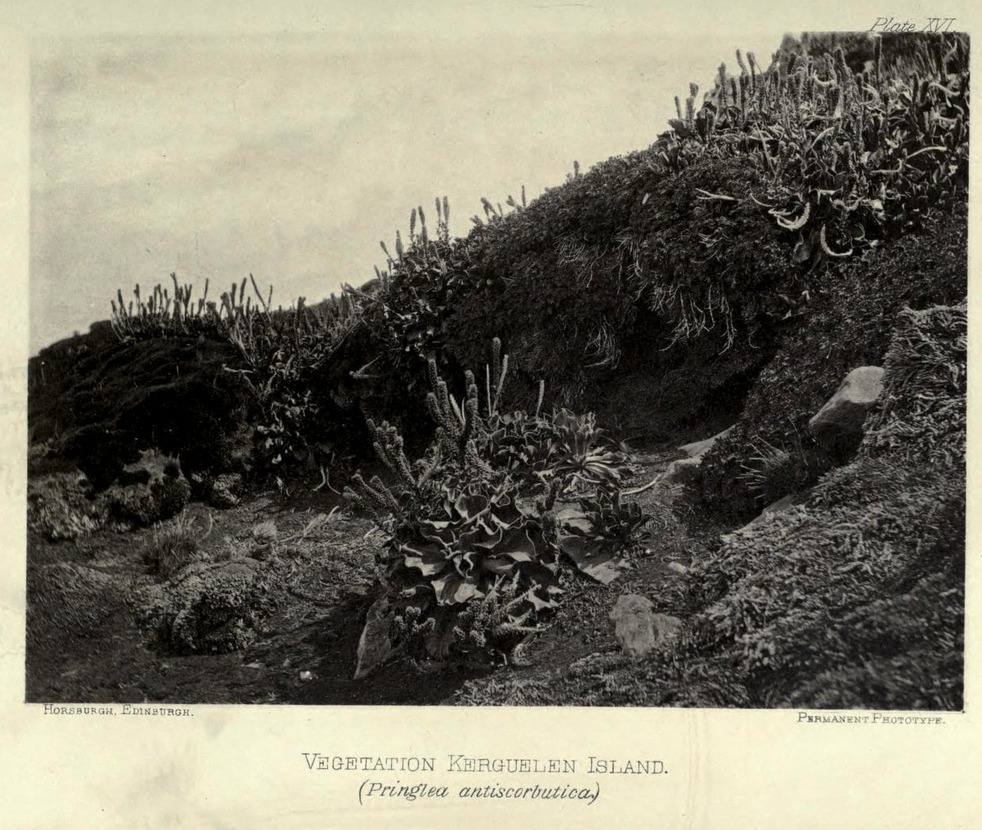
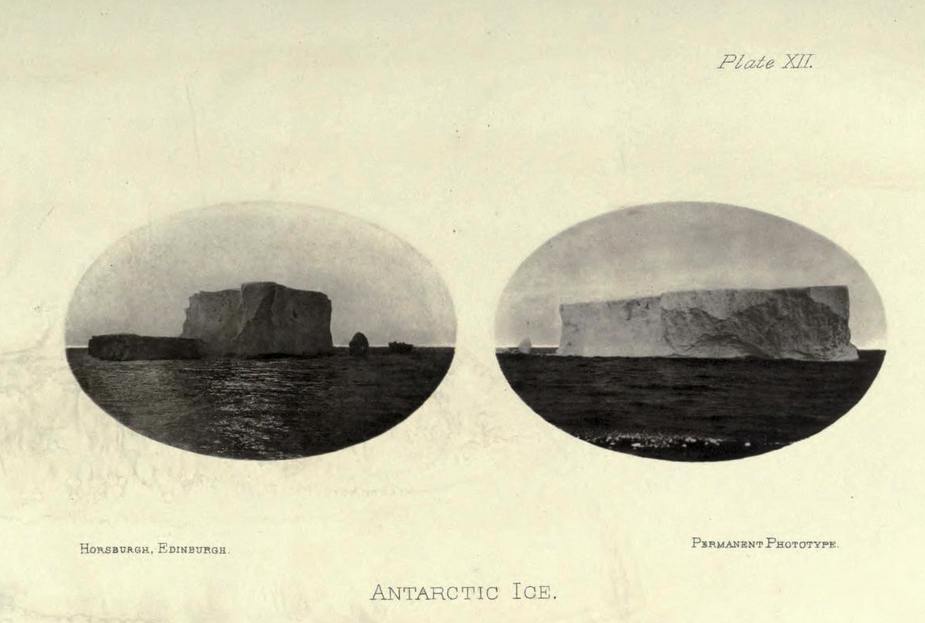
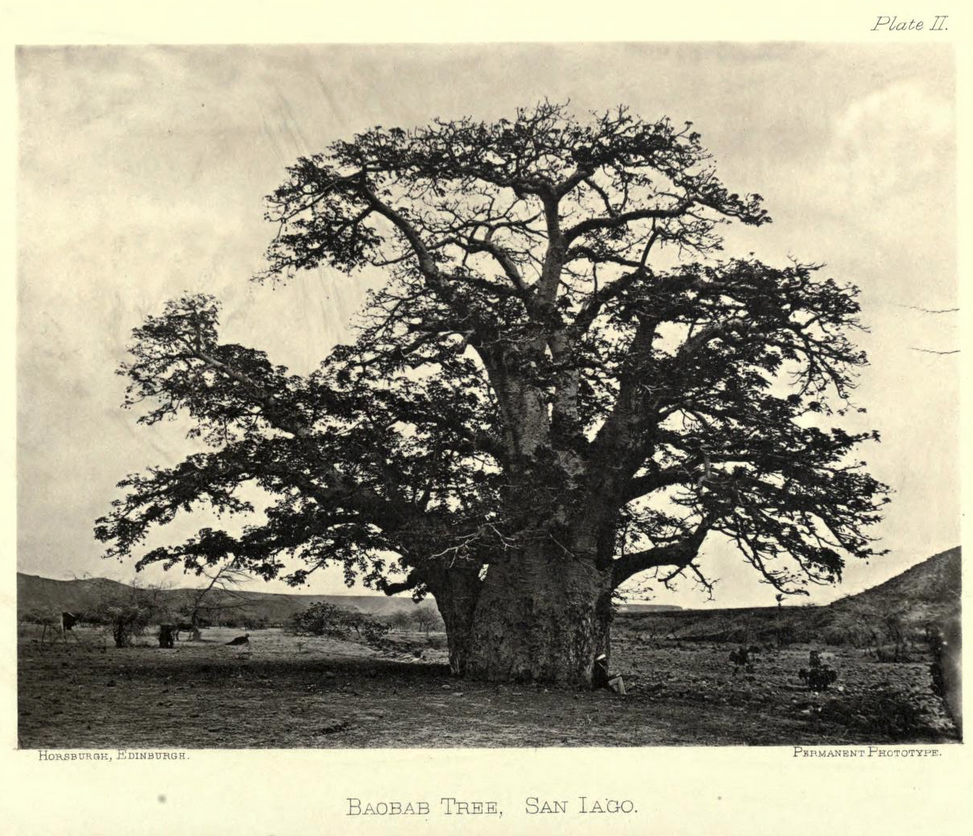
The HMS Challenger expedition helped kickstart the discipline of oceanography. The voyage is a monumental saga in the history of science and the history of exploration. It also played an important role in the history of photography. Not much is known about the photographers and the equipment they used. I was able to find a letter to the editor in an 1875 issue of Nature, referencing a new type of dry photographic plate. The letter was written by Henry Stuart Wortley, and seems to imply that a collodion process was used, including a combination of wet and dry plates. I want to investigate this further, but for now, here are a few of my favorite photographs from the official narrative of the expedition:

The Place of All the Demons

In the 1940s and 1950s, scholars were starting to think seriously about how to create artificial intelligence. They wrote papers and met regularly to discuss things like neural networks and machine learning. Oliver Selfridge was an important part of this conversation, and contributed to a number of early breakthroughs in thinking about artificial intelligence. One of these was a pattern recognition model that laid the foundations for computer image processing.

He imagined each node in the network as a hierarchical group of “demons” each assigned to recognize certain patterns, and to shout out when they recognize something like their assigned pattern. He wrote that each demon might “be assigned one letter of the alphabet, so that the task of the A-demon is to shout as loud of the amount of ‘A-ness’ that he sees in the image.” Then a demon at the top of the hierarchy listens to all the shouting and picks out the loudest shout as the best interpretation of the image.

He called the model “Pandemonium.”

Additional Links:

The original paper.

The Quest for Artificial Intelligence, by Nils J. Nilsson

“A Waste Land of Famine and Despair”: Kepler’s Tortured Personal Life

I want to do a review of The Sleepwalkers by Arthur Koestler at some point. Until then, here’s a short bit about Kepler. Kepler’s personal life was just so absurdly tragic that it stood out to me.

According to Koestler, we get this stuff from Kepler himself, who wrote an incredibly detailed family history. Koestler dwells on it at length, providing a detailed glimpse into the background and mindset of his subject. Here’s a brief outline of Kepler’s life. All quotes here are from Koestler, and I think some of them reveal his talent for colorful description.

  • “Johannes Kepler’s father was a mercenary adventurer who narrowly escaped the gallows. His mother, Katherine, … was brought up by an aunt who was burnt alive as a witch, and Katherine herself, accused in old age of consorting with the Devil, had as narrow an escape from the stake as the father had from the gallows.”
  • When Kepler was about three years old, his parents both left to fight Protestants in the Netherlands, despite being Protestant themselves. Kepler was left with his grandparents. His father went on two more trips, then disappeared.
  • He had six siblings, “of whom three..died in childhood, and two became normal, law-abiding citizens. But Heinrich, the next in age to Johannes, was an epileptic and a victim of the psychopathic streak running through the family.”
  • “Johannes was a sickly child, with thin limbs and a large, pasty face surrounded by dark curly hair. He was born with defective eyesight…his stomach and gallbladder gave constant trouble; he suffered from boils, rashes, and probably from piles, for he tells us that he could never sit still for any length of time and had to walk up and down.”
  • When he was four, he contracted smallpox and nearly died.
  • He compared himself to a dog constantly, even saying he had an aversion to bathing.
  • “Kepler belonged to the race of bleeders, the victims of emotional haemophilia, to whom every injury means multiplied danger, and who nevertheless must go on exposing himself to stabs and slashes. But one customary feature is conspicuously absent from his writings: the soothing drug of self-pity, which makes the sufferer spiritually impotent, and prevents his suffering from bearing fruit.”
  • Kepler’s first wife “resented her husband’s lowly position as a stargazer and understood nothing of his work.” He describes her in extremely bitter terms after she died at thirty-seven. Three of their five children died very young.
  • He had seven children with his second wife, “of whom three died in infancy.” Koestler presumes that his relationship with her was better than with his first wife, since he doesn’t write about her very much.
  • He was forced into virtual itinerancy in his last years, while trying to get some of his works printed. He spent ten months away from his family, and “was again plagued by rashes and boils; he was afraid that he would die before the printing of the Tables was finished; and the future was a waste land of famine and despair.”
  • After the struggles with publishing, he had difficulty obtaining payment for his work and accessing money owed to him. “He had money-deposits in various places, but he was unable to recover even the interests due to him. When he set out on that last journey across half of war-torn Europe, he took all the cash he had with him, leaving Susanna and the children penniless.”
  • He ended up in Ratisbon to try to get payment from the Emperor, but contracted a fever and died there in 1630.


And then there’s this quote from Kepler’s self-description that I quite identify with:

“In this man there are two opposite tendencies: always to regret any wasted time, and always to waste it willingly.”

Links:

The Sleepwalkers: A History of Man’s Changing Vision of the Universe, by Arthur Koestler

History Highlights 1

File:SS Sirius (1837).jpg
The SS Sirius, an early steamship

Math and Mining in the Ore Mountains

Deep in the heart of Central Europe, near the border of Saxony and Bohemia, lie the Ore Mountains. Rich in minerals, the Ore Mountains played a central role in the development of European metallurgy. They are home to some of the first European mining operations, and the inhabitants have been mining tin and silver there since the Pre-Classical Era.

For millennia, the region has attracted people looking to make a living. In the 16th century, as truly large-scale mining operations were underway, Georg Agricola arrived in the mining town of Chemnitz. He had just completed his university education, and took on a job as the town physician. He was somewhat out of place–an educated humanist living in a town of people who worked with their hands.

Agricola became deeply involved in the town, eventually becoming the mayor. And during that time, he attempted to apply his university education to the mining industry, writing on geology and mineralogy. He left us with De Re Metallica, a detailed account of metallurgy in the 16th century. It delves into geometry, and the applications of mathematics to planning and executing mining operations.

How much did this mathematical theory influence the actual mining practices of the time? According to historian Thomas Morel, not much. 

I think many people, including myself, have a tendency to think of the Scientific Revolution and the Industrial Revolution as connected. To some extent they were related, but Morel does a fantastic job of disentangling the theoretical from the practical, the scholar from the practitioner. 

It’s a difficult job, because the practitioners unfortunately don’t leave us a lot of direct descriptions of their work. To figure out the real-world practices at the time of Agricola, Morel looks to sources like mining laws and sermons in mining towns. These are indirect evidence, but are much closer to the daily lives and practicalities of mining than the writings of a Humanist physician.

In De Re Metallica, Agricola focuses on theoretical ideas about practices like determining where to dig a vertical shaft so that it intersects with a tunnel. These descriptions are complete with diagrams showing similar triangles.

Morel suggests that the actual topography of the Ore Mountains makes this idealized case impractical. He looks to diagrams from actual surveyors, and eventually to a sermon about why Martin Luther was awesome. 

This is a phenomenal piece of history. Apparently, a sermon by Cyriacus Spangenberg “included a detailed description of this specific surveying procedure that took up four pages.” If you’ve ever been to a Lutheran church, long sermons and extended religious analogies will be familiar. Apparently they have a long tradition, and thankfully for historians, can provide a glimpse into the actual lives of common people.

Morel argues that the practices revealed by these sources differ significantly from those described in De Re Metallica. “Taking Agricola’s words for granted,” Morel writes, “confuses his literary production with the practices of underground surveyors and hinders our understanding of both.” Surveying and mining practices were indeed advancing at this time, but not because the surveyors were reading Humanists and applying their theory.

So to some extent, the intellectual and practical worlds of 16th century mining were advancing along parallel, but non-intersecting paths. To me, this raises the question of how well this case study can be applied to other fields of science and engineering. But this case study was strong enough that I think it helps shift the burden of proof onto claims that scholarship influenced practice. 

Morel suggests that as far as any interaction happened between these two worlds, it was a subtle cross-fertilization. According to him, scholars and practitioners were always most interested in the task right in front of them. For Agricola, that may have been introducing new mathematical ideas to his audience (who were specifically not the miners he was writing about). For the surveyor, that was getting the job done efficiently. 

The extent and nature of this cross-fertilization is still something that is being explored in the History of Science. The perspective of the practitioners is more difficult to source, and has been somewhat neglected until recently. The relationship between these two worlds is a somewhat open question, and I think it’s one of the more interesting areas of research. If you know of other attempts to tackle this topic, let me know in the comments.

Source:

Thomas Morel, “De Re Geometrica: Writing, Drawing, and Preaching Mathematics in Early Modern Mines,” Isis, Volume 111, no. 1 (2020) https://doi.org/10.1086/707640


The Incredible Power of Steamships

I recently read Neptune’s Laboratory: Fantasy, Fear, and Science at Sea by Antony Adler. In addition to having a fantastic title, it provides a wonderful overview of oceanography as a scientific discipline.

I might do a longer review on this book in the future, but Adler describes the reception of steam ships by 19th century journalists and the public, and I had to share it:

“…it was only upon the arrival of the first commercially viable transatlantic steamship, Sirius, in New York in April of 1838, that newspapers declared the successful ‘annihilation of space and time.’ When soon thereafter some early passenger steamships exploded, at great loss of life, journalists blamed these accidents on ‘a public mind’ that had become ‘completely infatuated with a wish to be borne in the twinkling of an eye’ from place to place.”

I love these glimpses into the perception of new tech throughout time. You see attitudes that seem very persistent across time periods and groups of people.

Source:
Antony Adler, Neptune’s Laboratory: Fantasy, Fear, and Science at Sea


Grey Flag Pirates

Sometimes the history of exploration blends with maritime history. This more general history provides essential context for the history of exploration, so sometimes I might succumb to the temptation to include something not strictly within the confines of the blog’s stated topics. In this case: the pirate officials of the Song Dynasty.

China had problems with piracy along their coast for a good deal of their history. Maritime trade has a tumultuous history in China, partly due to their geography. In The Boundless Sea: A Human History of the Oceans, David Abulafia describes the interesting and controversial way that the Song Dynasty dealt with pirates, by giving them cushy government jobs:

“As more traffic crossed the sea, the temptation to pirates grew exponentially, and convoy escorts were sometimes provided to protect merchant ships; a navy came into being…the corsair Zhu Cong, defeated in 1135, merged his fleet of fifty ships and 10,000 sailors into the Song navy; he was rewarded with the rank of admiral, and others followed the same course. A brief poem circulated:’if you wish to become an official, kill and burn and accept a pardon.’”

Of course, this sparked debate over whether such a policy actually encouraged more piracy. It reminds me a little about the distinction between white hat, black hat, and grey hat hackers.

Source:
David Abulafia, The Boundless Sea: A Human History of the Oceans


Ice Melt Archaeology

A complicating factor in the history of technology is the fact that people don’t always write about the technology they use. This means that a lot of tech is lost to us, unless we actually find physical examples.

An odd side-effect of climate change is that melting ice is revealing archeological treasure troves. One instance, reported in the Smithsonian Magazine, is the Lendbreen route in Norway. Melting ice in the mountain passes has uncovered sleds, skis, clothing and other artifacts from multiple eras.

You can follow the progress of the archeologists at the website Secrets of the Ice, and get updates on Twitter here.