History Highlights 4: Darwin’s Wild Ride, Losing Lenses, Finding Lunar Landers

My schedule has become highly variable due to grad school and freelance work. I’m currently working on a series of posts about scientific photography on the British Antarctic Expedition–so far you can read a short introduction, and a post about Herbert Ponting’s early photographs of animals and ice. I’m still working on the next post in that series, which will focus more on the scientists of the Terra Nova expedition and their work, as seen through Ponting’s lens. Until then, here’s a new History Highlights–a periodic collection of new work and other interesting things in the history of science, exploration, and technology.

Recent History

News and new work in science, exploration, and technology.
Newly Digitized Antarctic Photography

Speaking of photography in Antarctica, the National Archives of Australia recently uploaded a number of photographs from Antarctic expeditions to their online system. Their records are a little difficult to navigate, but here’s a link to the site. I’m planning to look through these images for my research, and to see if there’s anything useful for the Herbert Ponting series I’m working on.
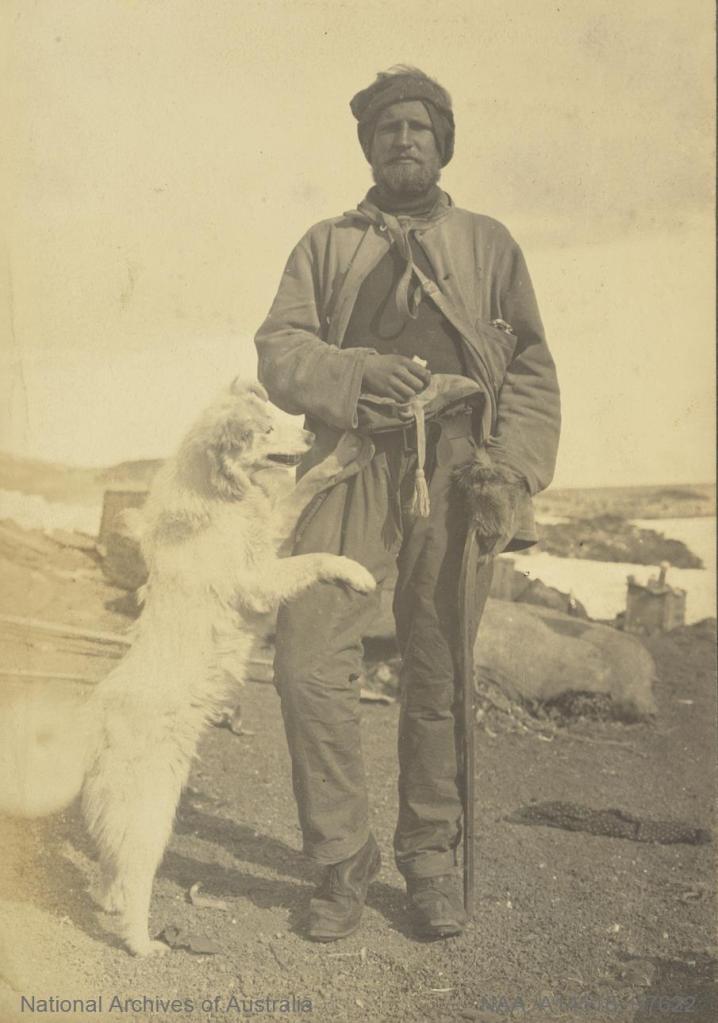
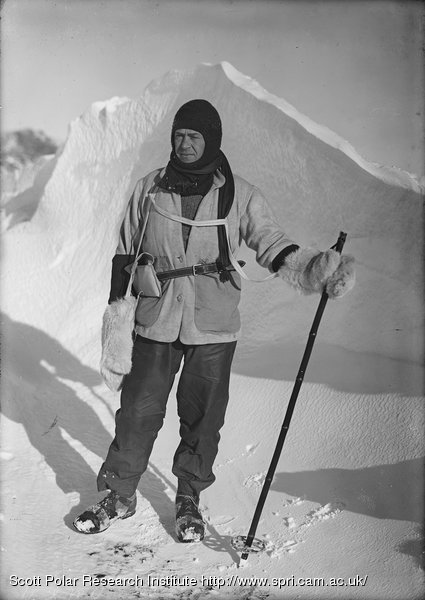
Raymond Priestly was a geologist who participated in both the Nimrod and Terra Nova expeditions to Antarctica under Shackleton and Scott. Here he is on the Nimrod expedition in 1908. He would go on to co-found the Scott Polar Research Institute. From NAA A14518 H7622.
Reconceptualizing the History of Science

Eric Moses Gurevitch shares an excellent article he wrote covering books by James Poskett and Pamela H. Smith. These works are part of an effort to broaden the history of science beyond the conventional narratives that have roots in nineteenth century chauvinisms. This re-conceptualization opens up new research possibilities in the history of science, and draws attention to the myriad ways humans have produced and shared knowledge about nature.

Miscellanea

Various highlights from my research, readings, and internet rabbit holes
Mr. Darwin’s Wild Ride

While Charles Darwin was in the Galapagos studying the rocks, plants, and animals, he used a wide variety of observational techniques. One of these apparently involved riding the tortoises:

I was always amused, when overtaking one of these great monsters as it was quietly pacing along, to see how suddenly, the instant I passed, it would draw in its head and legs, and uttering a deep hiss fall to the ground with a heavy sound, as if struck dead. I frequently got on their backs, and then, upon giving a few raps on the hinder part of the shell, they would rise up and walk away; but I found it very difficult to keep my balance.

Charles Darwin, Voyage of the Beagle
Sunken Treasure at the Bottom of McMurdo Sound

There is apparently a small treasure waiting to be recovered from the sea floor near Antarctica. As he was trying to photograph orcas from the deck of the Terra Nova, Herbert Ponting lost his favorite camera lens:

I leant over the poop rail…waiting for the whales to draw nearer, when, as I was about to release the shutter, the view disappeared from the finder, and light flooded the camera; at the same moment I heard something splash in the water. On examining the camera, what was my consternation to find that the lens-board had dropped into the sea, carrying with the the finest lens of my collection–a nine-inch Zeiss double protar, worth about £25, which had been presented to me some years ago by the Bausch and Lomb Optical Company of Rochester, U.S.A.

Herbert Ponting, The great white South; being an account of experiences with Captain Scott’s South pole expedition and of the nature life of the Antarctic

He sent a letter to Bausch and Lomb, and they sent him a new lens. But the old lens must still be there, two hundred fathoms (as Ponting claimed) under the surface of McMurdo Sound. I tried to find the lens he used, and came across a catalog from 1904 with a listing of Bausch and Lomb lenses. From Ponting’s description of the lens and his uses for it–both whales and scenic views–I think the lens below is probably the closest. I would love it if anyone with more expertise in historical photographic equipment would be able to provide some more insight.

This probably isn’t the same exact lens Ponting dropped into McMurdo Sound, but it may be similar. Catalog found in the reference library of Pacific Rim Camera.
First Lunar Rover found through “Space Archaeology”

Lunokhod was a Soviet spacecraft that became the first rover on another planetary body in 1970. The rover’s solar cells deployed using a unique clamshell design, and used cameras on each side of the vehicle for navigation.
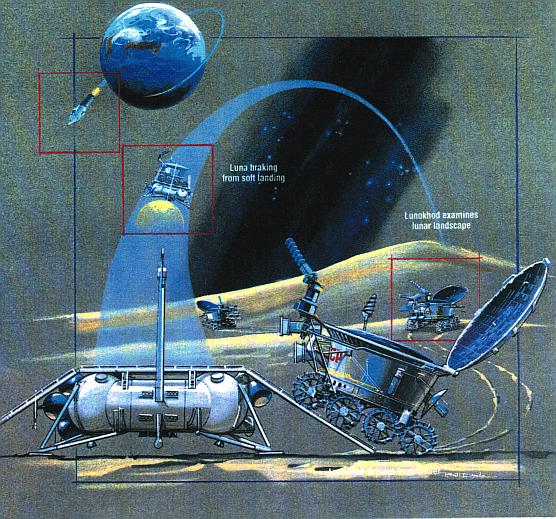
Lunokhod mission outline. From Wikimedia.
Model of the rover in the Museum of Cosmonautics. From Wikimedia.

In 2010, Lunokhod 1 was found, and was even capable of being used again for scientific experiments. The rover was equipped with retroreflectors like the one left by Apollo astronauts. This is actually how its final resting site was accidentally identified, when astrophysicist Tom Murphy was using a pulsed laser to study the lunar surface. The Lunar Reconnaissance Orbiter was able to use those coordinates to take new images of the Lunokhod landing site and lander forty years after its original mission.
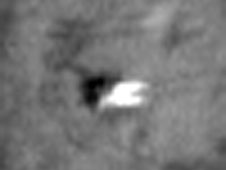
Luna 17 lander, from NASA/GSFC/Arizona State University.
Discourse on Things that Float

Galileo apparently got into a debate with a contemporary over dinner about why things float in water. This turned into an entire treatise on how things float, in which Galileo drew from preceding work by Archimedes. He also talks about some of his astronomical work. Here are a few quotes, with an example of the type of principles he discusses in the treatise:

This sufficeth me, for my present occasion, to have, by the above declared Examples, discovered and demonstrated, without extending such matters farther, and, as I might have done, into a long Treatise: yea, but that there was a necessity of resolving the above proposed doubt, I should have contented my self with that only, which is demonstrated by Archimedes, in his first Book De Insidentibus humido: where in generall termes he infers and confirms the same Of Natation (a) Lib. 1, Prop. 4. (b) Id. Lib. 1. Prop. 3. (c) Id. Lib. 1. Prop. 3. Conclusions, namely, that Solids (a) less grave than water, swim or float upon it, the (b) more grave go to the Bottom, and the (c) equally grave rest indifferently in all places, yea, though they should be wholly under water.

But, because that this Doctrine of Archimedes, perused, transcribed and examined by Signor Francesco Buonamico, in his fifth Book of Motion, Chap. 29, and afterwards by him confuted, might by the Authority of so renowned, and famous a Philosopher, be rendered dubious, and suspected of falsity; I have judged it necessary to defend it, if I am able so to do, and to clear Archimedes, from those censures, with which he appeareth to be charged….

The diversity of Figures given to this or that Solid, cannot any way be a Cause of its absolute Sinking or Swimming.

So that if a Solid being formed, for example, into a Sphericall Figure, doth sink or swim in the water, I say, that being formed into any other Figure, the same figure in the same water, shall sink or swim: nor can such its Motion by the Expansion or by other mutation of Figure, be impeded or taken away.

Galileo Galilei, Discourse on Floating Bodies

For more History Highlights from past weeks, click here. Follow the Inverting Vision Twitter account for updates on posts and other history of exploration and science content. Subscribe to get update in your inbox:

Photography and Science in Antarctica – Orcas and Ice

This is part two of a series of posts about photography and science on the Terra Nova expedition of 1910-193. You can read the introduction here. This week we find Ponting arriving in Antarctica, and beginning to get acquainted with the environment.

The Terra Nova. Ponting was a fan of icicles, and tried to include them in his shots whenever possible. From the Scott Polar Research Institute (SPRI).

Scientific curiosity drew photographer Herbert Ponting to Antarctica. Before his journey with the British Antarctic Expedition in 1910, the great southern continent was already a place of growing scientific interest. Early encounters in the late 18th and early 19th centuries had revealed ice shelves, animals, and mountains that encouraged dedicated missions to chart and understand the continent. James Weddel, Jules Dumont d’Urville, Charles Wilkes, and James Clark Ross revealed the contours of Antarctica, and returned to Europe and the United States with tantalizing information for biologists and geologists. 

Herbert Ponting was particularly interested in the animals of the Antarctic. Several years before Ponting climbed aboard the Terra Nova, his crew mates Robert Falcon Scott and Edward Wilson had made a landing on Ross Island during the Discovery expedition. In his diaries, Wilson vividly described the smells and sounds that greeted them when they made landfall at Cape Crozier–they had found one of the largest colonies of Adelie penguins. Ponting fantasized about being able to make camp at Cape Crozier and photograph the penguins there, but Scott chose Cape Evans on the other side of the island for their base of operations. 

Once they arrived, the crew used their tracked motor sledges to unload shelter materials and supplies. Ponting still had plenty of opportunity to observe and photograph wildlife. There was a colony of Adelie penguins near their camp, and the birds were not shy about greeting the visitors. “They strolled about,” Ponting wrote, “for all the world like a party of tourists taking in the sights.”1 This delighted the photographer, and he took photographs of their interactions with the crew, who liked to play games with the penguins.

An Adelie penguin pecks Ponting. From SPRI.
Henry Rennick and Francis Drake meet the penguins. From SPRI.

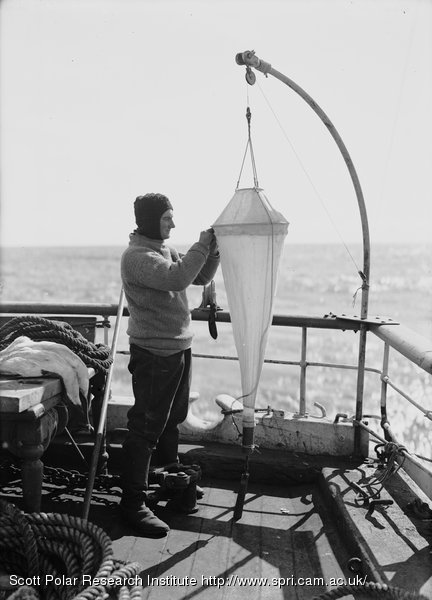
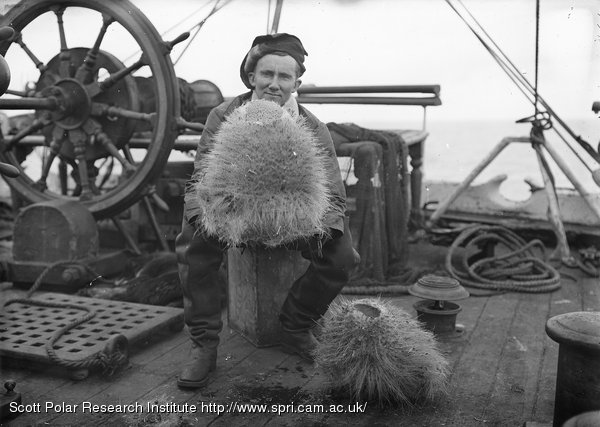
Later in the expedition, the scientific team would learn more about the life cycle and behaviors of the penguins. In the meantime, the crew at Cape Evans spent time studying other examples of marine life. The biologist Denis Lillie collected as many samples as possible with nets. These included an example of cephalodiscus, which are wormlike animals that live in colonies. They also caught “crustacea, star-fish, sea-urchins, great worms, anemones, molluscs,” and large glass sponges.

Denis Lille and his net. From SPRI.
Denis Lille and a glass sponge. From SPRI.

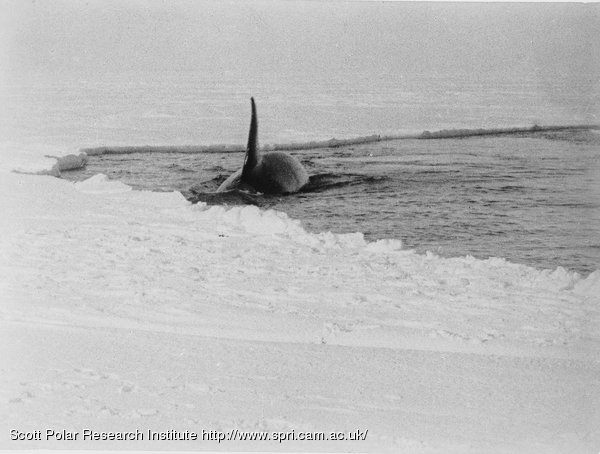
But Ponting was more interested in the animal that had accompanied their ship on the way to their temporary home: the orca. Ponting was keen to capture animal behaviors with his camera, in an effort to make his own contributions to the scientific work of the expedition. The orca and the blue whales were his first opportunity, but he found them exceedingly difficult to capture on film. It was difficult to predict when they would surface, so setting up a camera to capture things like their ‘spout’ was almost impossible. But he managed to capture some of their surfacing and hunting behavior with the cinematograph.

The top two images show orcas surfacing. The bottom pictures supposedly shows them hunting. From SPRI.

Ponting even tried to use his equipment to document and understand whale behavior, to the extent that he could. He used the frame rate of his camera (sixteen frames a second) to measure the duration of the orca’s spout. He tried to capture their grouping and hunting patterns, but was frustrated by the challenges of catching them at the right time. He never did get a film of the blue whales spouting. He also never got a film of whales breaching, despite sitting for nine hours at a spot where he saw one of the  “sportive monsters” perform the spectacular maneuver. 

The intelligence of the whales impressed both Ponting and the crew, and they were amazed by the hunting ability of the orcas. Ponting himself claimed to have been hunted while trying to get just the right shot of an orca, and included a fantastical illustration of the encounter. 

Ponting claimed that this was a very accurate portrayal of the attack. From his book.

The illustration demonstrates some of Ponting’s editorial inclinations. Ponting was an excellent photographer but he was an equally good salesman who was constantly searching for the spectacular and the picturesque. This made him well-suited to his role on the expedition. Photographs and books were a way to make some money from exploration, and they would be in high demand back home.2 Ponting’s photographs have to be viewed with this fact in mind–he was interested in science, but the picturesque held priority. 

Especially early on in the expedition, Ponting’s shots of crew members were often very carefully posed, and his shots of scientific subjects were as controlled as he could make them. His photographs of the whales are interesting in part because of the relative lack of control he had over his subjects.

Ponting found some degree of control in the ice, along with some of the most picturesque scenery he would encounter. The icebergs and ice floes of Antarctic waters captivated and frightened European explorers from the earliest days of Antarctic exploration. Edmond Halley (of comet fame) described encounters with Antarctic ice on his voyage to map magnetic variation in 1699. At first he first thought they were white mountains, and he compared them to white cliffs found in Great Britain. Later expeditions grappled with the ice, and some fell prey to it.

For mariners the ice represented unpredictability, but for the photographer they were relatively static (although still temporary) pieces of natural beauty. Ponting relished the long periods of daylight that he could use to capture the ice in different light conditions. He didn’t want to lose this opportunity, and slept very little for four days on end, working as long as “human endurance would permit.”

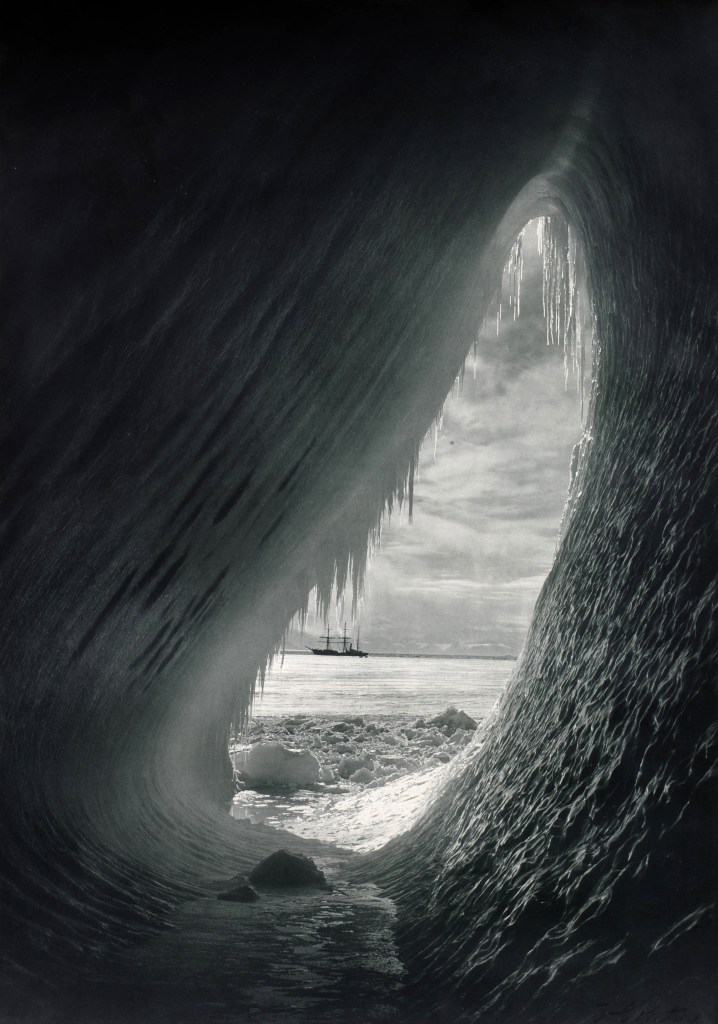
His most famous photograph captures the Terra Nova from within a grotto of ice. In his book, he described taking the picture:

A fringe of long icicles hung at the entrance of the grotto, and passing under these I was in the most wonderful place imaginable. From outside, the interior appeared quite white and colourless, but, once inside, it was a lovely symphony of blue and green. I made many photographs in this remarkable place–than which I secured none more beautiful the entire time I was in the South…I found that the colouring of the grotto changed with the position of the sun; this, sometimes green would predominate, then blue, and then again it was a delicate lilac. When the sun passed round to the west–opposite the entrance to the cavern–the beams that streamed in were reflected by myriads of crystals, which decomposed the rays into lovely prismatic hues, so that the walls appeared to be studded with gems.

Herbert Ponting, The Great White South: being an account of experiences with Captain Scott’s South pole expedition and of the nature life of the Antarctic
Grotto in an Iceberg, by Ponting. From Wikimedia.

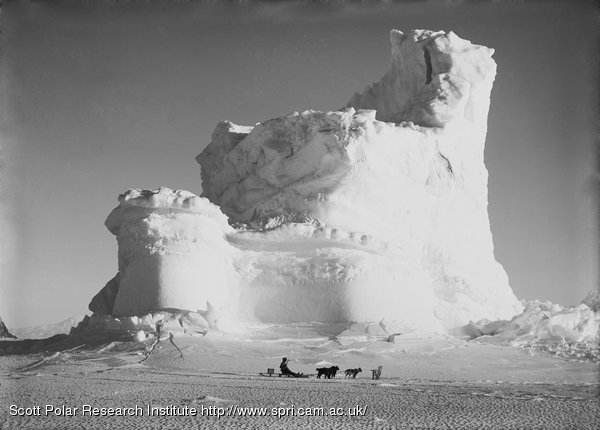
The elegant formations of icebergs had often been described by explorers in architectural terms, and Ponting’s photographs are some of the most successful at capturing this perspective.3 One of his most frequent subjects was the “Castle berg.”

Caslte Berg, with a dog team in the foreground. From SPRI.

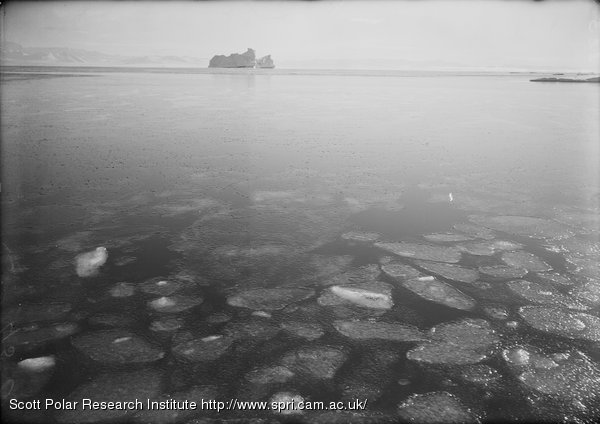
Ponting also documented the formation of “pancake ice,” describing how small crystals coalesced into larger discs of ice. These discs grew very quickly into large sheets of ice that became ice floes. He managed to take a series of photographs showing the formation of these ice features.

The various stages of pancake ice. From SPRI.

The ice, the whales, seals, and penguins took up most of Ponting’s attention in the early days of the expedition. Teams of scientists had been dispatched in various directions, while Ponting stayed behind with the rest of the crew. In the next post, we will catch up with these teams, who investigated emperor penguin colonies and Antarctic geology. 

Footnotes

  1. Quotes and information on Herbert Ponting comes primarily from his book The Great White South: being an account of experiences with Captain Scott’s South pole expedition and of the nature life of the Antarctic
  2. For more, see James R. Ryan, Photography and Exploration
  3. Kirsten Hastrup, “The Ice as Argument: Topographical Mementos in the High Arctic,” The Cambridge Journal of Anthropology, Vol 31, No 1 (2013), pp. 51-67

Photography and Science in Antarctica – Introduction – Herbert Ponting

This is a short introduction to a planned series of posts about photography and science on the British Antarctic Expedition. It includes another story about photographing orcas and ice

In 1910, the British Antarctic Expedition set out on the Terra Nova with the goal of being the first people to reach the geographic south pole. Captain Robert Falcon Scott organized and led the expedition–the second Antarctic voyage in his career. The Terra Nova expedition is now famous for being beaten to the pole by Roald Amundsen, and for the tragic deaths of Scott and the polar team on their return journey. But the story of the Terra Nova is also a story of scientific research. Captain Scott recruited a team of scientists and made their work a top priority, which may have been one factor in their second-place finish at the pole. Scott also personally recruited the man that would capture everything on film: Herbert Ponting.

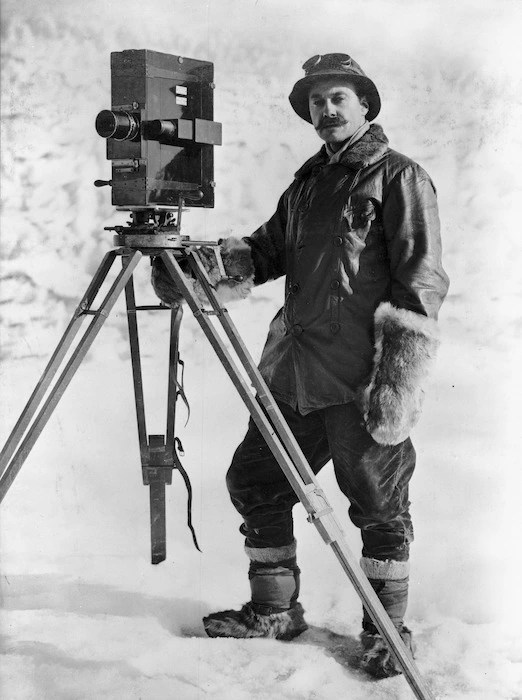
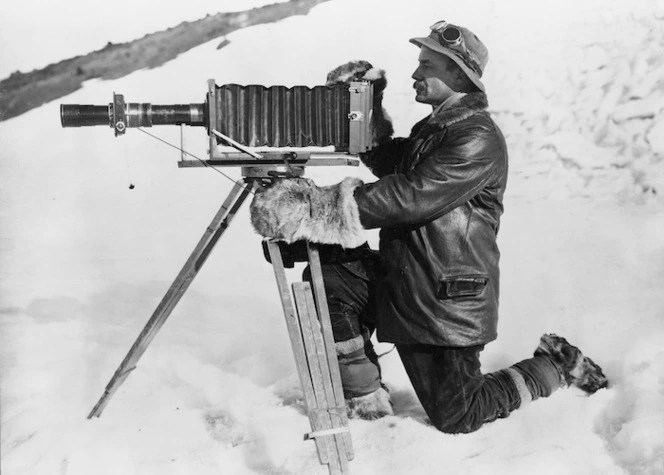
Herbert George Ponting and cinematograph, Antarctica. Kinsey, Joseph James (Sir), 1852-1936 :Photographs relating to Antarctica and mountaineering. Ref: PA1-f-067-067-2. Alexander Turnbull Library, Wellington, New Zealand. /records/23244038

Ponting was already a rather accomplished photographer when Scott approached him in 1909. He was on the verge of publishing a travel book about his experiences in Japan, but Scott convinced Ponting to go to the frigid wastes of Antarctica within a year of their first meeting. Scott’s emphasis on science was a major draw for the photographer. The expedition was, in Ponting’s words: “a chance, such as never would come to me again, to turn the experience I had gained to some permanent benefit to Science.” Over the course of the expedition, Ponting used his extensive experience to document animal life and monumental ice formations, and to immortalize on film the mountains and the men of Antarctica.

In his photographs, Ponting distilled the notion of the heroic male explorer. This archetype defined exploration the late nineteenth and early twentieth centuries. Travel narratives and photographs from these men were major commercial successes, and Ponting’s photographs even used the archetype to advertise beans. The idea of polar exploration as an act of masculine heroics has haunted Antarctic science into the 21st century. The Antarctic science community has struggled to move away from this old paradigm and create a safe and welcoming environment for scientists to do work that many dream of for their entire lives.

Captain Scott, from the Scott Polar Research Institute
An advertisement for Heinz, from the Scott Polar Research Institute.

Ponting very carefully arranged his photographs of the crew in ways that were specifically designed to conjure these “heroic” notions of the explorer and the scientist. But the images also give us insight into the scientific work done by the crew of the Terra Nova expedition. The scientific team was led by Dr. Edward Adrian Wilson, who the crew affectionately called ‘Uncle Bill.’ He was a capable zoologist, and both Ponting and Scott write about him with effusive admiration. Scott and Wilson also recruited a meteorologist, a physicist, and several geologists (one of whom was Raymond Priestly, a veteran of an early Shackleton expedition).

The scientists brought with them a wide variety of supplies and scientific instruments. These included a number of thermometers, telescopes, chemical glassware, and even balloons. Once in Antarctica, the expedition set up several laboratories, including a dark room. Ponting also took photographs on the Terra Nova, and had a photographic lab integrated into the ship. It was roomier than his assigned bunk, and the photographer ended up sleeping there under the light cast from the ruby-glass porthole.

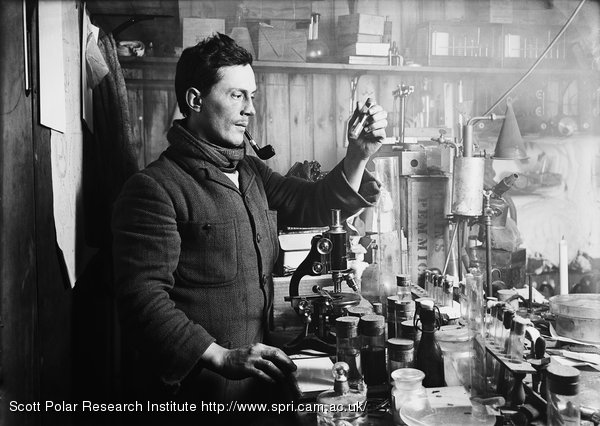
Dr. Atkinson in the lab. From the Scott Polar Research Institute.

Ponting brought with him “an incredible quantity of gear.” This included tin cases full of film and photographic plates, which were hermetically sealed in tins to prevent damage. There were also color filters and telephoto lenses. The crew brought several small cameras, and Ponting gave some lessons on how to use the equipment. Ponting himself primarily used a pair of cinematographs to take films, and folding cameras for stills.

Herbert George Ponting and telephoto apparatus, Antarctica. Kinsey, Joseph James (Sir), 1852-1936 :Photographs relating to Antarctica and mountaineering. Ref: PA1-f-067-067-3. Alexander Turnbull Library, Wellington, New Zealand. /records/22514241

Read the next post about photographing orcas and ice. Subscribe here: