
Welcome to Inverting Vision, a blog about the history of exploration, science, and technology. From this point forward, I will be publishing posts every Thursday unless fate intervenes. History Highlights will appear occasionally as I work on more substantial posts. Next week I’m hoping to write about the scientific instruments that appear in Herbert Ponting’s photographs of the British Antarctic Expedition. Until next week, here are some highlights from my readings and the wider exploration and science community.
Do we know more about space than the deep sea?
Probably not these days, according to marine scientists Alan Jamieson, Premu Arasu, and Thomas Linley. In a fantastic article in The Conversation, they write that the truth of this notion depends on what comparisons you make. They explain that if you just consider the Moon, it may have been true during a small window in the 1950s and 1960s. In fact this may have been when the impression that we know more about space than the oceans originated. In those decades scientists were mapping the Moon more extensively, especially as NASA prepared for the Apollo landings. The Surveyor and Lunar Orbiter missions played a key role in this process, taking photographs of the lunar surface that were used by scientists and Apollo mission planners.

But this same period was very early in the history of fruitful deep sea oceanography. Echo sounding tech had only been in use for a few decades, and scientists were just starting to use echo sounding to map the seafloor (the first truly comprehensive map wasn’t published until Marie Tharp’s map in 1977). The authors of the article argue that since then, more robust exploration of the deep sea has produced a wealth of knowledge that probably surpasses our knowledge of the Moon and especially Mars. Go read their article to learn more.
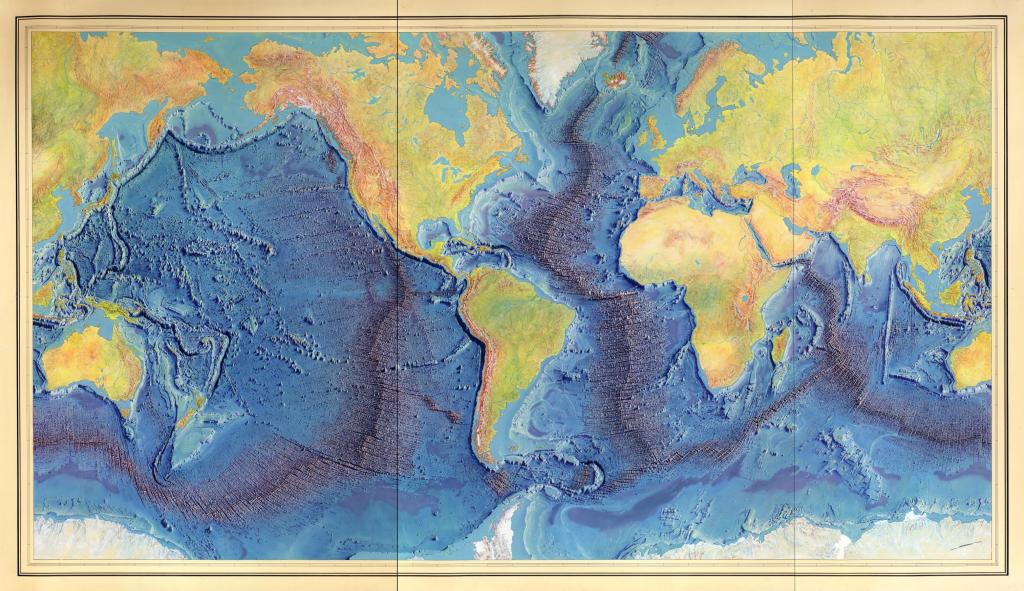
In my experience, people casually referring to this idea often extend it to saying that we know more about “space” than the ocean. This must be even farther off the mark, even when you just consider objects in our solar system and disregard exoplanets. Europa and Enceladus may contain entire oceans that we know very little about. I’m looking forward to the launch of the Europa Clipper mission in 2024, which will hopefully bring us more information about Europa (although it won’t arrive at Jupiter until 2030).
Alvin and the Recovery of a Broken Arrow
Woods Hole tweets about the role DSV Alvin played in the 1966 recovery of a hydrogen bomb (referred to as a “broken arrow”) from the bottom of the Mediterranean.
Missions for the military were relatively common in the early days of deep-submergence vehicles, and especially for Alvin. The scientists were sometimes able to tack on scientific objectives to these missions, or military missions became a way to test or fund the development of vehicles and scientific projects. The relationship between the military and deep sea exploration will probably be a topic for a future blog post.
The Curious Life of the Vema
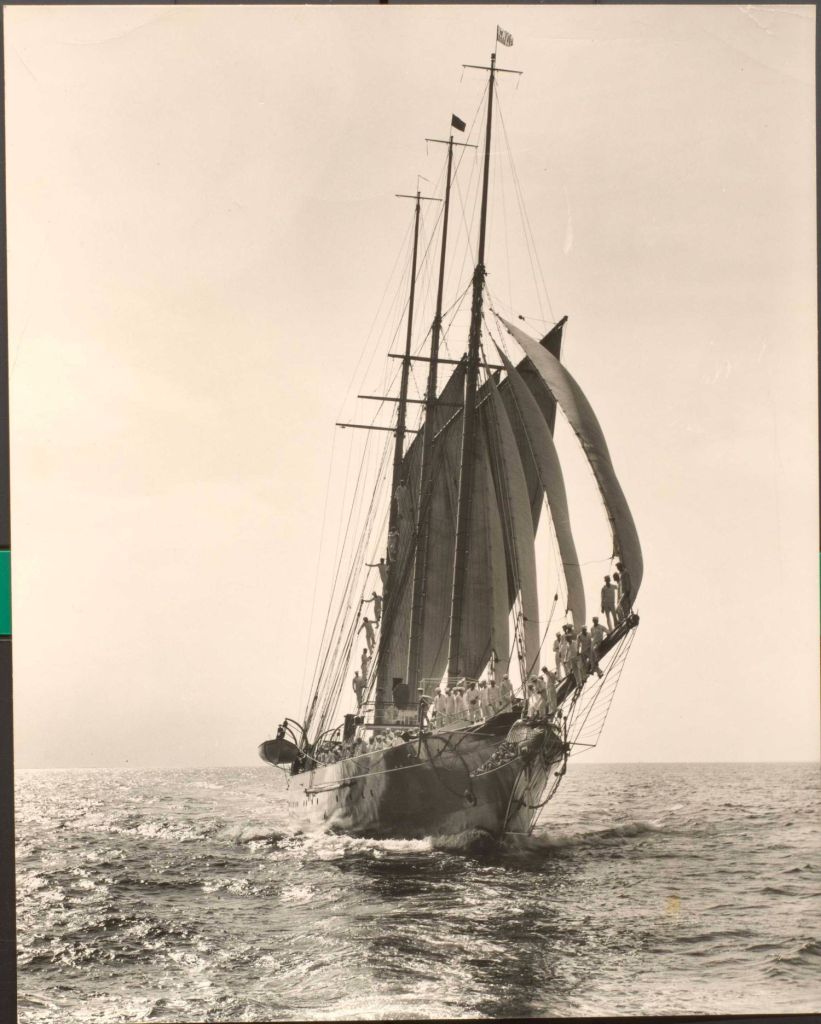
The Vema was an oceanographic research vessel that played a crucial role in the early mapping of the ocean floor and exploration of the Mid-Atlantic Ridge in the 1950s. Marie Tharp and her research partners used data from the Vema to create the seafloor map mentioned earlier. But that was only one small chapter in the life of the Vema. The sailing vessel was built in the 1920s for a wealthy American financier who used it as a yacht and hosted actors and celebrities. He sold the yacht to a Norwegian buyer who gave it the name Vema. Then the US military acquired the Vema in WWII and used for training. After the war the military discarded it, and eventually it was recovered and sold it to Columbia University, where it was used as a research vessel until the 1980s. Since then, it has been a chartered yacht for vacations in the Caribbean. Last year the yacht company announced they had new plans for the ship formerly known as Vema. They haven’t revealed what the new plans are.
Whales as Living Museums
Bathsheba Demuth writes about the role of whales in the history of Beringia in her book Floating Coast. She describes how bowhead whales were hunted by various groups throughout the history of the region. Sometimes the whales escaped these hunts with harpoons still buried in their bodies. Because bowhead whales can live for over 200 years, they sometimes collected a decent number of the tools used against them. Demuth describes a particular whale that carried “a museum of old weapons in his flesh.” These weapons ranged from ivory harpoons to explosive lance tips.
Ancient Voyage to the Arctic
It’s possible that in the 4th century BCE a Greek explorer named Pytheas ventured as far as the Arctic north of Europe, but later classical writers seriously doubted his claims. We know about him from later writers like Strabo and Polybius. In the Histories, Polybius recounts with skepticism Pytheas’ claim that in the far north “there [was] neither unmixed land or sea or air, but a kind of compound of all three (like the jelly-fish or Pulmo Marinus [sea lung]), in which earth and sea and everything else are held in suspense, and which forms a kind of connecting link to the whole, through which one can neither walk nor sail.”(Plb. 34.5) Voyages this far were rare for the Greeks, and Polybius was in part doubtful about how far Pytheas claimed to have sailed.
For more History Highlights from past weeks, click here. Follow the Inverting Vision Twitter account for updates on posts and other history of exploration and science content. Subscribe to get update in your inbox:
I strive to make my writing as accurate as possible. If you have a correction or a suggestion for a post, please leave a comment or email me at invertingvision@gmail.com. If you liked this post, please share it!





 Inverting Vision


