
In Exploration Review, I collect news from the last couple weeks about the exploration of remote places.
In this edition: return to the Moon, asteroid science, and tiny underwater robots.
Special Note for the few of you who currently subscribe both to my Substack and my history blog at invertingvision.com: This year, I’m going to be experimenting with a content publishing model called POSSE (Publish on Site, Syndicate Everywhere). That means you probably got two copies of this post in your inbox. Feel free to keep your subscription on your preferred platform, and unsubscribe elsewhere. You will still get all of my content.
Return to the Moon
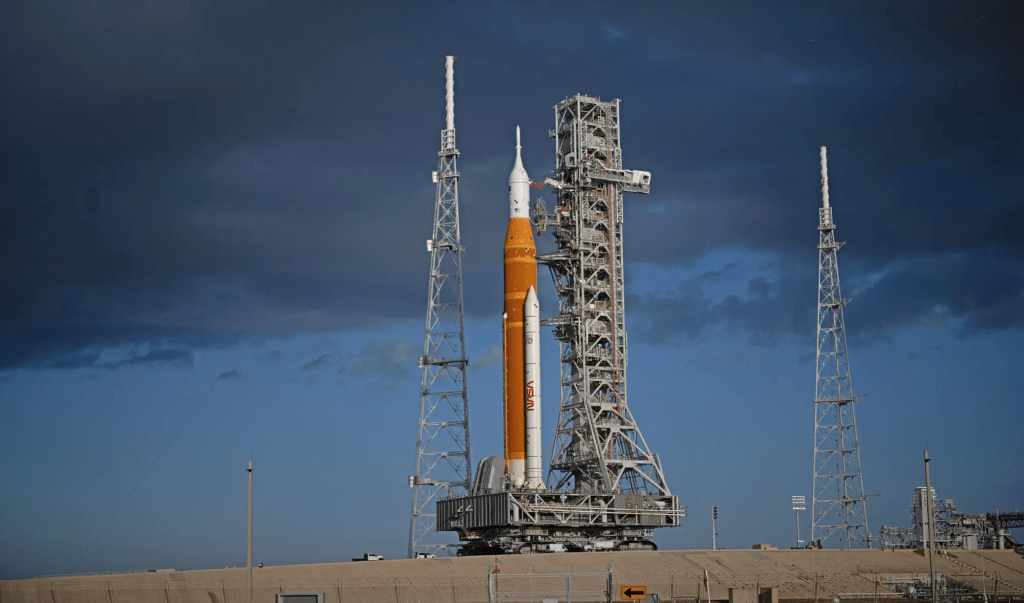
Artemis II’s rocket is back on the launchpad after undergoing repairs, and they’re hoping for an April 1 launch. People may be returning to orbit the Moon very soon. The last attempts were delayed for technical issues, and its always possible that more issues or weather will delay the next attempt. But there are several opportunities in April, so it seems likely that we will see a launch in the next month.
https://www.nbcnews.com/science/space/nasa-roll-out-artemis-ii-moon-rocket-launch-pad-rcna264106
Artemis II will be an orbital mission, similar to Apollo 8, which sent astronauts to orbit the Moon for the first time. Apollo 8 launched at the end of 1968, which was a year of major domestic and international turmoil–the assassinations of MLK and RFK, escalation in the Vietnam war, and major protests across the world. The parallels are difficult to miss. I have seen people discussing the difficulties of getting excited for such an event in the current news environment, and writing about what a successful Artemis II launch would mean for NASA and for the US.
Jared Isaacman, the new NASA administrator, has been making a lot of statements about the future of Artemis and NASA. One of the most significant changes on the horizon is the reorganization of future Artemis missions, which Jeff Foust explains fully here:
https://www.thespacereview.com/article/5171/1
Artemis III would be changed to an earth-orbit rendezvous mission slated for 2027, which also mirrors the Apollo progression. It’s hard to say how likely Artemis changes are to salvage NASA’s chances at a crewed Moon landing in the near future. They don’t have a functional lander yet, which is part of the reason for the reorganization. But historically, nearly every new administration changes the plan to return to the Moon or get to Mars, and it almost always just creates more delays. The ironic thing in this instance is that the current plan came together under Trump I, kept uncharacteristic consistency into the Biden administration, and now the reorganization is happening under Trump II. Since it is not a complete rehaul of the program, however, perhaps it will turn out differently.
Isaacman has also talked about major changes to NASA’s workforce, moving contracted work back in-house. He hopes to accelerate NASA activity in some domains, including robotic Moon missions–Isaacman told Science that he wants to do a robotic “landing on the Moon every month for the next, who know, 3 years.”
Staffing cuts at NASA and funding cuts to scientific projects have led to major uncertainty in the planetary science community. Isaacman thinks that maybe signalling demand will stimulate private launch and robotics partners to step up, enabling more missions. Companies currently contracted for CLPS might be interested in responding.
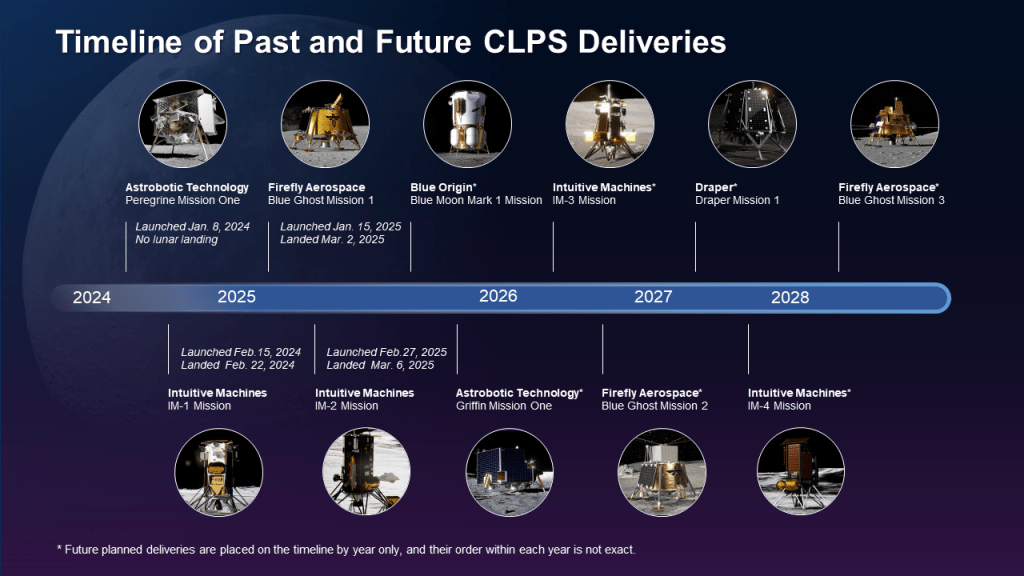
But they are all still very early in development, and Isaacman himself simply mentions “science and tech demonstration capabilities” as the possible payloads. None of this would be super encouraging to scientists looking for research opportunities. His nods toward improving the cost and timeline of non-lunar science missions were fairly vague. The people who I could see being encouraged by these remarks: investors interested in industrial uses of lunar robotics, who want the companies developing technology platforms to continue seeing growth.
Asteroid Science
Studies are continuing to come out from recent asteroid missions, including the DART mission that bumped into Dimorphos in 2022. Since then, scientists have been tracking the orbital shifts of Dimorphos and its companion Didymos, and have found a change in their orbit around the sun:
https://arstechnica.com/science/2026/03/nasas-dart-mission-shifted-the-orbits-of-two-asteroids/
A March 16 study on new analysis of asteroid Ryugu has made a splash in the news. The Japanese Hayabusa 2 spacecraft took sample from Ryugu that were returned in 2020. Scientists found organic molecules, which led to headlines indicating Ryugu, along with other asteroids, had “all the ingredients for life.”
Elise Cutts has a great explanation of exactly how significant this finding is. Basically, we’ve been finding these sorts of molecules in space for a long time, but continuing to confirm their presence in studies like this one is certainly important. But knowing the molecules are out there is just one part of the full story:
https://www.reviewertoo.com/the-asteroid-ryugu-contains-every-letter-of-the-genetic-alphabet/
Setbacks and Success in the Cryosphere
The Ukraine war is making Arctic science more difficult. Scientists studying algal blooms in the Pacific Arctic have been unable to collaborate with Russian scientists since the war. Geopolitics has a nasty habit of getting in the way of science sometimes. Growing scientific internationalism in the late 19th century was
Donald M Anderson writes: “One of the things that makes it hard to study the distribution of these blooms and cysts is the treaty line that separates U.S. and Russian waters. Although algae doesn’t recognize national borders and the Alexandrium population clearly extends beyond our current measurements, we cannot sample west of this boundary.”
https://www.whoi.edu/oceanus/feature/a-scientific-casualty-of-the-russia-ukraine-war/
Down south, however, the Australian Antarctic Program just completed major operations in the Heard and McDonald islands, “the first campaign of its kind in 20 years.”
Miscellanea
March 16 was the hundred-year anniversary of Robert Goddard’s first liquid-fueled rocket.
The A23a iceberg, which was the largest on Earth for a while, is melting.
Knowable Magazine has an overview of recent developments in deep-sea mining.
We’re seeing more cool tiny undersea-exploring robots.
https://www.raspberrypi.com/news/exploring-the-ocean-with-raspberry-pi-powered-marine-robots/
New Mars rover selfie:
 Inverting Vision