Spectacle on Other Worlds

The first spacecraft from Earth to touch another world carried no people, but it did carry a unique sort of flag. Early on the morning of September 14, 1959, the Soviet space probe Luna 2 impacted the surface of the Moon. Engineers had placed stainless steel spheres aboard the spacecraft, designed to send tiny pentagonal banners across the lunar landscape. The little flags were emblazoned with the hammer and sickle, and Russian script reading: “CCCP, September, 1959.”1
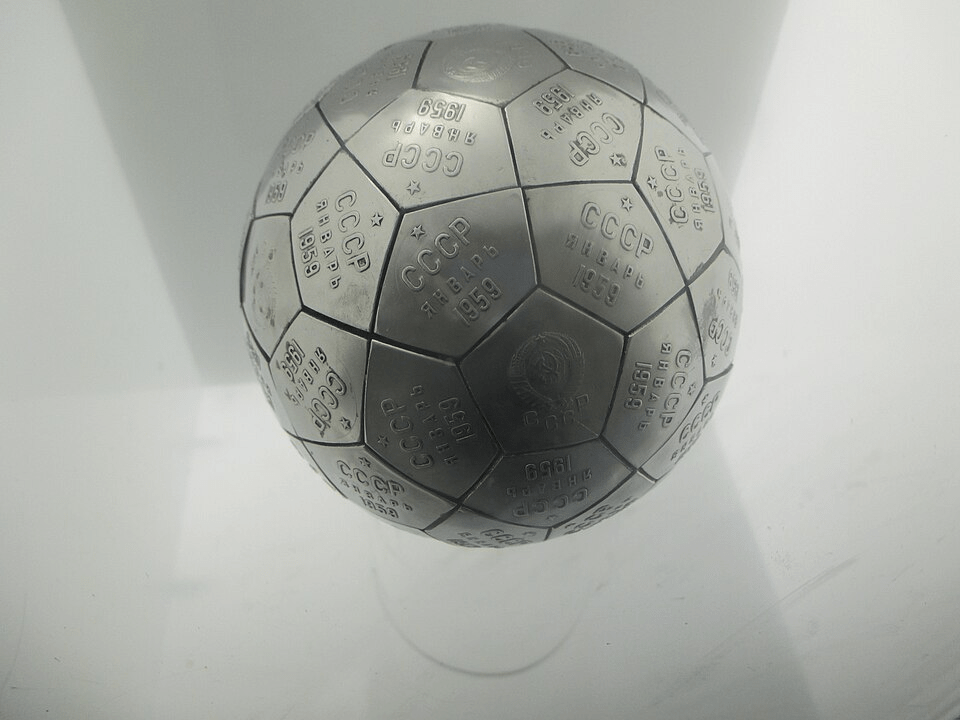
A replica of the Luna 2 pennant on display in the Kansas Cosmosphere. Source: Patrick Pelletier via Wikimedia.

The spheres were made at OKB-1, the Experimental Design Bureau where engineers worked under the leadership of Sergei Korolev to create some of the first space rockets. 2 They were commonly referred to as pennants,3 and you can find more pictures of these pennants on Don P. Mitchell’s excellent website.4 Mitchell speculates that the Luna 2 pennants probably vaporized on impact. On the other hand, the New York Times reported at the time that “[the Soviet Government] said steps had been taken to prevent the destruction of the pennants by the impact.” Regardless of their survival, the pennants accomplished an important objective.

“The day after the historic impact,” historian Asif Siddiqi writes, “[Nikita] Khrushchev triumphantly gave a replica of the ball of pendants to Eisenhower. It was a potent display of the power of politics in the emerging Soviet space programme.”5 This was the point: a spectacle designed to send a message to the United States about the Soviet lead in missile development. There was some (faint) hope on the Soviet side that this spectacle would actually end the Cold War altogether.6

Luna 2’s pennants were just one in a series of such spectacles that constituted the Space Race. From Sputnik to Apollo, visible demonstrations of power replaced nuclear war. In the competition for geopolitical influence that was the Cold War, these projects signaled the strength of competing economic ideologies to worldwide spectators.7 In the 1950s and 1960s, this political impetus for spectacle led humans to explore the solar system up close for the first time. We sent robots to other worlds, and people to the Moon, because of a geopolitical competition. But is that the only reason we went?

I have been fascinated by the reasons people participated in the Space Race–especially the engineers and scientists who worked directly on missions to other celestial bodies. Certainly many of them were Cold Warriors, eager and willing to be recruited to a geopolitical signalling war. But not all of them were, and even those who happily went to nationalistic battle often had priorities that ranked higher in their own minds. In fact, these other motivations may have played a strong role in making the Space Race happen in the first place.

Luna 2 itself may be an example. Siddiqi explains that “contrary to conventional wisdom, it was not the Soviet Party leadership which advocated or called for Soviet pre-eminence in space at this early stage, but Korolev himself who was actualising his intense thirst to claim ‘firsts’ in the new arena of space exploration.” He goes on to say that Korolev was in partly motivated by competition with Wernher von Braun. “One wonders if there would indeed have been a programme at the time if it had not been for Korolev,” Siddiqi writes. The engineers had to convince the Cold Warriors that lunar flights were worth doing.8

Engineering ambitions and personal rivalry were not the only motivations for early space explorers. One of the most interesting examples I have seen comes from Oran Nicks, who was NASA’s director of Lunar and Planetary Programs in the early 1960s. Nicks was an engineer in a department of scientists, and that put him in a unique position. He was also not a Cold Warrior, at least not to the extent of many of his colleagues.

This isn’t to say the political pressures of the Space Race weren’t on his mind. In the early 60s, Nicks was working on the Ranger impact probes to the Moon, which were plagued by a series of early failures. In his book Far Travelers, Nicks recalls that Luna’s successes had made these failures particularly difficult. “Khrushchev had chided us publicly,” Nicks writes, “by quipping that their pennant had gotten lonesome waiting for an American companion.”

But when it came to making an overtly nationalistic response, Nicks took a different attitude. He recounts a disagreement that came up during work on a Mariner probe to Mars. Mariner project manager Jack James had suggested that the spacecraft should have the seal of the United States embossed on a panel, and went to the trouble of mocking it up.9 Nicks was vehemently opposed. Here’s what he wrote (emphasis mine):

His view was understandable; we were competing with the Russians in the race to the planets, and Americans could be proud that our “trademark” would be exhibited for current and future generations to see. My concern was that we might be accused of exhibitionism, something distasteful to me, for I was deadly serious about doing the mission for other reasons. The Russians had bragged about landing a pendant on the Moon, and I wanted no part in that disgusting game.

Oran Nicks, Far Travelers, p 37

Nicks and James compromised, and the seal made it onto the spacecraft. Nicks explains that he “insisted on a low-profile, no-publicity approach,” and was happy that “even after the successful flight there was very little publicity about the seal, and none at all negative.”10
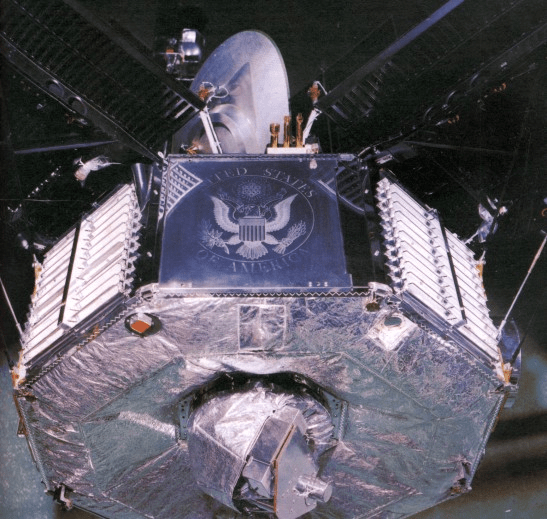
Nicks doesn’t specify which Mariner, but it was likely Mariner IV (1964), shown here. Images comes from Wikimedia, but the original source link is broken. A black-and-white version of this image can be found in NASA Technical Report 32-957 on the temperature control subsystem.

So what were the “other reasons” that Nicks was deadly serious about? To Nicks, the American space program was a project of exploration, pure and simple. He had an expansive definition of the word “explorer” that was rooted in his view of history:

Exploration seems to be in our genes. As they developed the means to do it, men explored the perimeter of the Mediterranean, past the pillars of Hercules, to the sentinel islands off the continent…We tend now to think of exploration in a restricted sense-as a scientific, often geographic, expedition, an athletic activity pursued by specialists dressed in fur parkas like Shackleton’s or in solar topees like Livingston’s. The connotations are overly restrictive if they fail to allow for great tidal movements like the waves of people from Asia that periodically flowed west and south, or for the Scandanavians who crossed the Atlantic in numbers centuries before Columbus. These waves of venturesome people were of a higher order than the random movement of nomads seeking fresh forage…We must conclude that for some of the species, long and perilous passages were no real deterrent to the exploring imperative.

Oran Nicks, Far Travelers, pp 6-7

Nicks is conflating a series of explorations that all occurred for different reasons ranging from survival, to geopolitics, to science. To him, they are part of an innate impulse that all humans have in common. He is situating himself, the United States, and the Soviet Union in a grand tradition that encompasses all of human history.

He was not the only person to do this sort of thing. The space explorers of the 1960s often invoked historical analogy–in the US, this was often the narrative of the American frontier. But these analogies were often related to more specific impulses: colonization, adventure, competition, scientific investigation. Nicks’ framing of exploration as an “instinct” is somewhat distinct. He believes that exploration is something done for its own sake, out of sheer curiosity. The scientific investigations on the missions he managed were an expression of this curiosity, rather than a means to some other end.11

Chertok, in his reflections on the Soviet space program, also remembers people thinking beyond the geopolitics:

Cosmonautics did not arise simply from militarization, and its aims were more than purely propagandistic. During the first post-Sputnik year, the foundations were laid for truly scientific research in space, serving the interests of all humankind…I am not writing about this out of nostalgia for the ‘good old days,’ but because I remember well how people from the most diverse social strata felt about our space successes.

Chertok, Rockets and People, Volume II, pp 435-436

The space programs in both nations were collaborations between people with widely varying motivations. They convinced their governments that pursuing certain objectives in space also served the ends of the state. They competed with each other for funding and for influence over the long-term direction of their programs. In this context, geopolitical competition seems like less of a direct motivation for space exploration, and more of an enabling factor that unlocked resources for would-be explorers.


  1. Siddiqi, Asif A. “First to the Moon,” Journal of the British Interplanetary Society, Vol 51, pp 231-238, 1998, PDF: https://static1.squarespace.com/static/5ef8124031cfcf448b11db32/t/5f1c476085d7250b810190c1/1595688803275/Siddiqi+First+to+the+Moon+1998.pdf ↩︎
  2. Chertok, Boris, ed. Asif Siddiqi, Rockets and People, Volume II: Creating a Rocket Industry, NASA, 2006, pp 446-448 PDF: https://www.nasa.gov/wp-content/uploads/2015/04/635963main_rocketspeoplevolume2-ebook.pdf?emrc=5bed7c ↩︎
  3. Are they called “pennants” or “pendants”? Contemporary newspapers, Mitchell and most other sources say pennants. Siddiqi and Chertok say pendant. Seems to come from a comparison made to ship’s pennant displays (Chertok, in unsourced quote from 447). Wikipedia says pendant is an obsolete spelling of pennant, citing the Dictionary of Vexillology. ↩︎
  4. I’m probably going to link to Mitchell and Sven Grahn a lot on this blog. They have both done amazing work on early Soviet robotics, among other topics, and their work has led me to important sources. You should check out their websites and their books. ↩︎
  5. Siddiqi, p 235-236 The image at the top of this post shows an additional replica, now sitting in the Kansas Cosmosphere. The original replica is held by the Eisenhower Presidential Library and Museum. ↩︎
  6. Chertok, p 447 Certainly it seems like Chertok may have believed this, or believed that Soviet leaders held that hope. “Alas,” he writes, “this did not happen. It was not in our power.” ↩︎
  7. See MacDonald, Alexander, The Long Space Age: The Economic Origins of Space Exploration from Colonial America to the Cold War, 2017, Yale University Press. Especially Chapter 4. https://www.jstor.org/stable/j.ctt1n2tvkx.8 ↩︎
  8. Siddiqi, pp 231-232 ↩︎
  9. Nicks, Oran, Far Travelers: The Exploring Machines, NASA, 1985, https://ntrs.nasa.gov/citations/19850024813 ↩︎
  10. Nicks, p 37 ↩︎
  11. Werner Von Braun, for example, was certainly motivated by colonization and also religious notions. Historian Catherine Newell writes about religious aspects of the American space program in her book Destined for the Stars. Historian Michael Robinson has talked about “true believers” among other types of space explorers. Russian cosmism was a big influence on early Soviet engineers. I plan to do a taxonomy of space explorers at some point, going through various motivations and the historical analogies used to justify and explain them. I see Nicks’ expansive definition of exploration as human instinct most reflected in Carl Sagan’s writings. ↩︎
Updates

It’s been a while since my last post, so I wanted to get back to the blog with an update on what I’ve been working on, and what’s next in 2025.

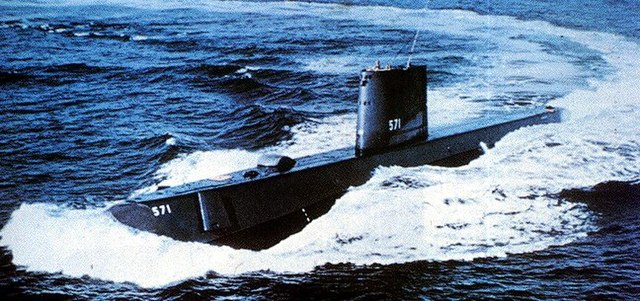
The USS Nautilus resurfacing. From U.S. Navy/Wikimedia.

This summer I was lucky enough to start working with JSTOR Daily as a regular contributor. JSTOR is a large digital repository of academic journals, and a valuable research tool. I was fortunate to have high school teachers who taught us how to use JSTOR and similar resources, and I used them extensively in college.

It was always exciting for me. These journals contain an ongoing conversation between the brightest minds in nearly every academic field. In some cases, those conversations stretch back centuries. On JSTOR, historical documents live side-by-side with cutting edge research.

Generally you get access to JSTOR through affiliation with an educational institution–college students usually get access with their university email. But there are also subscription options for independent scholars and individuals.

JSTOR Daily is an effort to both show off and share the treasures contained in their repositories. Every day, they post very short summaries of fascinating articles. They strive to make these relevant to current events, or to provide essential context to help understand the significance of the research. Each summary contains a link that provides free access to that article.

I’ve been covering a history of science and technology “beat” for JSTOR Daily. So far, it has been an incredibly fulfilling and instructive experience. Summarizing and contextualizing detailed academic articles in 500 words or less is an intriguing writing puzzle. Every time I sit down to write one, I remember a particular conversation with my dad about writing. He shared a famous remark that stuck with me: “I would have written a shorter letter, but I did not have the time.” (From Mark Twain? Now that I’m googling –  Blaise Pascal? Seems like a lot of writers have shared the same feeling.)

It’s helping me accomplish one of my main goals: to highlight and share the incredible work being doing by historians all the time.

You can find my author page here. I’m going to try to start posting on my Bluesky when a new post goes up, but I will also include links in future History Highlights. Here are a few of my favorites so far:

Additional update 2/13/2025:

Since this post, I have been primarily focused on my teaching, JSTOR writing, and other articles, including a new one in Aeon Magazine. However, I have also been doing research for some planned 2025 blog posts. If you’re interested in learning more about early lunar robotics (and musings on the history of scientific exploration and technology), let me know by subscribing to Inverting Vision below:

The First Time NASA Photographed a Lunar Lander

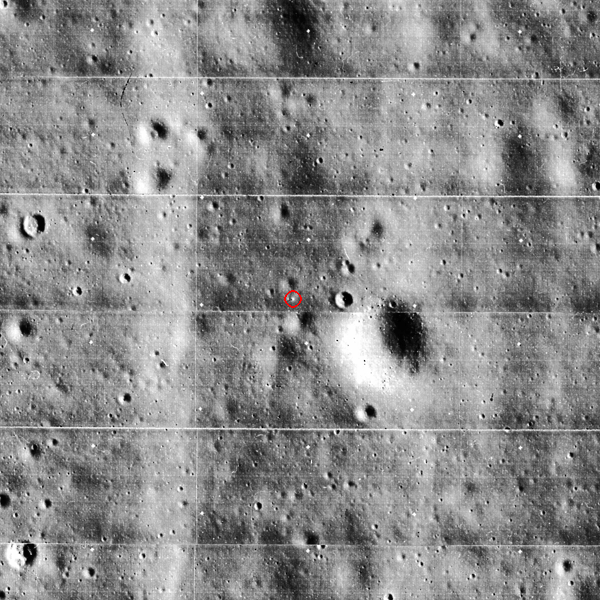
The Odysseus lunar lander built by Intuitive Machines (IM) recently became the first U.S. robot on the Moon’s surface since the Surveyor landers in the 1960s. Earlier this week, IM worked with NASA to get pictures of the lander from orbit. The resulting image is impressive, showing the lander as a tiny speck in the vast grey landscape near the Moon’s south pole. The image is also an echo of the first time NASA managed this feat, 57 years ago. In 1967, NASA’s third Lunar Orbiter spacecraft snagged a photograph of Surveyor I. The story of how engineers acquired that photograph (and it is a literal analog photograph) is fascinating, and the image itself played an important role in getting Apollo astronauts to the Moon. First, here’s the image of Odysseus along with the historic photograph of Surveyor:

Odysseus in the South Polar region of the Moon. Taken with the Lunar Reconnaissance Orbiter. Credit: NASA/Goddard/Arizona State University
Surveyor I in Oceanus Procellarum on the Moon. Taken with Lunar Orbiter III in 1967. Credit: NASA

It’s a bit easier to see Odysseus in the new image than it is to see Surveyor in the Lunar Orbiter (LO) photograph. But both of them are pretty difficult to spot, beyond the telltale shadow. And making out any detail is impossible. So what’s the point? For NASA in the 1960s, it was all about safety.

At the time, the push toward the Apollo landings was quickly accelerating. One of the top priorities was to find suitable landing sites. Telescopic imagery of the Moon was fairly comprehensive, but had some serious limitations, so NASA initiated the Lunar Orbiter program. Engineers put robots into orbit around the Moon, equipped with Kodak cameras and film, and took high-resolution images of potential Apollo landing sites.1 Meanwhile, they Surveyor robots soft-landed on the surface, took pictures, and used scoops to dig into the soil. Knowledge about the nature of the lunar surface grew rapidly. It began to quell doubts that some scientists held about the potential of landing people on the Moon.2 The imaging of Surveyor landing sites was an important part of this process.

For scientists in the 1960s, seeing the lander wasn’t as important as seeing the area around the it. Images from the ground could help scientists understand what they were seeing from above. At the time, orbital imagery was pretty difficult to interpret. Shadows were used to figure out the height or depth of some features, but other patterns in the orbital imagery were harder to make sense of. Scientists used aerial imagery of Earth to get started, since you could easily compare pictures of mountains and canyons taken from airplanes to the real thing.3 But the forces that shaped features on Earth weren’t necessarily the same as those that shaped features on the Moon, so the Earth-analog method was not always a reliable guide. What they really wanted were images from the lunar surface. That’s what Surveyor landers were able to provide.

If scientists could compare orbital images with ground-based images of the real lunar surface, they could be more confident in their interpretations. This could make it easier to select Apollo landing sites with confidence. And that’s exactly what they did using a combination Surveyor and Lunar Orbiter imaging. The story of Surveyor III gives us a great example of this.

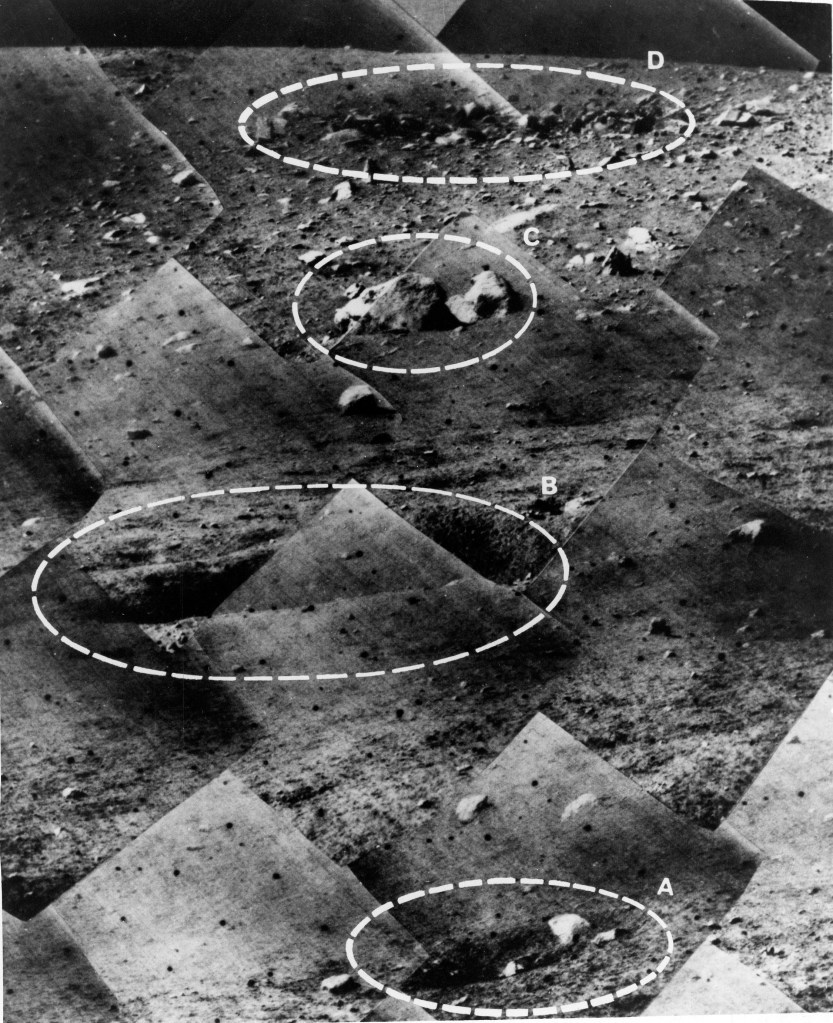
In the same mission that took the photograph of Surveyor I, engineers also took photos of the planned landing area for Surveyor III (which launched while LOIII was still in orbit around the Moon). They hoped that a successful Surveyor III mission would then provide images from the ground that scientists could compare to orbital imagery. The plan was a complete success. Using pictures from Surveyor III, they were able to isolate the exact position of Surveyor III in the orbital imagery.4

An image from Boeing’s contractor report on Lunar Orbiter III photography. The final Surveyor landing site is shown, along with features that later seen in Surveyor pictures, included below. Credit: NASA/Boeing

Scientists got a lot of great data from the robots. Apollo planners analyzed the images and data, and used the information to plan Apollo landing sites. They were able to find places that were both safe for landing, and scientifically interesting. For scientists, that generally meant trying to land Apollo astronauts in places that were geologically distinct.

This wasn’t really something that many of the astronauts were particularly interested in, at least at first. They were something of soldiers in the Cold War, and neither they nor the government officials directing the program thought that science was the main priority. The priority was getting a man to the Moon before the Soviet Union.5 The selection of later Apollo sites based on scientific interest was, at least in part, a concession to the scientists who were integral to the safety and success of the mission’s primary objective. But this isn’t to say that these groups saw no use for science within Apollo. Science itself could also serve Cold War goals, as it became a source of prestige–a pattern in scientific exploration going back centuries.

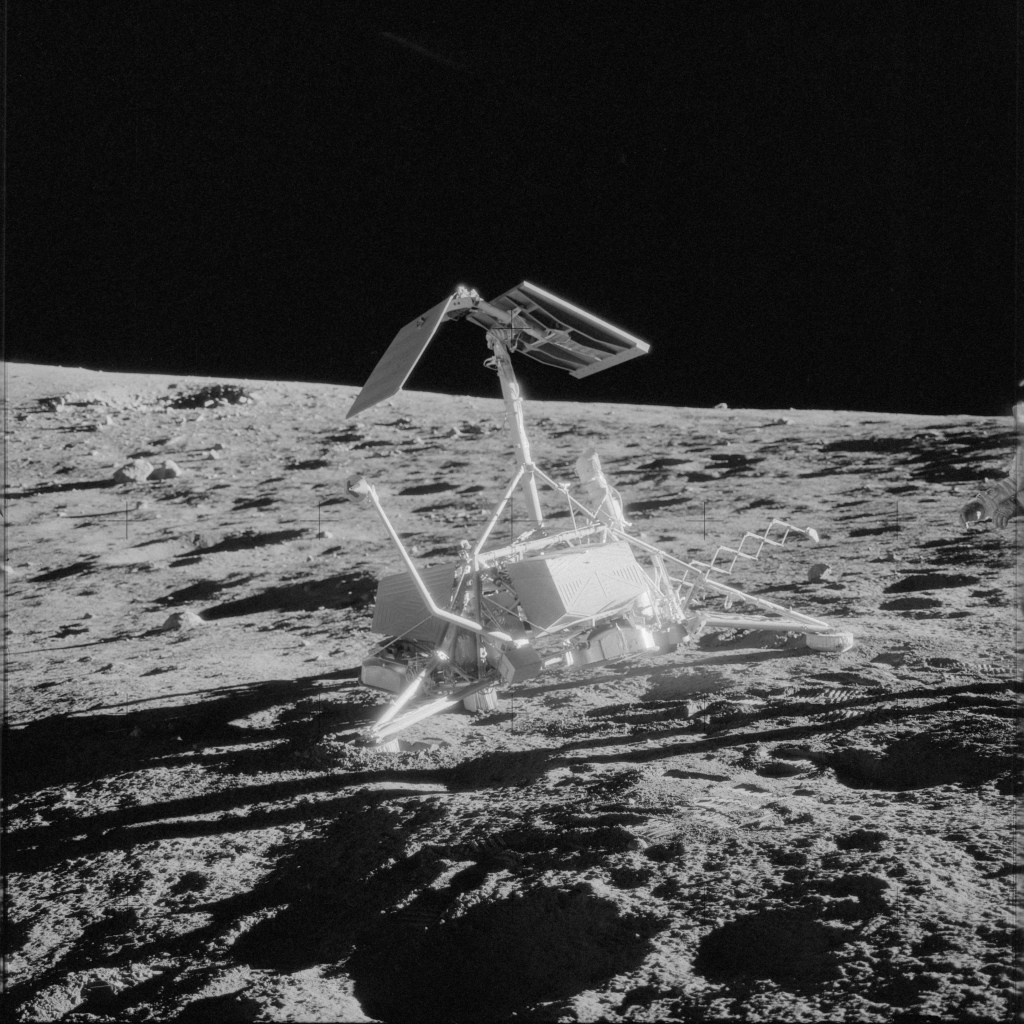
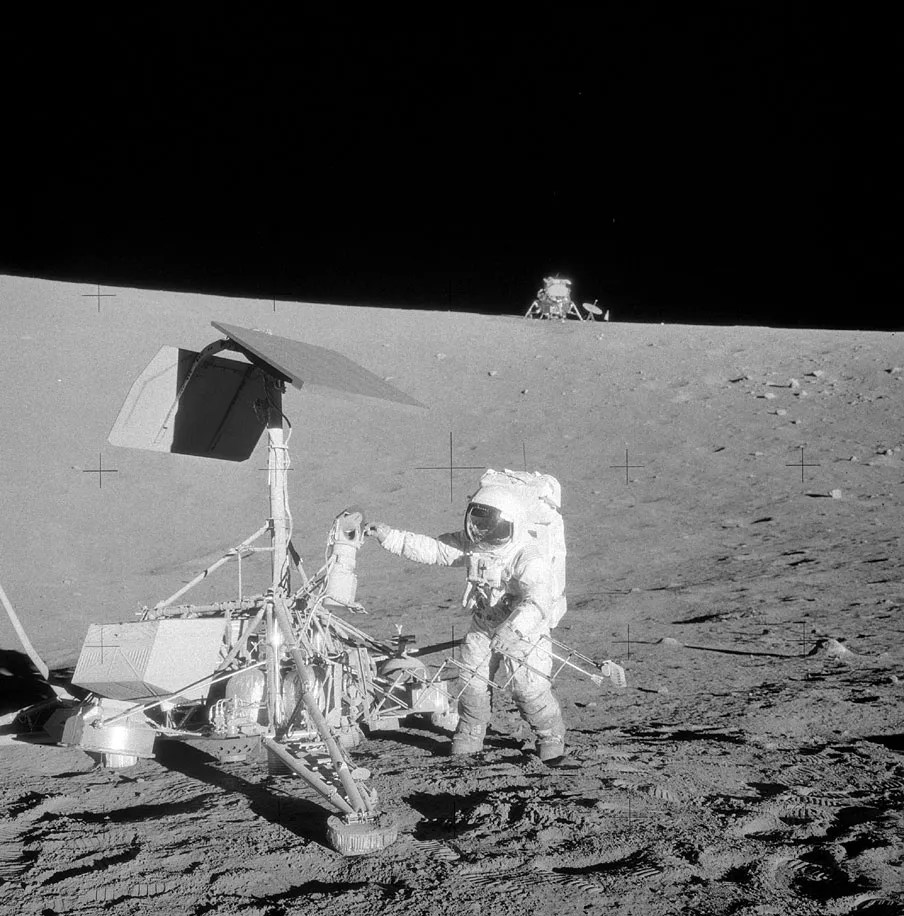
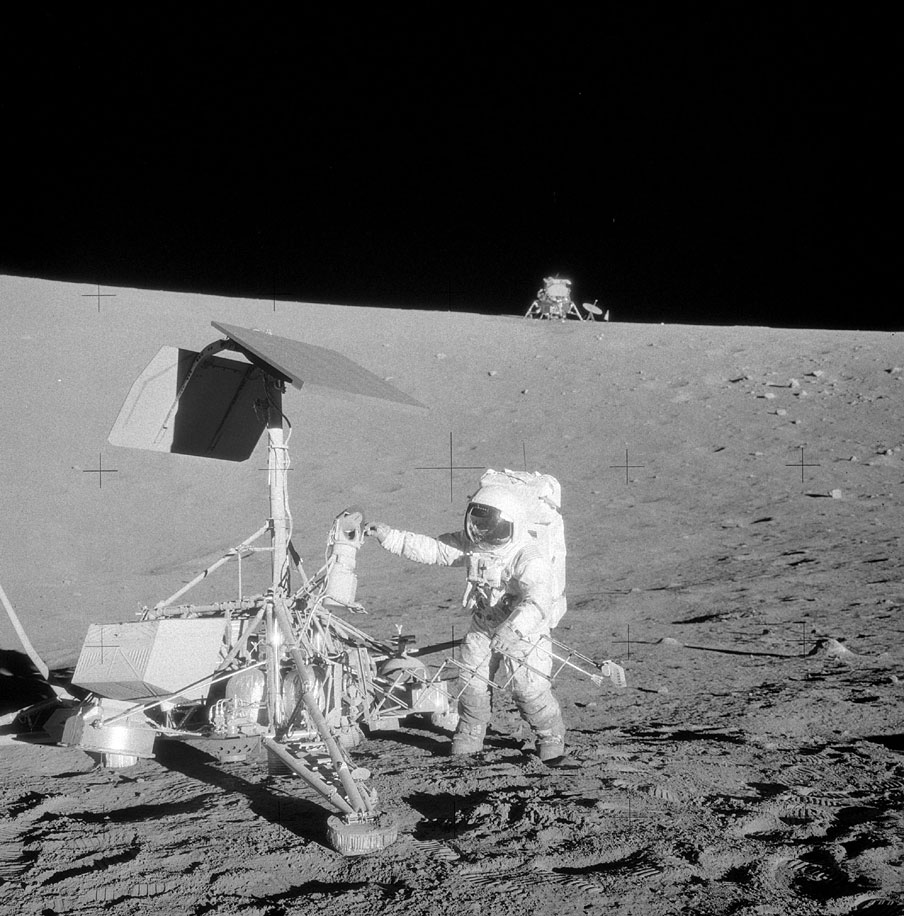
With Apollo 12, the story of Surveyor III came full circle and we got one of the coolest pictures ever taken from the lunar surface. Out of scientific and engineering interest, Apollo 12 landed in the same site as Surveyor III. Al Bean and Pete Conrad got to see the robot up close, which is how we have the image from earlier showing Surveyor sitting on the Moon. They took pictures, and even grabbed pieces of the robot to bring back home for analysis. Right now, the TV camera of Surveyor III sit in the Smithsonian, where you can visit and see actual hardware returned from the Moon. The Apollo astronauts also took what I think are some of the most incredible photographs from the history of exploration–human space explorers interacting directly with their robot counterparts.

Apollo astronaut Pete Conrad “jiggles” the spacecraft to see how firmly it’s rooted to the ground. Credit: NASA

CORRECTION 11/21/2024: The original version of this post identified the astronaut in the last picture as Alan Bean. It’s actually Pete Conrad, and Alan Bean is the one taking the photograph.

Footnotes:

  1. If you want to know more about this, Lunar Orbiter photography was the topic of my master’s thesis, which can be found in the about section. ↩︎
  2. There’s a famous story of how scientists feared the landing vehicle would sink into the soil, an idea that did come from a fairly well-known scientist. But many geologists at the time were pretty dismissive of his claims. There were other potential issues though, including ignorance of the electrostatic properties of the lunar material, which could have led to severe dust build-up on equipment. Bottom line: not a lot was known for sure about the nature of the surface. This was an issue if you wanted to land there. ↩︎
  3. For a description of lunar mapping efforts around this time, see Kopal and Carder, Mapping of the Moon. The difficulty of interpreting the photographs can be seen in a variety of scientific papers from the time. Examples can be found in Interpretation of Lunar Probe Data, ed. Jack Green, 1966. ↩︎
  4. Boeing was the primary contractor on Lunar Orbiter. Images and methods can be found in their contractor reports for NASA. ↩︎
  5. Detailed comments the relative priority of science on the Apollo Mission can be seen in A Review of Space Research, the document that came out of the 1962 Iowa Summer Study. ↩︎

History Highlights 4: Darwin’s Wild Ride, Losing Lenses, Finding Lunar Landers

My schedule has become highly variable due to grad school and freelance work. I’m currently working on a series of posts about scientific photography on the British Antarctic Expedition–so far you can read a short introduction, and a post about Herbert Ponting’s early photographs of animals and ice. I’m still working on the next post in that series, which will focus more on the scientists of the Terra Nova expedition and their work, as seen through Ponting’s lens. Until then, here’s a new History Highlights–a periodic collection of new work and other interesting things in the history of science, exploration, and technology.

Recent History

News and new work in science, exploration, and technology.
Newly Digitized Antarctic Photography

Speaking of photography in Antarctica, the National Archives of Australia recently uploaded a number of photographs from Antarctic expeditions to their online system. Their records are a little difficult to navigate, but here’s a link to the site. I’m planning to look through these images for my research, and to see if there’s anything useful for the Herbert Ponting series I’m working on.

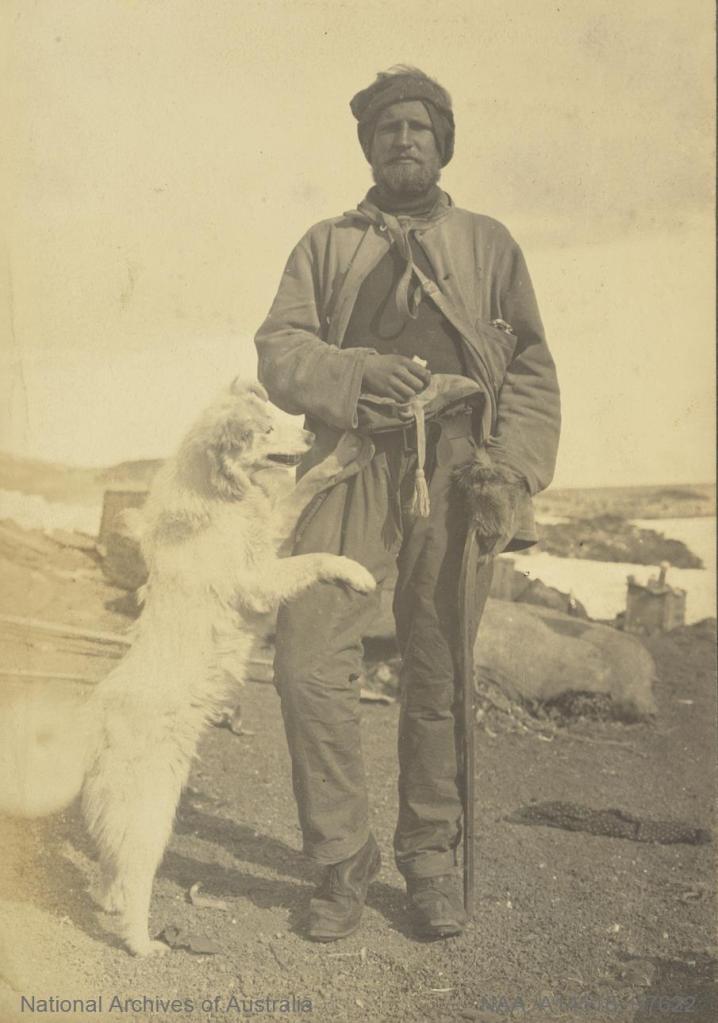
Raymond Priestly was a geologist who participated in both the Nimrod and Terra Nova expeditions to Antarctica under Shackleton and Scott. Here he is on the Nimrod expedition in 1908. He would go on to co-found the Scott Polar Research Institute. From NAA A14518 H7622.
Reconceptualizing the History of Science

Eric Moses Gurevitch shares an excellent article he wrote covering books by James Poskett and Pamela H. Smith. These works are part of an effort to broaden the history of science beyond the conventional narratives that have roots in nineteenth century chauvinisms. This re-conceptualization opens up new research possibilities in the history of science, and draws attention to the myriad ways humans have produced and shared knowledge about nature.

Miscellanea

Various highlights from my research, readings, and internet rabbit holes
Mr. Darwin’s Wild Ride

While Charles Darwin was in the Galapagos studying the rocks, plants, and animals, he used a wide variety of observational techniques. One of these apparently involved riding the tortoises:

I was always amused, when overtaking one of these great monsters as it was quietly pacing along, to see how suddenly, the instant I passed, it would draw in its head and legs, and uttering a deep hiss fall to the ground with a heavy sound, as if struck dead. I frequently got on their backs, and then, upon giving a few raps on the hinder part of the shell, they would rise up and walk away; but I found it very difficult to keep my balance.

Charles Darwin, Voyage of the Beagle
Sunken Treasure at the Bottom of McMurdo Sound

There is apparently a small treasure waiting to be recovered from the sea floor near Antarctica. As he was trying to photograph orcas from the deck of the Terra Nova, Herbert Ponting lost his favorite camera lens:

I leant over the poop rail…waiting for the whales to draw nearer, when, as I was about to release the shutter, the view disappeared from the finder, and light flooded the camera; at the same moment I heard something splash in the water. On examining the camera, what was my consternation to find that the lens-board had dropped into the sea, carrying with the the finest lens of my collection–a nine-inch Zeiss double protar, worth about £25, which had been presented to me some years ago by the Bausch and Lomb Optical Company of Rochester, U.S.A.

Herbert Ponting, The great white South; being an account of experiences with Captain Scott’s South pole expedition and of the nature life of the Antarctic

He sent a letter to Bausch and Lomb, and they sent him a new lens. But the old lens must still be there, two hundred fathoms (as Ponting claimed) under the surface of McMurdo Sound. I tried to find the lens he used, and came across a catalog from 1904 with a listing of Bausch and Lomb lenses. From Ponting’s description of the lens and his uses for it–both whales and scenic views–I think the lens below is probably the closest. I would love it if anyone with more expertise in historical photographic equipment would be able to provide some more insight.

This probably isn’t the same exact lens Ponting dropped into McMurdo Sound, but it may be similar. Catalog found in the reference library of Pacific Rim Camera.
First Lunar Rover found through “Space Archaeology”

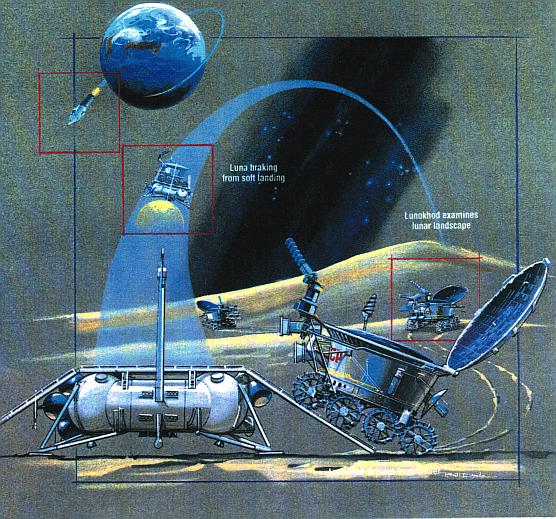
Lunokhod was a Soviet spacecraft that became the first rover on another planetary body in 1970. The rover’s solar cells deployed using a unique clamshell design, and used cameras on each side of the vehicle for navigation.

Lunokhod mission outline. From Wikimedia.
Model of the rover in the Museum of Cosmonautics. From Wikimedia.

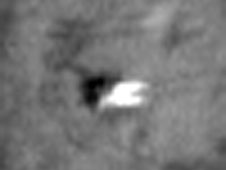
In 2010, Lunokhod 1 was found, and was even capable of being used again for scientific experiments. The rover was equipped with retroreflectors like the one left by Apollo astronauts. This is actually how its final resting site was accidentally identified, when astrophysicist Tom Murphy was using a pulsed laser to study the lunar surface. The Lunar Reconnaissance Orbiter was able to use those coordinates to take new images of the Lunokhod landing site and lander forty years after its original mission.

Luna 17 lander, from NASA/GSFC/Arizona State University.
Discourse on Things that Float

Galileo apparently got into a debate with a contemporary over dinner about why things float in water. This turned into an entire treatise on how things float, in which Galileo drew from preceding work by Archimedes. He also talks about some of his astronomical work. Here are a few quotes, with an example of the type of principles he discusses in the treatise:

This sufficeth me, for my present occasion, to have, by the above declared Examples, discovered and demonstrated, without extending such matters farther, and, as I might have done, into a long Treatise: yea, but that there was a necessity of resolving the above proposed doubt, I should have contented my self with that only, which is demonstrated by Archimedes, in his first Book De Insidentibus humido: where in generall termes he infers and confirms the same Of Natation (a) Lib. 1, Prop. 4. (b) Id. Lib. 1. Prop. 3. (c) Id. Lib. 1. Prop. 3. Conclusions, namely, that Solids (a) less grave than water, swim or float upon it, the (b) more grave go to the Bottom, and the (c) equally grave rest indifferently in all places, yea, though they should be wholly under water.

But, because that this Doctrine of Archimedes, perused, transcribed and examined by Signor Francesco Buonamico, in his fifth Book of Motion, Chap. 29, and afterwards by him confuted, might by the Authority of so renowned, and famous a Philosopher, be rendered dubious, and suspected of falsity; I have judged it necessary to defend it, if I am able so to do, and to clear Archimedes, from those censures, with which he appeareth to be charged….

The diversity of Figures given to this or that Solid, cannot any way be a Cause of its absolute Sinking or Swimming.

So that if a Solid being formed, for example, into a Sphericall Figure, doth sink or swim in the water, I say, that being formed into any other Figure, the same figure in the same water, shall sink or swim: nor can such its Motion by the Expansion or by other mutation of Figure, be impeded or taken away.

Galileo Galilei, Discourse on Floating Bodies

For more History Highlights from past weeks, click here. Follow the Inverting Vision Twitter account for updates on posts and other history of exploration and science content. Subscribe to get update in your inbox: