
I visited Dayton, Ohio in the summers of 2016 and 2017. It felt like a pilgrimage of sorts, because in many ways Dayton is the Mecca of the aerospace history world. Recently, news emerged of the plan to demolish the Wright Brothers’ first bike shop. I figured it would be a good opportunity to write a little about Dayton, and in the process develop my thoughts on historical preservation in general.
To approach the question of historical preservation in Dayton, we need to understand why Dayton is significant in the history of aviation. Kitty Hawk, seemingly more so than Dayton, is inextricably linked in the public imagination with the Wright Brothers and the dawn of human flight. North Carolina even put it on their license plate. They’re “First in Flight!”
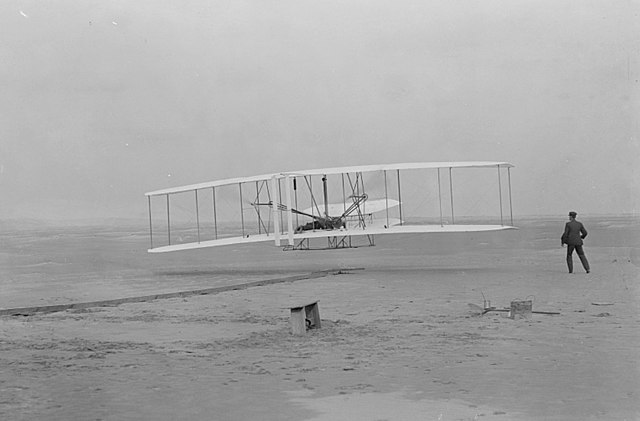
Kitty Hawk gets a lot of press, but in many ways the work that went on in Ohio was more important. Dayton was the hometown of the Wright brothers, and is where they sold bikes. It’s where they first played with toy helicopters that helped spark their interest in flight. It’s where they developed and tested the first heavier-than-air flying machines. And at least in my estimation, Dayton is where the most significant moment in early aviation history took place.
The test of the Wright Flyer I at Kitty Hawk was an incredibly important proof-of-concept for sustained, powered flight. They chose Kill Devil Hills because the strong winds made it easier to achieve the levels of lift they needed. They took off into the wind, meaning less work for the engines in generating the necessary air speed on the wings. But the brief distance covered by the Wright Flyer I, and the short amount of time it stayed in the air, does not distinguish it all that much from the other tests performed by the Wrights and their competitors.
The Wright Flyer I was in many ways a modified glider, given a bit of a distance boost by an engine, but unable to actually remain in the air for a long period. The Wright Flyer II gained more distance and air time. But to me, both vehicles were more like motor-gliders than anything else. They were incapable of staying in the air under their own power for sustained periods. Sustained flight is what humans dreamed about for millennia.
Sustained flight was first achieved in Dayton, Ohio. On an October day in 1905, Wilbur took to the skies in the Wright Flyer III. He circled around Huffman Prairie for almost 40 minutes, and most importantly — he landed on purpose, and only because he ran out of fuel. This was the first time humans really flew. And it happened in Dayton. When you read their descriptions of these flights, it becomes clear that the brothers only felt they had truly accomplished their goal with the Flyer III.
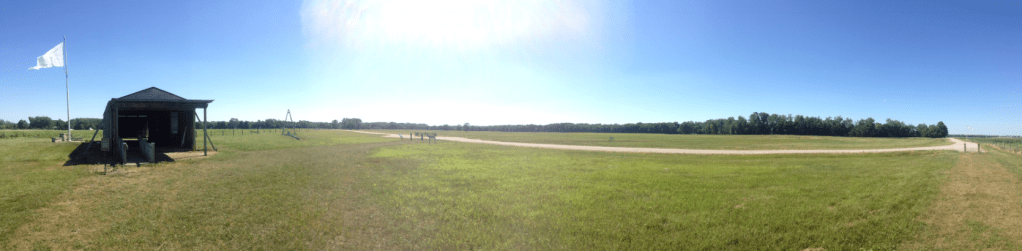
Whether or not you agree with me about the Huffman Prairie flight being more significant than Kitty Hawk, this is certainly a story worth preserving. The City of Dayton has a responsibility to this history.
Preservation is important, but it has limits. And before I dive into this, I have a confession – I’m an artifact hoarder. If there is some token of an event, some odd trinket or symbol of an experience, I hold on to it. I keep a lot of things that would normally be considered trash. For example, I keep a lot of receipts when I go on trips. These sorts of things are fascinating and valuable to me. A receipt holds a wealth of information and captures memories and moments that pictures can’t.
If I could hold on to all of these things, I would. I realized pretty early that this could potentially be a problem, so I limited myself to one large box of artifacts. I have three boxes now. But despite this proclivity, I have forced myself to become more and more selective. Some artifacts actually represent important experiences or spark real memories of formative events, and those are the ones I try to prioritize. I’ve learned to let go of the merely interesting.
I come home from trips with a handful of receipts. But my artifact boxes contain maybe two or three in total. And the ones I kept have particular significance beyond just being interesting.
So although it pains me a bit to write–we don’t have to preserve every last piece of history. The world moves on, things change. If we never demolished a historic building, we wouldn’t have made new ones, we wouldn’t have made new stories and created new histories. We need to be thoughtful about what we preserve. Dayton is a great example of how to accomplish that, and the limits of those efforts.
There is a large collection of Wright Brothers sites in Dayton. I spent two summers there, and visited most of them. They have done a phenomenal job of preserving important aspects of the story that played out in Dayton, and providing the public with a way to explore that history. And it’s more than enough.
You can spend entire days going from site to site, reading through the information, getting to spend time in the presence of Orville and Wilbur’s tools, prototypes, and personal effects. You can go to the Dayton Aviation Heritage National Historic Park. They have a number of incredible artifacts, including one of their cycle shops (they had six locations in total). You can even go to the library at Wright State University, and access a treasure trove of their personal journals and photographs (I did this and it was a spiritual experience). You can go to Huffman Prairie, and trace the path Wilbur took around the big, thorny honey locust tree. And you can go to Carillon Historical Park, and see the Wright Flyer III.
The Wright Flyer III was almost lost. An enormous effort went into preserving it and restoring it, led by Orville himself. To me, this preservation effort was absolutely worth it. That particular artifact is representative of one of the most monumental steps in human history. Being able to actually see it in person adds something ineffable to the story of flight. Walking into the large room that houses it feels like stepping into a temple.
The barely-standing remains of their first bike shop that moved after a year, before their work on flight really began, is an interesting place. It’s physical existence isn’t crucial to telling their story.
I would love to have a brick from the building though. I would even start a new box for it.
 Inverting Vision