
In Highlights, I share a collection of interesting history things I’ve come across recently. In this edition: an interesting map, an atmospheric nuclear detonation, and Ursula le Guin’s version of the Tao Te Ching.
I was recently gifted The Library of Lost Maps by James Cheshire. One of the maps he uses to introduce the book is this 1945 “Air Age Map of the World.” By the end of WWII, air travel was becoming more accessible, and the people who made maps like this were looking forward to widespread air travel in peace time. The map is centered on London, and uses a map projection that shows straight-line routes to major destinations.
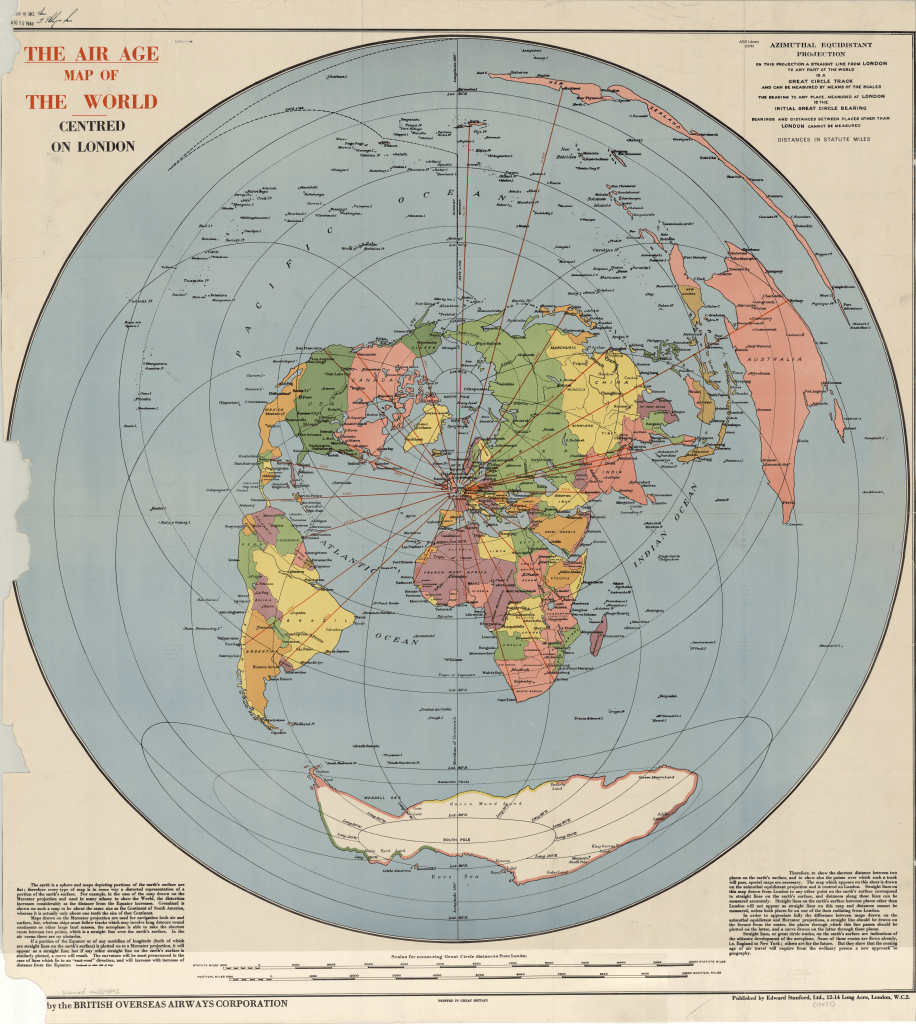
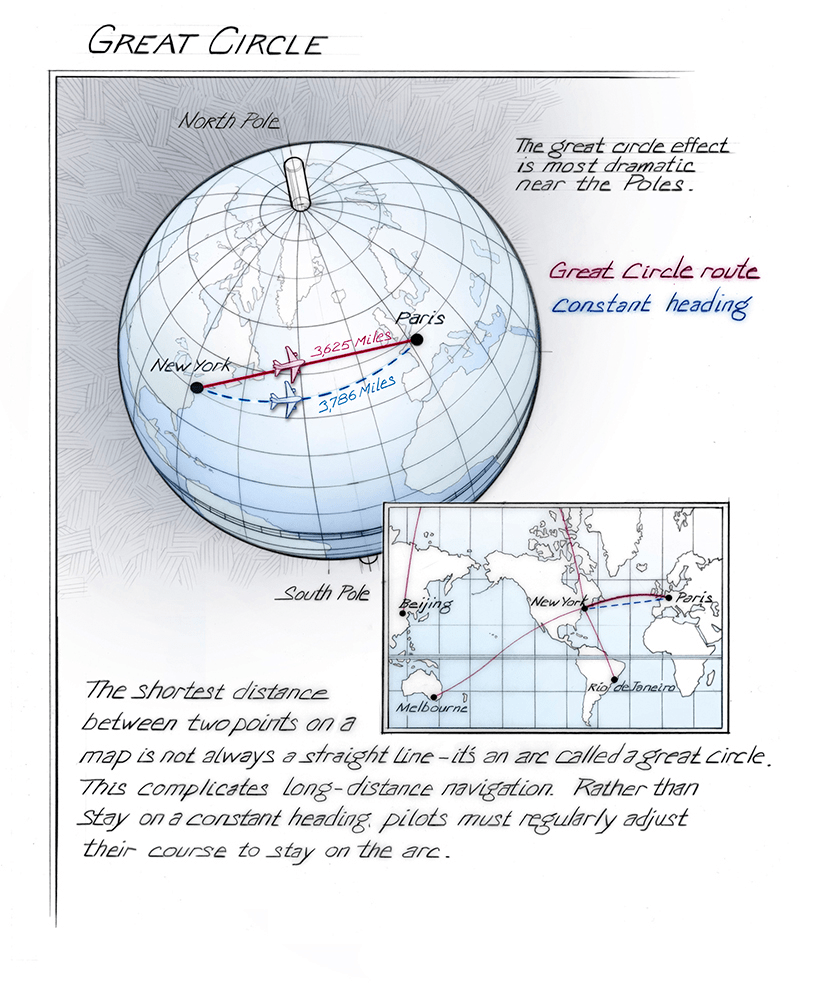
It’s a great example of how modes of travel can literally reshape maps. The nice thing about planes is that you can fly straight from one city to another–but because the Earth is roughly spherical, that direct route appears curved on our usual map projections. Pilots use a technique called great-circle navigation to take the shortest route between two place (see the illustration below). “Air Age” maps often use an azimuthal equidistant projection, which shows the great circle routes as straight lines emanating from the center of the map.
The map reminds me of the Tabula Peutingeriana (TP), which shows the Roman road system. The TP is a medieval map that may have roots in classical sources. It’s shape was partly due to the technology it was produced with: parchment scrolls. But also, its aim wasn’t necessarily to produce an accurate physical description, but to show important sites in the empire and their connections with each other. This could aid the reader in imagining the relevant geography of the region. (More from Michael Rathmann: PDF).
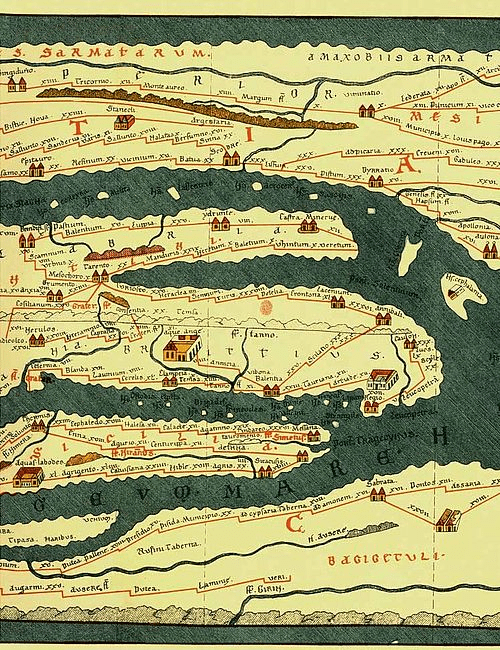
These maps sacrifice geographic fidelity for the sake of displaying the relationship between places. In these cases, that relationship is defined by specific transportation technologies. The classic example of this that many people today are familiar with are subway maps.
In 1962, the United States detonated a thermonuclear warhead in the atmosphere above Hawaii. Part of a project called Starfish Prime, the detonation impacted communications on the ground and the telecommunications satellites in orbit at the time. It provided opportunities for scientists to study the effects (both at the time: PDF, and decades later), reaffirmed the dangers of testing nuclear weapons in the atmosphere, and preceded bans of atmospheric nuclear weapons testing.

Finally, I’ve been reading a collection of poems by Ursula Le Guin. I was delighted to find that the collection includes her own rendition of the Tao Te Ching. She calls it a rendition, rather than a translation, since she wrote through comparing different English translations of the text, looking at differences in translation for specific characters. She used the Paul Carus translation as a “touchstone,” since it included details on each Chinese character used. Le Guin writes:
Ursula Le Guin, Collected Poems, Page 290
“If I could focus on which word the translators were interpreting, I could begin to understand why they made the choice they did. I could compare various interpretations and see why they varied so tremendously; could see how much explanation, sometimes how much bias, was included in the translation; could discover for myself that several English meanings might lead me back to the same Chinese word. And, finally, for all my ignorance of the language, I could gain an intuition of the style, the gait and cadence, of the original, necessary to my ear and conscience if I was to try to reproduce it in English.”
She compiled it over decades, eventually receiving support and guidance from Dr. J.P. Seaton, a professor and translator. Le Guin’s rendition is interesting to me not so much as an authoritative translation, but as a way to access the meaning Le Guin found in the text. That meaning, regardless of accuracy or connection to the original, was enormously influential on who she was as an author and as a human being. In that a way, it’s a bit like the maps at the beginning of this post. Reading it has been a way to ground myself lately. I wanted to end with a couple chapters that hit particularly hard:
30
Not Making War
A Taoist wouldn’t advise a ruler
to use force of arms for conquest;
that tactic backfires.
Where the army marched
grow thorns and thistles.
After the war
come the bad harvests.
Good leaders prosper, that’s all,
not presuming on victory.
They prosper without boasting,
or domineering, or arrogance,
prosper because they can’t help it,
prosper without violence.
Things flourish then perish.
Not the Way.
What’s not the Way
soon ends.
31
Against War
Even the best weapon
is an unhappy tool,
hateful to living things.
So the follower of the Way
stays away from it.
Weapons are unhappy tools,
not chosen by thoughtful people,
to be used only when there is no choice,
and with a calm, still mind,
without enjoyment.
To enjoy using weapons is to enjoy killing people,
and to enjoy killing people
is to lose your share in the common good.
It is right that the murder of many people
be mourned and lamented.
It is right that a victor in war
be received with funeral ceremonies.
 Inverting Vision


