
This is a short introduction to a planned series of posts about photography and science on the British Antarctic Expedition. It includes another story about photographing orcas and ice.
In 1910, the British Antarctic Expedition set out on the Terra Nova with the goal of being the first people to reach the geographic south pole. Captain Robert Falcon Scott organized and led the expedition–the second Antarctic voyage in his career. The Terra Nova expedition is now famous for being beaten to the pole by Roald Amundsen, and for the tragic deaths of Scott and the polar team on their return journey. But the story of the Terra Nova is also a story of scientific research. Captain Scott recruited a team of scientists and made their work a top priority, which may have been one factor in their second-place finish at the pole. Scott also personally recruited the man that would capture everything on film: Herbert Ponting.
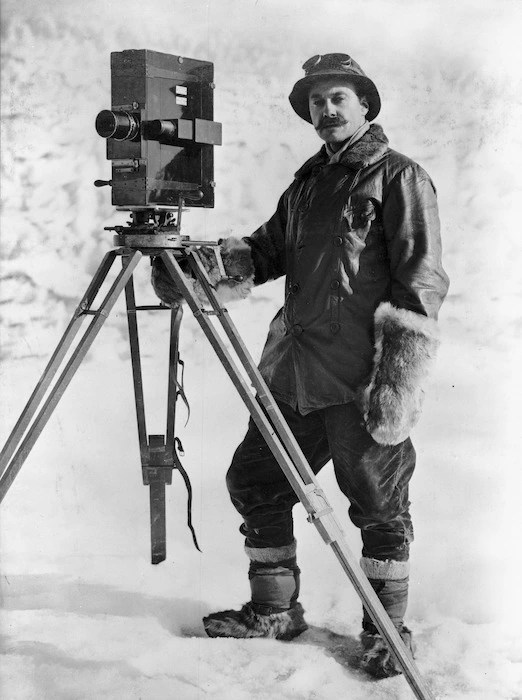
Ponting was already a rather accomplished photographer when Scott approached him in 1909. He was on the verge of publishing a travel book about his experiences in Japan, but Scott convinced Ponting to go to the frigid wastes of Antarctica within a year of their first meeting. Scott’s emphasis on science was a major draw for the photographer. The expedition was, in Ponting’s words: “a chance, such as never would come to me again, to turn the experience I had gained to some permanent benefit to Science.” Over the course of the expedition, Ponting used his extensive experience to document animal life and monumental ice formations, and to immortalize on film the mountains and the men of Antarctica.
In his photographs, Ponting distilled the notion of the heroic male explorer. This archetype defined exploration the late nineteenth and early twentieth centuries. Travel narratives and photographs from these men were major commercial successes, and Ponting’s photographs even used the archetype to advertise beans. The idea of polar exploration as an act of masculine heroics has haunted Antarctic science into the 21st century. The Antarctic science community has struggled to move away from this old paradigm and create a safe and welcoming environment for scientists to do work that many dream of for their entire lives.
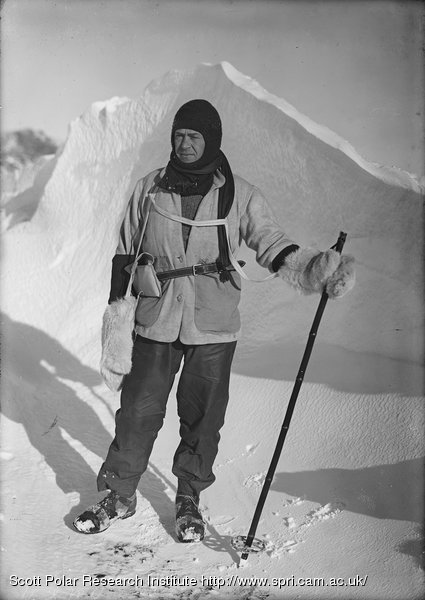

Ponting very carefully arranged his photographs of the crew in ways that were specifically designed to conjure these “heroic” notions of the explorer and the scientist. But the images also give us insight into the scientific work done by the crew of the Terra Nova expedition. The scientific team was led by Dr. Edward Adrian Wilson, who the crew affectionately called ‘Uncle Bill.’ He was a capable zoologist, and both Ponting and Scott write about him with effusive admiration. Scott and Wilson also recruited a meteorologist, a physicist, and several geologists (one of whom was Raymond Priestly, a veteran of an early Shackleton expedition).
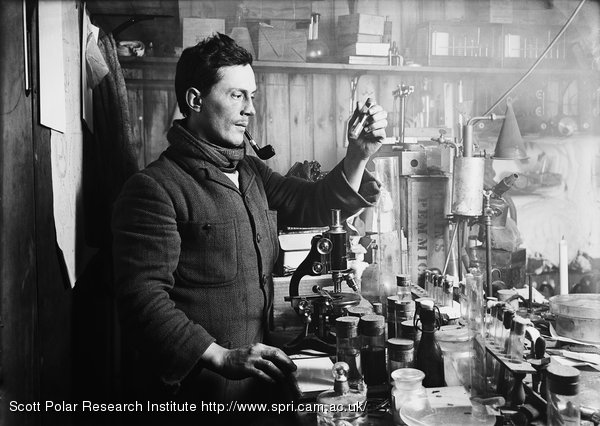
The scientists brought with them a wide variety of supplies and scientific instruments. These included a number of thermometers, telescopes, chemical glassware, and even balloons. Once in Antarctica, the expedition set up several laboratories, including a dark room. Ponting also took photographs on the Terra Nova, and had a photographic lab integrated into the ship. It was roomier than his assigned bunk, and the photographer ended up sleeping there under the light cast from the ruby-glass porthole.
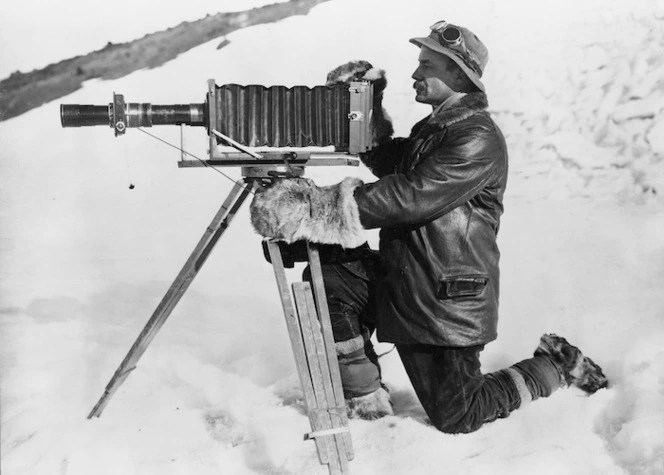
Ponting brought with him “an incredible quantity of gear.” This included tin cases full of film and photographic plates, which were hermetically sealed in tins to prevent damage. There were also color filters and telephoto lenses. The crew brought several small cameras, and Ponting gave some lessons on how to use the equipment. Ponting himself primarily used a pair of cinematographs to take films, and folding cameras for stills.
Read the next post about photographing orcas and ice. Subscribe here:
 Inverting Vision
Pingback: History Highlights 4: Darwin’s Wild Ride, Losing Lenses, Finding Lunar Landers – Inverting Vision
Pingback: Photography and Science in Antarctica – Orcas and Ice – Inverting Vision