Exploring the Far Side of the Moon: A Visual History

Lunar exploration has always held a strange position in the history of exploration. For all of human history, people have been staring up at the Moon, and for centuries astronomers used telescopes to study the lunar surface. The telescopic surveying and mapping of the Moon by astronomers can (and should, I think) be considered a form of exploration. From this perspective, the Moon had been thoroughly explored far before the dawn of the Space Age. But on the other hand, because of the nature of the Moon’s orbit, the Moon also possessed some of the most mysterious and inaccessible terrain that ever taunted exploration-minded humans.

The Moon is tidally locked, meaning that only one side of the Moon ever faces the Earth. And so for all those millennia of Moon-gazing, there was an entire half of our natural satellite that no human had ever seen before. We would only get our first look at the end of the 1950s, and it would take even longer for us to complete a full map of the Moon. Here is a visual history of how we did it, designed to guide you through the process, even if you aren’t yet familiar with any lunar features.

First, let’s look at the near side of the Moon. The dark parts are the maria, Latin for “seas.” The brighter parts are, generally, called the highlands.

Needs no introduction. From NASA

The maria provide helpful landmarks for understanding how the far side of the Moon was revealed, and I have highlighted a few helpful maria below. In red you can see the Sea of Tranquility, probably the most famous mare, since that’s where Apollo 11 landed. But the other ones I have marked will be the most helpful landmarks for this history. We will especially be tracking Grimaldi, really a crater on the western limb (edge) of the Moon with a mare floor. Over on the eastern limb, highlighted in green, is the Mare Humboldtianum. I’ve highlighted Mare Crisium in blue, since it is large and distinctive. But mainly keep your eye on Grimaldi and Humboldtianum.

ORANGE: Grimaldi Crater, RED: Sea of Tranquility (Mare Tranquillitatis) , BLUE: Mare Crisium, GREEN: Mare Humboldtianum

Oddly, even though the moon is tidally locked, we have been able to see small portions of the far side, due to a wobbling motion called lunar libration. You can see libration happening in the animation below. You might be able to notice that Humboldtianum actually disappears over the limb at certain times. Because of libration, we have actually been able to see more than fifty percent of the lunar surface for a long time. In the 17th century, astronomers began using telescopes to study the extent of libration, and to extend lunar maps slightly.1

File:Lunar libration with phase Oct 2007 HD.gif
Lunar Libration, from Wikimedia

William Gilbert and Galileo were some of the first astronomers to detect and measure libration, and to attempt mapping the Moon in detail.2 Over time, astronomers began depicting the effects of libration on their maps, which can be seen very well in Johannes Hevelius‘ 1647 map from his Selenographia. The slivers on the northern and southern edges of the map show which areas come in and out of view through libration, and you can see that the effect is slightly more pronounced near the poles. You might even be able to find Humboldtianum on this map.

Hevelius was using some traditional astronomical measuring devices, but he was also using telescopes of his own construction.3

We also see libration depicted on the map below, made by Giovanni Battista Riccioli in collaboration with Francesco Maria Grimaldi in 1651. Riccioli’s naming scheme was one of the most influential, and our maps today retain many of his names. You can see Mare Tranquillitatus and Mare Crisium on this map, for example. You can also see that Riccioli named the crater Grimaldi after his illustrator. He also named a nearby crater after himself, and yet another in the vicinity after Hevelius. Humboldtianum, however, is named Zoroaster on Riccioli’s map.

Below, you can see the effects of libration on the visibility of Zoroaster/Humboldtianum. It’s helpful to note the positions of Aristotle, Hercules, Atlas, and Endymion. They can help you orient yourself around the northeastern limb.

This view was the one that astronomers had for the next several centuries. Better telescopes allowed observers to add a little more detail near the limbs, but observing features there would always prove extremely difficult. For the time being, the far side of the Moon would remain obscured. We can get a decent idea of the extent of our knowledge using John Russell’s Selenographia, an amazing lunar globe from 1797.4

John Russell’s Selenographia, a lunar globe made in 1797. All images of globe from Science Museum Group. This image is released under a CC BY-NC-SA 4.0 Licence

On the back of the globe, you can see the blank spots on our map. You can also see clever mechanisms Russell devised to display the movement of the Moon caused by libration.

The back of Russell’s globe, showing blank space with inscriptions, and mechanisms for displaying libration.

If we take a closer look at the western limb, we can see Grimaldi clearly, with Riccioli and Hevelius nearby. We can also see that Russell has filled in a lot of the area sometimes hidden through libration to the west of that area. This is where his map became more difficult to align with real features on the lunar surface. This is partly because that area is heavily cratered, and gives us a tantalizing glimpse at one of the largest and most complex surface features on the Moon.

The western edge of Russell’s globe, with Grimaldi highlighted in orange.

If we look really closely at the western limb as libration brings more westward features into view, we see what looks like some layered mountains, interspersed with dark surfaces. Russell looks to be depicting some of these mountains, and the darker areas between them. These seemed to go unnoticed by other astronomers until the late nineteenth century, when Russell’s darker areas begin to appear on maps again. But there is another dark mare beyond those mountains, and in the early twentieth century, German astronomer Julius Franz gave it the name Mare Orientale.5

We wouldn’t be able to get a better look at the far side of the Moon until we invented a way to send cameras there. At the dawn of the Space Age, rockets gave us the ability to do just that. In 1959, Soviet engineers created a series of robotic probes, and launched them toward the Moon. One of these managed a lunar flyby, and was named Luna 3. Engineers equipped Luna 3 with a film camera, capable of developing the exposed film, scanning the images, and transmitting them back to Earth by radio. For a fantastic look at the technology involved here, and some of the images, check out Don P. Mitchell’s website. You should also read Sven Grahn’s work on how Jodrell Bank radio observatory in England intercepted the images as they returned.

In October of 1959, in a cramped room on the Crimean Peninsula, Russian engineers Boris Chertok, Sergei Korolev, and colleagues watched as images materialized slowly on heat-sensitive paper.6 Here is the first image we have of the far side of the Moon:

File:Luna 3 moon.jpg
The first photograph of the far side of the Moon (1959). From Wikimedia.

It is not the highest quality, but it is fairly amazing that it was possible at all in 1959, given the early state of the technology. Below, I’ve highlighted our landmark maria for reference–we’re seeing around the eastern limb. While distinct craters are hard to make out, we can easily see some new maria. The ones to the right and south of Mare Crisium are Mare Smythii and Mare Marignis (we had some glimpses of them on the eastern limb before Luna). But way out there on the right hand side of the image are two entirely new, entirely distinctive maria. The large one in the north was named Mare Moscoviense. The one in the south with the peak in the middle is the crater Tsiolkovskiy, named for the pioneering Russian rocket scientist.

Russian astronomer Yuri Naumovich Lipsky led the effort to interpret the images and begin a map of the lunar far side. His efforts led to the following maps:

Schematic chart. You can probably spot Crisium and Humboldtianum. From Zdeněk Kopal’s Mapping of the Moon: Past and Present.

This globe was produced, which is a fantastic glimpse at how much of the surface Luna 3 managed to add to our map. But you can clearly see the massive blank spot, and Mare Orientale remains frustratingly in mystery.

It would remain that way until 1965, when Soviet engineers sent another robotic spacecraft past the Moon. Zond 3, which may have been destined for Mars, flew by the Moon equipped with another film-based system, and captured a handful of images. To see more about the technical details of Zond 3 and its flight, you should check out Andrew LePage’s website. And once again, Don P. Mitchell has an incredible collection of Soviet lunar photographs.
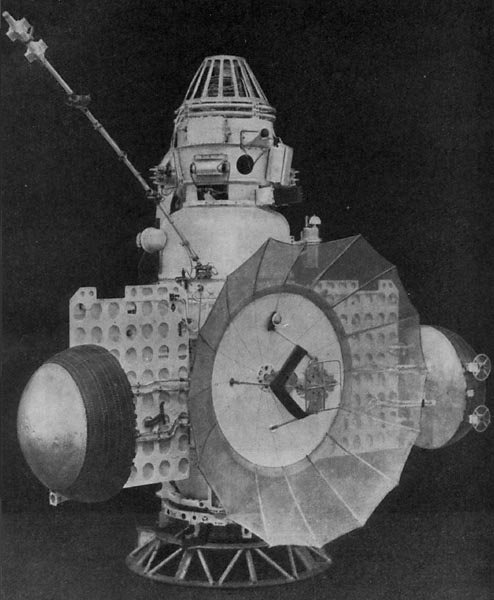
undefined
Zond 2 – Zond 3 was part of the same series of spacecraft. From Wikimedia.

And, for the first time, we see Mare Orientale in its entirety:

Zond 3, Frame 3, the first full look at Mare Orientale, originally processed by Yu. N. Lipsky (1965). From Don P. Mitchell’s excellent website.

Here’s a reminder of where we are, to orient ourselves. Zond 3 is giving us a glimpse over the western limb, past Grimaldi:

Zond 3, frame 18. From Don P. Mitchell (seriously, go check out his website).

And once again, Lipsky went to work putting all this new data on the map. You should be able to see Crisium, Humboldtianum, and Grimaldi for reference. We can now see Orientale, Muscioviense, and Tsiolkovskiy in their proper positions. But notice, there are still blank spots on the map.

Then, in 1966 and 1967, NASA sent five robotic probes to the Moon: the Lunar Orbiters. The Eastman Kodak company adapted camera systems they had designed for the Air Force to the task of mapping the Moon in preparation for the Apollo program.7 The teams behind Lunar Orbiter took thousands of incredibly high resolution images of the lunar surface. The first several Lunar Orbiters were mainly used to scout out landing sites for Apollo on the near side. But even on Lunar Orbiter I, they managed to capture some images of the far side. One of them was this shot, with Tsilkovskiy sitting in the foreground of the first “Earthrise” image ever captured.

What made Lunar Orbiter distinct from the Soviet efforts was not only the number of images, but the level of detail that each image contained. Two lenses allowed the simultaneous capture of both medium-resolution and high resolution images, like this one showing the central peak of Tsiolkovsky and its inner walls.

On Lunar Orbiter IV and V, scientists got the opportunity to play a more direct role in target selection. In the shot below from Lunar Orbiter IV, you can see Grimaldi, and down there near the edge, coming into full view: Mare Orientale. Just a few shot later…

Mare Orientale.

Between all the Lunar Orbiters, we gained imagery of 99 percent of the lunar surface. This allowed cartographers to create a fully detailed map of the lunar far side.8

Apollo astronauts orbiting around the Moon would add to our imagery and understanding of the far side, as would more Soviet probes. Later robotic probes would fill in the few remaining gaps, which were mainly near the poles. Over those years, our knowledge and understanding of the lunar surface would only continue to grow. For centuries, the far side of the Moon had been one large blank spot on a map. Then, in less than ten years, largely due to the hard work of engineers and scientists working with robotic probes, we filled in blank spots. We have become more fully acquainted with our Moon, but we still have more to learn.

Special note for posterity:
This post was written the day before the crew of Artemis II flew around the Moon. One reason for the focus on Mare Orientale in this history is a quirk in the history of direct observation of the lunar far side by astronauts. On all the Apollo missions, their orbits and the lighting conditions never allowed them to view Mare Orientale under sunlight. The closest they got was an image of Orientale under Earthsine on Apollo 17. Tomorrow, people will see Mare Orientale in fully glory for the first time.

Mare Orientale in Earthshine on Apollo 17. From NASA/LPI.

Update 4/12/2026:
On Monday, April 6 – they did it.

“The Moon’s Great Scar,” from NASA.

  1. There are a lot of great histories of the early mapping of the Moon, but I won’t linger long on the details in this post. One of the most definitive is Ewen Whitaker’s Mapping and Naming of the Moon. There is also a good section on the topic in Mapping of the Moon: Past and Present by Zdeněk Kopal and Carder. Much of the information in this post comes from these sources. ↩︎
  2. Stephen Pumfrey argues Gilbert was definitively first: https://adsabs.harvard.edu/full/2011JHA….42..193P ↩︎
  3. Janet Vertesi takes a look at where Hevelius’ instruments fit into the technological culture of the time: https://www.jstor.org/stable/40731030 ↩︎
  4. The Linda Hall Library has a digital copy of Russell’s pamphlet, in which he describes the workings of the device: https://catalog.lindahall.org/permalink/01LINDAHALL_INST/1oon2h5/alma99455413405961 ↩︎
  5. Mare Orientale means “Eastern Sea,” which is confusing, considering it is on the western limb. The name was correct at the time Franz observed it–the directions changed in 1961. Ewen Whitaker and Richard Baum have a great history of Mare Orientale, which highlights the contributions of Russell, and explains the shift in directions. ↩︎
  6. See Boris Chertok’s Rockets and People, Volume II (PDF), translated by Asif Siddiqi. 519-538 ↩︎
  7. An older version of this article stated that the camera systems were designed for the CIA, but actually the ancestral tech of the LO cameras was originally designed for the Air Force as a part of WS-117L. Kodak camera systems in WS-117L did become a part of the CIA project CORONA. But the film readout system that was incorporated into Lunar Orbiter was a part of SAMOS (PDF), a separate component of WS-117L that was not transferred to the CIA. Both USAF and CIA satellite reconnaissance systems were soon were soon bundled into the organization that became the National Reconnaissance Office (NRO). The author caught this mistake on a re-read. ↩︎
  8. For more on Lunar Orbiter, you can find my master’s thesis on the about page, which focuses especially on the Kodak camera systems and the role of science in Lunar Orbiter. There is also NASA’s official history by Bruce Byers, and Farouk El-Baz’s The Moon as Viewed by Lunar Orbiter. The Lunar and Planetary Institute has an amazing page hosting images from Lunar Orbiter. ↩︎

“Standing By”: Science Communication on Apollo 8

This morning, as I sipped my coffee, I took in the view of a crescent Earth from the perspective of astronauts heading toward the Moon. It’s the first time this has been possible in over 50 years. Yesterday, as I awaited the launch of Artemis II, I watched the CBS broadcast of Apollo 8, in which Walter Cronkite guided America through the very first journey around the Moon in 1968.

Throughout the broadcast, Cronkite regularly broke away from the action to talk to leading scientists. Viewers were taken to Jodrell Bank observatory in England, where the eminent astronomer Bernard Lovell sat with a CBS reporter, a radio telescope looming behind them. Then to the Jet Propulsion Laboratory, where American geologist Eugene Shoemaker sat beside a giant lunar globe, excitedly answering questions.

Scientists had a complex relationship with Apollo. Many scientists at the time looked at the price tag for the “man-in-space” program, and couldn’t help but imagine how many scientific robots could have been constructed and sent across the solar system with those dollars. Some were extremely vocal about this, to the frustration of NASA officials. Many scientists were concerned that science was being misused to legitimize missions that had dubious scientific value. But others agreed with NASA’s arguments that Apollo was an important part of selling a space program and enabling long-term access to space. And others still were genuinely excited about the possibility of doing field work on the Moon.

Apollo 8 in particular had limited scientific value, but science featured heavily in the broadcast nevertheless. This may have been exactly the sort of “science-washing” that worried so many scientists. But Lovell and Shoemaker had the opportunity to explain the exact limitations of Apollo 8 to the CBS audience themselves. In doing so, they highlighted the work of lunar robotics teams that preceded the Apollo missions, and explained the questions that future Apollo missions might help to answer. Missions that Apollo 8 would enable.

Below, you will find quotes from these interviews, with my quick analysis. To keep this post short(ish), I have tried to limit my descriptions to things I find most interesting or relevant. If you’re interested, I highly recommend watching the entire clips. They are a fascinating look back at science communication during our first trip around the Moon.

Note: Many thanks you to the anonymous person who uploaded all this archival footage. I’m not linking all of it in this post–in part to avoid clutter and limit length, but you can find the clips by a search (for CBS Apollo 8 footage), or find the links here: https://bsky.app/profile/inverting-vision.bsky.social/post/3mihebmpves23


Being interested in lunar robotics, I was looking to see how the robots would show up, especially Lunar Orbiter. Not long after the launch, Cronkite cut to Terry Drinkwater reporting from the Jet Propulsion Laboratory (JPL) in California, which built and operated some of the robots.

Drinkwater reports that people watching the launch at JPL are “thinking back to all that has gone on here in unmanned exploration of the Moon.” Then he takes the audience on a whirlwind tour of the Pioneer, Ranger, Surveyor, and Lunar Orbiter spacecraft. They show models of each vehicle, and images they produced, discussing how each contributed to science and Apollo planning.

An illustration of the three major lunar robots sent to the Moon by NASA. From a 1966 NASA press kit (PDF)

Later, they cut to an interview with Bernard Lovell. Lovell was director of the Jodrell Bank observatory in England, which had a fascinating role in early lunar exploration. They used their telescope to track the first robotic lunar missions, even intercepting image transmissions from Soviet lunar probes. Lovell was very straightforward about the limited scientific value of Apollo 8. “The orbiters and the landers have already given us a very great deal of scientific information about the nature of the lunar terrain and the constitution of the surface,” he said, explaining that “for a really significant addition to that knowledge, we will have to wait until the Apollo ship actually lands men on the Moon, and that really would be terribly exciting…”


When Apollo 8 arrived at the Moon, astronaut Jim Lovell began narrating what he saw from the spacecraft. He described a grey lunar surface that looked like plaster-of-paris. After their report, Cronkite brought in “Doc Shoemaker,” who sat in JPL next to a massive lunar globe, wearing his bolo tie. Shoemaker was one of the foremost of the new generation of geologists interested in taking their field work to the Moon.

Cronkite replayed Lovell’s description, inviting Shoemaker to “point to those spots on the Moon” as Lovell described them. Shoemaker silently points to the Sea of Tranquility as Lovell says that the mare “doesn’t stand out as well here as it does back on Earth.” Doc Shoemaker then points to the surrounding craters as Lovell begins talking about them. It’s really delightful, and having a human expert directly point out these features on a map adds something that animations don’t quite capture. I know that there were people watching at the time who still remember Shoemaker’s appearance, and it influenced their career direction.

“You did that one so well, you won your audition,” Cronkite says to Shoemaker. Then he starts asking Shoemaker about orbits, discussing gravitational pull and its relationship to orbital speeds. They introduce the ideas of “pericynthion”–the part of a lunar orbit passing closest to the Moon–and “apocynthion,” the point of an orbit farthest from the Moon. Cronkite mentions that the “Cynthus” part of those terms refers to an old name for the Moon. Shoemaker corrects him, claiming that those terms are actually more generalized, for the orbit of any smaller body around a larger body.

Today, the generalized terms usually used are periapsis and apoapsis. But Cynthus is an interesting Greek term. Appropriately, it was sometimes used as a name for Artemis, because the Greek goddess was by legend born on Mount Cynthus. Artemis was very much associated with Selene, goddess of the Moon. Any satellite of another body can be considered a “moon,” and the term “moon” was used that way even into the 60s, so its usage as a general term is also plausible. But Shoemaker was a geologist who was relatively new to spaceflight, so he could have been mistaken. My understanding is that these terms did in fact primarily refer to lunar orbits during Apollo, and that Cronkite was right here.

Regardless, Cronkite concedes. “Well I had one correct fact out of four there, that’s not bad, batting .250 on the apo…pericynthion.”


As the astronauts flew around the Moon, they cut back to Bernard Lovell again. This interview is particularly charming. While Lovell, a very distinguished scientist, was fairly even-keeled in earlier interviews, he is now visibly excited. Or at least, I think, as visibly excited as an old English astronomer can get.

He was apparently repeating “fantastic, utterly fantastic,” according to CBS reporter Morley Safer. Then Lovell gives his reflection:

“I must confess this is really one of the great moments…it’s very hard to believe that there are human beings actually flying around the Moon and giving this description of what they see. I don’t know if other people are like I am over this, but although as a scientist I have seen the photographs of the Moon so often, through so many telescopes, and more recently, these marvelous photographs sent back by the cameras. It still really almost bewilders me to try to understand that now at this moment we’ve been listening to a human being there giving these descriptions of what the volcanoes look like…”


There are several points at which Shoemaker talks Cronkite and the audience through things that the astronauts are seeing. At one point, they get confused by the fact that astronauts are talking about craters with names that are suspiciously familiar.

“I don’t find [those craters] on my Moon map here: Carr, Miller, Borman, Houston, Collins,” Cronkite reports. “They sound like they’re named after a bunch of people at the Houston manned space center to me, and I wonder how they do get these names, and how long they’ve been named that, and whether or not these fellas are going to name a few for the first time…”

Shoemaker was also befuddled. The astronauts were near the far side of the Moon, and he realizes what happened:

“[they] actually were just off the edge…of the globe…this is Mare Smythii, which was mentioned…a number of the craters they mentioned have no formal names yet–they’re back around the edge of this model, and cannot be seen from the Earth. They have been recorded on the unmanned Lunar Orbiter photographs, but no formal names have been attached. Since they have to have some kind of handle to be talked about, the astronauts have just given them names, and of course it’s fun to use the names that are most familiar, the names of your comrades in this kind of work. So I was a little puzzled too, I didn’t know what those names were, but it soon became apparent that these were the ones that had just been adopted for the mission.”

Mare Smythii and surrounding craters, as seen from Apollo 16. From Wikimedia.

Then he gets to describe the International Astronomical Union, and their naming processes, to the audience, bringing them into the world of space nomenclature.

He mentioned the Lunar Orbiter photographs there, which get a lot of air time. In other portions of the broadcast, they cut back to pre-recorded videos with the astronauts talking about their mission. In one, Bill Anders, the primary photographer on the mission, talks about their photographic objectives.

“The Orbiter photography was very good,” he explains, “but where the Orbiter photography was not so good, because the Orbiter was in  highly elliptical orbit…we hope to improve on that…”

Then Shoemaker talks Lunar Orbiter, holding up a far-side image. Unfortunately, the recording on Youtube cuts out here.

But my favorite part is a recording of Jim Lovell talking about their flight path, using a Lunar Orbiter photograph of the Sea of Tranquility. He describes landmarks in detail, making analogies to explain the scale to the audience, like the length of the runway at Ellington Air Force base. 

Jim Lovell holds up a Lunar Orbiter photograph

“You already talk like you’ve flown it and seen it,” the reporter interviewing him says.

“Yeah, this area has become quite familiar to me…I know it quite well,” Lovell replies.

Then Cronkite cuts in: “Jim Lovell, who ‘knows it quite well.’ He hadn’t been to it before, but such is the study and the training of these astronauts that he felt he did.”

To me it speaks to the power of the Lunar Orbiter images. I think a lot about the telepresence sometimes created by the use of remote sensing technology for exploration. While a visceral sense of telepresence was fairly limited in early lunar robotics, there are often little moments where you catch a glimmer of it. This is one of them. 

Lunar Orbiter V, Frame 52M. From LOIRP in National Archives.

I am reasonably certain that Lovell is holding a cropped and annotated annotated version of the Lunar Orbiter photograph above, taken on Lunar Orbiter V. If so, he gets some of the details wrong. For example, he mentions a “half-hidden” crater that he refers to as “Maskelyne B” off the edge of the picture. It’s really Maskelyne F, seen just to the right of the rectangular artifact in the middle of the full image. Maskelyne B is actually visible in the image he’s holding (in the upper central portion of the frame, behind the large crater, which is Maskelyne).

Honestly, I don’t fault him for making mistakes. The astronauts spent time under the guidance of scientists studying these images, but it was a pretty wild crash course. For Apollo 8, the goal was for them to be able to identify photographic targets. It was more important to visually recognize targets than to be able to accurately name them. But this was all part of the show–using science to convey a sense of exploration and to legitimize the project. The astronauts had to become something like amateur science communicators themselves.

And in fact, the Apollo 8 astronauts produced many spectacular images, like this one showing the central peak of the far side crater Tsiolkovsky:

The central peak of Tsiolkovsky from Apollo 8. From Wikimedia.

Later in the clip, they cut to Shoemaker again, who describes their flight path and some of these photographic objectives. There was real science to be done here, however limited. Science communication like this, even if it is flawed, can often serve very important ends for a community hoping to create excitement and support for their research.


Robert Jastrow, an astronomer and NASA official, also makes a couple appearances. He does a good job of explaining some of the overall scientific objectives of lunar exploration, and the findings of the robotic missions thus far. One of the biggest questions that needed answering was the age and origin of the Moon.

“The information returned by spacecraft has answered some questions in that connection,” Jastrow explains, “but raised as many as it’s answered…”

Robert Jastrow. From Wikimedia.

They talk about the scientific return of Apollo 8, and Jastrow, like Bernard Lovell, frames it as a stepping stone towards the real scientific return expected from a landing.

Jastrow then talks through some Lunar Orbiter photographs with Cronkite.  “It’s a fairly new crater,” he says, holding up an Orbiter photo, “an expert like Gene Shoemaker would have to tell us exactly how old it is…” He mentions Meteor Crater in Arizona, talking about how scientists identify the difference between new and old craters. Shoemaker had done extensive work at Meteor Crater in his attempt to understand lunar cratering.

In one appearance with Jastrow, Cronkite asks jokingly whether the Moon is made out of green cheese, teeing up Jastrow to talk about Surveyor and its findings about lunar composition. 

At the beginning of the video after this one, Jastrow and Cronkite talk about the capabilities of astronauts vs. robots. Jastrow makes the claim that a robot would be more expensive, but I think this probably relies on the assumption of a robot that could match the generalized capabilities of a human. Certainly the capabilities of robots in the 60s meant that humans had a bigger advantage over robots than nowadays–but even then, a great deal could be done with robots for a relatively low cost, which is exactly the source of much Apollo skepticism in the scientific community.

At the end, Jastrow and Cronkite talk about Mars.


Of course, this was happening in 1968, amid a great deal of turmoil across the country and the world. In a special report summarizing Apollo 8, Cronkite framed the contrast with characteristic eloquence:

“A year of trouble and turbulence, anger and assassination, is now coming to an end in incandescent triumph…”

https://www.c-span.org/clip/reel-america/user-clip-cronkite-introduction-to-apollo-8/5198544


Many scientists weren’t above seeing Apollo’s significance beyond science, as seen in some of the videos above. In the special report, they included more interviews with Bernard Lovell, Harold Urey, and Eugene Shoemaker:

https://www.c-span.org/clip/reel-america/user-clip-scientific-perspectives-on-apollo-8/5198546

Spectacle on Other Worlds

The first spacecraft from Earth to touch another world carried no people, but it did carry a unique sort of flag. Early on the morning of September 14, 1959, the Soviet space probe Luna 2 impacted the surface of the Moon. Engineers had placed stainless steel spheres aboard the spacecraft, designed to send tiny pentagonal banners across the lunar landscape. The little flags were emblazoned with the hammer and sickle, and Russian script reading: “CCCP, September, 1959.”1

A replica of the Luna 2 pennant on display in the Kansas Cosmosphere. Source: Patrick Pelletier via Wikimedia.

The spheres were made at OKB-1, the Experimental Design Bureau where engineers worked under the leadership of Sergei Korolev to create some of the first space rockets. 2 They were commonly referred to as pennants,3 and you can find more pictures of these pennants on Don P. Mitchell’s excellent website.4 Mitchell speculates that the Luna 2 pennants probably vaporized on impact. On the other hand, the New York Times reported at the time that “[the Soviet Government] said steps had been taken to prevent the destruction of the pennants by the impact.” Regardless of their survival, the pennants accomplished an important objective.

“The day after the historic impact,” historian Asif Siddiqi writes, “[Nikita] Khrushchev triumphantly gave a replica of the ball of pendants to Eisenhower. It was a potent display of the power of politics in the emerging Soviet space programme.”5 This was the point: a spectacle designed to send a message to the United States about the Soviet lead in missile development. There was some (faint) hope on the Soviet side that this spectacle would actually end the Cold War altogether.6

Luna 2’s pennants were just one in a series of such spectacles that constituted the Space Race. From Sputnik to Apollo, visible demonstrations of power replaced nuclear war. In the competition for geopolitical influence that was the Cold War, these projects signaled the strength of competing economic ideologies to worldwide spectators.7 In the 1950s and 1960s, this political impetus for spectacle led humans to explore the solar system up close for the first time. We sent robots to other worlds, and people to the Moon, because of a geopolitical competition. But is that the only reason we went?

I have been fascinated by the reasons people participated in the Space Race–especially the engineers and scientists who worked directly on missions to other celestial bodies. Certainly many of them were Cold Warriors, eager and willing to be recruited to a geopolitical signalling war. But not all of them were, and even those who happily went to nationalistic battle often had priorities that ranked higher in their own minds. In fact, these other motivations may have played a strong role in making the Space Race happen in the first place.

Luna 2 itself may be an example. Siddiqi explains that “contrary to conventional wisdom, it was not the Soviet Party leadership which advocated or called for Soviet pre-eminence in space at this early stage, but Korolev himself who was actualising his intense thirst to claim ‘firsts’ in the new arena of space exploration.” He goes on to say that Korolev was in partly motivated by competition with Wernher von Braun. “One wonders if there would indeed have been a programme at the time if it had not been for Korolev,” Siddiqi writes. The engineers had to convince the Cold Warriors that lunar flights were worth doing.8

Engineering ambitions and personal rivalry were not the only motivations for early space explorers. One of the most interesting examples I have seen comes from Oran Nicks, who was NASA’s director of Lunar and Planetary Programs in the early 1960s. Nicks was an engineer in a department of scientists, and that put him in a unique position. He was also not a Cold Warrior, at least not to the extent of many of his colleagues.

This isn’t to say the political pressures of the Space Race weren’t on his mind. In the early 60s, Nicks was working on the Ranger impact probes to the Moon, which were plagued by a series of early failures. In his book Far Travelers, Nicks recalls that Luna’s successes had made these failures particularly difficult. “Khrushchev had chided us publicly,” Nicks writes, “by quipping that their pennant had gotten lonesome waiting for an American companion.”

But when it came to making an overtly nationalistic response, Nicks took a different attitude. He recounts a disagreement that came up during work on a Mariner probe to Mars. Mariner project manager Jack James had suggested that the spacecraft should have the seal of the United States embossed on a panel, and went to the trouble of mocking it up.9 Nicks was vehemently opposed. Here’s what he wrote (emphasis mine):

His view was understandable; we were competing with the Russians in the race to the planets, and Americans could be proud that our “trademark” would be exhibited for current and future generations to see. My concern was that we might be accused of exhibitionism, something distasteful to me, for I was deadly serious about doing the mission for other reasons. The Russians had bragged about landing a pendant on the Moon, and I wanted no part in that disgusting game.

Oran Nicks, Far Travelers, p 37

Nicks and James compromised, and the seal made it onto the spacecraft. Nicks explains that he “insisted on a low-profile, no-publicity approach,” and was happy that “even after the successful flight there was very little publicity about the seal, and none at all negative.”10

Nicks doesn’t specify which Mariner, but it was likely Mariner IV (1964), shown here. Images comes from Wikimedia, but the original source link is broken. A black-and-white version of this image can be found in NASA Technical Report 32-957 on the temperature control subsystem.

So what were the “other reasons” that Nicks was deadly serious about? To Nicks, the American space program was a project of exploration, pure and simple. He had an expansive definition of the word “explorer” that was rooted in his view of history:

Exploration seems to be in our genes. As they developed the means to do it, men explored the perimeter of the Mediterranean, past the pillars of Hercules, to the sentinel islands off the continent…We tend now to think of exploration in a restricted sense-as a scientific, often geographic, expedition, an athletic activity pursued by specialists dressed in fur parkas like Shackleton’s or in solar topees like Livingston’s. The connotations are overly restrictive if they fail to allow for great tidal movements like the waves of people from Asia that periodically flowed west and south, or for the Scandanavians who crossed the Atlantic in numbers centuries before Columbus. These waves of venturesome people were of a higher order than the random movement of nomads seeking fresh forage…We must conclude that for some of the species, long and perilous passages were no real deterrent to the exploring imperative.

Oran Nicks, Far Travelers, pp 6-7

Nicks is conflating a series of explorations that all occurred for different reasons ranging from survival, to geopolitics, to science. To him, they are part of an innate impulse that all humans have in common. He is situating himself, the United States, and the Soviet Union in a grand tradition that encompasses all of human history.

He was not the only person to do this sort of thing. The space explorers of the 1960s often invoked historical analogy–in the US, this was often the narrative of the American frontier. But these analogies were often related to more specific impulses: colonization, adventure, competition, scientific investigation. Nicks’ framing of exploration as an “instinct” is somewhat distinct. He believes that exploration is something done for its own sake, out of sheer curiosity. The scientific investigations on the missions he managed were an expression of this curiosity, rather than a means to some other end.11

Chertok, in his reflections on the Soviet space program, also remembers people thinking beyond the geopolitics:

Cosmonautics did not arise simply from militarization, and its aims were more than purely propagandistic. During the first post-Sputnik year, the foundations were laid for truly scientific research in space, serving the interests of all humankind…I am not writing about this out of nostalgia for the ‘good old days,’ but because I remember well how people from the most diverse social strata felt about our space successes.

Chertok, Rockets and People, Volume II, pp 435-436

The space programs in both nations were collaborations between people with widely varying motivations. They convinced their governments that pursuing certain objectives in space also served the ends of the state. They competed with each other for funding and for influence over the long-term direction of their programs. In this context, geopolitical competition seems like less of a direct motivation for space exploration, and more of an enabling factor that unlocked resources for would-be explorers.


  1. Siddiqi, Asif A. “First to the Moon,” Journal of the British Interplanetary Society, Vol 51, pp 231-238, 1998, PDF: https://static1.squarespace.com/static/5ef8124031cfcf448b11db32/t/5f1c476085d7250b810190c1/1595688803275/Siddiqi+First+to+the+Moon+1998.pdf ↩︎
  2. Chertok, Boris, ed. Asif Siddiqi, Rockets and People, Volume II: Creating a Rocket Industry, NASA, 2006, pp 446-448 PDF: https://www.nasa.gov/wp-content/uploads/2015/04/635963main_rocketspeoplevolume2-ebook.pdf?emrc=5bed7c ↩︎
  3. Are they called “pennants” or “pendants”? Contemporary newspapers, Mitchell and most other sources say pennants. Siddiqi and Chertok say pendant. Seems to come from a comparison made to ship’s pennant displays (Chertok, in unsourced quote from 447). Wikipedia says pendant is an obsolete spelling of pennant, citing the Dictionary of Vexillology. ↩︎
  4. I’m probably going to link to Mitchell and Sven Grahn a lot on this blog. They have both done amazing work on early Soviet robotics, among other topics, and their work has led me to important sources. You should check out their websites and their books. ↩︎
  5. Siddiqi, p 235-236 The image at the top of this post shows an additional replica, now sitting in the Kansas Cosmosphere. The original replica is held by the Eisenhower Presidential Library and Museum. ↩︎
  6. Chertok, p 447 Certainly it seems like Chertok may have believed this, or believed that Soviet leaders held that hope. “Alas,” he writes, “this did not happen. It was not in our power.” ↩︎
  7. See MacDonald, Alexander, The Long Space Age: The Economic Origins of Space Exploration from Colonial America to the Cold War, 2017, Yale University Press. Especially Chapter 4. https://www.jstor.org/stable/j.ctt1n2tvkx.8 ↩︎
  8. Siddiqi, pp 231-232 ↩︎
  9. Nicks, Oran, Far Travelers: The Exploring Machines, NASA, 1985, https://ntrs.nasa.gov/citations/19850024813 ↩︎
  10. Nicks, p 37 ↩︎
  11. Werner Von Braun, for example, was certainly motivated by colonization and also religious notions. Historian Catherine Newell writes about religious aspects of the American space program in her book Destined for the Stars. Historian Michael Robinson has talked about “true believers” among other types of space explorers. Russian cosmism was a big influence on early Soviet engineers. I plan to do a taxonomy of space explorers at some point, going through various motivations and the historical analogies used to justify and explain them. I see Nicks’ expansive definition of exploration as human instinct most reflected in Carl Sagan’s writings. ↩︎

Updates

It’s been a while since my last post, so I wanted to get back to the blog with an update on what I’ve been working on, and what’s next in 2025.

The USS Nautilus resurfacing. From U.S. Navy/Wikimedia.

This summer I was lucky enough to start working with JSTOR Daily as a regular contributor. JSTOR is a large digital repository of academic journals, and a valuable research tool. I was fortunate to have high school teachers who taught us how to use JSTOR and similar resources, and I used them extensively in college.

It was always exciting for me. These journals contain an ongoing conversation between the brightest minds in nearly every academic field. In some cases, those conversations stretch back centuries. On JSTOR, historical documents live side-by-side with cutting edge research.

Generally you get access to JSTOR through affiliation with an educational institution–college students usually get access with their university email. But there are also subscription options for independent scholars and individuals.

JSTOR Daily is an effort to both show off and share the treasures contained in their repositories. Every day, they post very short summaries of fascinating articles. They strive to make these relevant to current events, or to provide essential context to help understand the significance of the research. Each summary contains a link that provides free access to that article.

I’ve been covering a history of science and technology “beat” for JSTOR Daily. So far, it has been an incredibly fulfilling and instructive experience. Summarizing and contextualizing detailed academic articles in 500 words or less is an intriguing writing puzzle. Every time I sit down to write one, I remember a particular conversation with my dad about writing. He shared a famous remark that stuck with me: “I would have written a shorter letter, but I did not have the time.” (From Mark Twain? Now that I’m googling –  Blaise Pascal? Seems like a lot of writers have shared the same feeling.)

It’s helping me accomplish one of my main goals: to highlight and share the incredible work being doing by historians all the time.

You can find my author page here. I’m going to try to start posting on my Bluesky when a new post goes up, but I will also include links in future History Highlights. Here are a few of my favorites so far:

Additional update 2/13/2025:

Since this post, I have been primarily focused on my teaching, JSTOR writing, and other articles, including a new one in Aeon Magazine. However, I have also been doing research for some planned 2025 blog posts. If you’re interested in learning more about early lunar robotics (and musings on the history of scientific exploration and technology), let me know by subscribing to Inverting Vision below:

History Highlights 4: Darwin’s Wild Ride, Losing Lenses, Finding Lunar Landers

My schedule has become highly variable due to grad school and freelance work. I’m currently working on a series of posts about scientific photography on the British Antarctic Expedition–so far you can read a short introduction, and a post about Herbert Ponting’s early photographs of animals and ice. I’m still working on the next post in that series, which will focus more on the scientists of the Terra Nova expedition and their work, as seen through Ponting’s lens. Until then, here’s a new History Highlights–a periodic collection of new work and other interesting things in the history of science, exploration, and technology.

Recent History

News and new work in science, exploration, and technology.
Newly Digitized Antarctic Photography

Speaking of photography in Antarctica, the National Archives of Australia recently uploaded a number of photographs from Antarctic expeditions to their online system. Their records are a little difficult to navigate, but here’s a link to the site. I’m planning to look through these images for my research, and to see if there’s anything useful for the Herbert Ponting series I’m working on.

Raymond Priestly was a geologist who participated in both the Nimrod and Terra Nova expeditions to Antarctica under Shackleton and Scott. Here he is on the Nimrod expedition in 1908. He would go on to co-found the Scott Polar Research Institute. From NAA A14518 H7622.
Reconceptualizing the History of Science

Eric Moses Gurevitch shares an excellent article he wrote covering books by James Poskett and Pamela H. Smith. These works are part of an effort to broaden the history of science beyond the conventional narratives that have roots in nineteenth century chauvinisms. This re-conceptualization opens up new research possibilities in the history of science, and draws attention to the myriad ways humans have produced and shared knowledge about nature.

Miscellanea

Various highlights from my research, readings, and internet rabbit holes
Mr. Darwin’s Wild Ride

While Charles Darwin was in the Galapagos studying the rocks, plants, and animals, he used a wide variety of observational techniques. One of these apparently involved riding the tortoises:

I was always amused, when overtaking one of these great monsters as it was quietly pacing along, to see how suddenly, the instant I passed, it would draw in its head and legs, and uttering a deep hiss fall to the ground with a heavy sound, as if struck dead. I frequently got on their backs, and then, upon giving a few raps on the hinder part of the shell, they would rise up and walk away; but I found it very difficult to keep my balance.

Charles Darwin, Voyage of the Beagle
Sunken Treasure at the Bottom of McMurdo Sound

There is apparently a small treasure waiting to be recovered from the sea floor near Antarctica. As he was trying to photograph orcas from the deck of the Terra Nova, Herbert Ponting lost his favorite camera lens:

I leant over the poop rail…waiting for the whales to draw nearer, when, as I was about to release the shutter, the view disappeared from the finder, and light flooded the camera; at the same moment I heard something splash in the water. On examining the camera, what was my consternation to find that the lens-board had dropped into the sea, carrying with the the finest lens of my collection–a nine-inch Zeiss double protar, worth about £25, which had been presented to me some years ago by the Bausch and Lomb Optical Company of Rochester, U.S.A.

Herbert Ponting, The great white South; being an account of experiences with Captain Scott’s South pole expedition and of the nature life of the Antarctic

He sent a letter to Bausch and Lomb, and they sent him a new lens. But the old lens must still be there, two hundred fathoms (as Ponting claimed) under the surface of McMurdo Sound. I tried to find the lens he used, and came across a catalog from 1904 with a listing of Bausch and Lomb lenses. From Ponting’s description of the lens and his uses for it–both whales and scenic views–I think the lens below is probably the closest. I would love it if anyone with more expertise in historical photographic equipment would be able to provide some more insight.

This probably isn’t the same exact lens Ponting dropped into McMurdo Sound, but it may be similar. Catalog found in the reference library of Pacific Rim Camera.
First Lunar Rover found through “Space Archaeology”

Lunokhod was a Soviet spacecraft that became the first rover on another planetary body in 1970. The rover’s solar cells deployed using a unique clamshell design, and used cameras on each side of the vehicle for navigation.

Lunokhod mission outline. From Wikimedia.
Model of the rover in the Museum of Cosmonautics. From Wikimedia.

In 2010, Lunokhod 1 was found, and was even capable of being used again for scientific experiments. The rover was equipped with retroreflectors like the one left by Apollo astronauts. This is actually how its final resting site was accidentally identified, when astrophysicist Tom Murphy was using a pulsed laser to study the lunar surface. The Lunar Reconnaissance Orbiter was able to use those coordinates to take new images of the Lunokhod landing site and lander forty years after its original mission.

Luna 17 lander, from NASA/GSFC/Arizona State University.
Discourse on Things that Float

Galileo apparently got into a debate with a contemporary over dinner about why things float in water. This turned into an entire treatise on how things float, in which Galileo drew from preceding work by Archimedes. He also talks about some of his astronomical work. Here are a few quotes, with an example of the type of principles he discusses in the treatise:

This sufficeth me, for my present occasion, to have, by the above declared Examples, discovered and demonstrated, without extending such matters farther, and, as I might have done, into a long Treatise: yea, but that there was a necessity of resolving the above proposed doubt, I should have contented my self with that only, which is demonstrated by Archimedes, in his first Book De Insidentibus humido: where in generall termes he infers and confirms the same Of Natation (a) Lib. 1, Prop. 4. (b) Id. Lib. 1. Prop. 3. (c) Id. Lib. 1. Prop. 3. Conclusions, namely, that Solids (a) less grave than water, swim or float upon it, the (b) more grave go to the Bottom, and the (c) equally grave rest indifferently in all places, yea, though they should be wholly under water.

But, because that this Doctrine of Archimedes, perused, transcribed and examined by Signor Francesco Buonamico, in his fifth Book of Motion, Chap. 29, and afterwards by him confuted, might by the Authority of so renowned, and famous a Philosopher, be rendered dubious, and suspected of falsity; I have judged it necessary to defend it, if I am able so to do, and to clear Archimedes, from those censures, with which he appeareth to be charged….

The diversity of Figures given to this or that Solid, cannot any way be a Cause of its absolute Sinking or Swimming.

So that if a Solid being formed, for example, into a Sphericall Figure, doth sink or swim in the water, I say, that being formed into any other Figure, the same figure in the same water, shall sink or swim: nor can such its Motion by the Expansion or by other mutation of Figure, be impeded or taken away.

Galileo Galilei, Discourse on Floating Bodies

For more History Highlights from past weeks, click here. Follow the Inverting Vision Twitter account for updates on posts and other history of exploration and science content. Subscribe to get update in your inbox:

Photography and Science in Antarctica – Orcas and Ice

This is part two of a series of posts about photography and science on the Terra Nova expedition of 1910-193. You can read the introduction here. This week we find Ponting arriving in Antarctica, and beginning to get acquainted with the environment.

The Terra Nova. Ponting was a fan of icicles, and tried to include them in his shots whenever possible. From the Scott Polar Research Institute (SPRI).

Scientific curiosity drew photographer Herbert Ponting to Antarctica. Before his journey with the British Antarctic Expedition in 1910, the great southern continent was already a place of growing scientific interest. Early encounters in the late 18th and early 19th centuries had revealed ice shelves, animals, and mountains that encouraged dedicated missions to chart and understand the continent. James Weddel, Jules Dumont d’Urville, Charles Wilkes, and James Clark Ross revealed the contours of Antarctica, and returned to Europe and the United States with tantalizing information for biologists and geologists. 

Herbert Ponting was particularly interested in the animals of the Antarctic. Several years before Ponting climbed aboard the Terra Nova, his crew mates Robert Falcon Scott and Edward Wilson had made a landing on Ross Island during the Discovery expedition. In his diaries, Wilson vividly described the smells and sounds that greeted them when they made landfall at Cape Crozier–they had found one of the largest colonies of Adelie penguins. Ponting fantasized about being able to make camp at Cape Crozier and photograph the penguins there, but Scott chose Cape Evans on the other side of the island for their base of operations. 

Once they arrived, the crew used their tracked motor sledges to unload shelter materials and supplies. Ponting still had plenty of opportunity to observe and photograph wildlife. There was a colony of Adelie penguins near their camp, and the birds were not shy about greeting the visitors. “They strolled about,” Ponting wrote, “for all the world like a party of tourists taking in the sights.”1 This delighted the photographer, and he took photographs of their interactions with the crew, who liked to play games with the penguins.

An Adelie penguin pecks Ponting. From SPRI.
Henry Rennick and Francis Drake meet the penguins. From SPRI.

Later in the expedition, the scientific team would learn more about the life cycle and behaviors of the penguins. In the meantime, the crew at Cape Evans spent time studying other examples of marine life. The biologist Denis Lillie collected as many samples as possible with nets. These included an example of cephalodiscus, which are wormlike animals that live in colonies. They also caught “crustacea, star-fish, sea-urchins, great worms, anemones, molluscs,” and large glass sponges.

Denis Lille and his net. From SPRI.
Denis Lille and a glass sponge. From SPRI.

But Ponting was more interested in the animal that had accompanied their ship on the way to their temporary home: the orca. Ponting was keen to capture animal behaviors with his camera, in an effort to make his own contributions to the scientific work of the expedition. The orca and the blue whales were his first opportunity, but he found them exceedingly difficult to capture on film. It was difficult to predict when they would surface, so setting up a camera to capture things like their ‘spout’ was almost impossible. But he managed to capture some of their surfacing and hunting behavior with the cinematograph.

The top two images show orcas surfacing. The bottom pictures supposedly shows them hunting. From SPRI.

Ponting even tried to use his equipment to document and understand whale behavior, to the extent that he could. He used the frame rate of his camera (sixteen frames a second) to measure the duration of the orca’s spout. He tried to capture their grouping and hunting patterns, but was frustrated by the challenges of catching them at the right time. He never did get a film of the blue whales spouting. He also never got a film of whales breaching, despite sitting for nine hours at a spot where he saw one of the  “sportive monsters” perform the spectacular maneuver. 

The intelligence of the whales impressed both Ponting and the crew, and they were amazed by the hunting ability of the orcas. Ponting himself claimed to have been hunted while trying to get just the right shot of an orca, and included a fantastical illustration of the encounter. 

Ponting claimed that this was a very accurate portrayal of the attack. From his book.

The illustration demonstrates some of Ponting’s editorial inclinations. Ponting was an excellent photographer but he was an equally good salesman who was constantly searching for the spectacular and the picturesque. This made him well-suited to his role on the expedition. Photographs and books were a way to make some money from exploration, and they would be in high demand back home.2 Ponting’s photographs have to be viewed with this fact in mind–he was interested in science, but the picturesque held priority. 

Especially early on in the expedition, Ponting’s shots of crew members were often very carefully posed, and his shots of scientific subjects were as controlled as he could make them. His photographs of the whales are interesting in part because of the relative lack of control he had over his subjects.

Ponting found some degree of control in the ice, along with some of the most picturesque scenery he would encounter. The icebergs and ice floes of Antarctic waters captivated and frightened European explorers from the earliest days of Antarctic exploration. Edmond Halley (of comet fame) described encounters with Antarctic ice on his voyage to map magnetic variation in 1699. At first he first thought they were white mountains, and he compared them to white cliffs found in Great Britain. Later expeditions grappled with the ice, and some fell prey to it.

For mariners the ice represented unpredictability, but for the photographer they were relatively static (although still temporary) pieces of natural beauty. Ponting relished the long periods of daylight that he could use to capture the ice in different light conditions. He didn’t want to lose this opportunity, and slept very little for four days on end, working as long as “human endurance would permit.”

His most famous photograph captures the Terra Nova from within a grotto of ice. In his book, he described taking the picture:

A fringe of long icicles hung at the entrance of the grotto, and passing under these I was in the most wonderful place imaginable. From outside, the interior appeared quite white and colourless, but, once inside, it was a lovely symphony of blue and green. I made many photographs in this remarkable place–than which I secured none more beautiful the entire time I was in the South…I found that the colouring of the grotto changed with the position of the sun; this, sometimes green would predominate, then blue, and then again it was a delicate lilac. When the sun passed round to the west–opposite the entrance to the cavern–the beams that streamed in were reflected by myriads of crystals, which decomposed the rays into lovely prismatic hues, so that the walls appeared to be studded with gems.

Herbert Ponting, The Great White South: being an account of experiences with Captain Scott’s South pole expedition and of the nature life of the Antarctic
Grotto in an Iceberg, by Ponting. From Wikimedia.

The elegant formations of icebergs had often been described by explorers in architectural terms, and Ponting’s photographs are some of the most successful at capturing this perspective.3 One of his most frequent subjects was the “Castle berg.”

Caslte Berg, with a dog team in the foreground. From SPRI.

Ponting also documented the formation of “pancake ice,” describing how small crystals coalesced into larger discs of ice. These discs grew very quickly into large sheets of ice that became ice floes. He managed to take a series of photographs showing the formation of these ice features.

The various stages of pancake ice. From SPRI.

The ice, the whales, seals, and penguins took up most of Ponting’s attention in the early days of the expedition. Teams of scientists had been dispatched in various directions, while Ponting stayed behind with the rest of the crew. In the next post, we will catch up with these teams, who investigated emperor penguin colonies and Antarctic geology. 

Footnotes

  1. Quotes and information on Herbert Ponting comes primarily from his book The Great White South: being an account of experiences with Captain Scott’s South pole expedition and of the nature life of the Antarctic
  2. For more, see James R. Ryan, Photography and Exploration
  3. Kirsten Hastrup, “The Ice as Argument: Topographical Mementos in the High Arctic,” The Cambridge Journal of Anthropology, Vol 31, No 1 (2013), pp. 51-67

Photography and Science in Antarctica – Introduction – Herbert Ponting

This is a short introduction to a planned series of posts about photography and science on the British Antarctic Expedition. It includes another story about photographing orcas and ice

In 1910, the British Antarctic Expedition set out on the Terra Nova with the goal of being the first people to reach the geographic south pole. Captain Robert Falcon Scott organized and led the expedition–the second Antarctic voyage in his career. The Terra Nova expedition is now famous for being beaten to the pole by Roald Amundsen, and for the tragic deaths of Scott and the polar team on their return journey. But the story of the Terra Nova is also a story of scientific research. Captain Scott recruited a team of scientists and made their work a top priority, which may have been one factor in their second-place finish at the pole. Scott also personally recruited the man that would capture everything on film: Herbert Ponting.

Herbert George Ponting and cinematograph, Antarctica. Kinsey, Joseph James (Sir), 1852-1936 :Photographs relating to Antarctica and mountaineering. Ref: PA1-f-067-067-2. Alexander Turnbull Library, Wellington, New Zealand. /records/23244038

Ponting was already a rather accomplished photographer when Scott approached him in 1909. He was on the verge of publishing a travel book about his experiences in Japan, but Scott convinced Ponting to go to the frigid wastes of Antarctica within a year of their first meeting. Scott’s emphasis on science was a major draw for the photographer. The expedition was, in Ponting’s words: “a chance, such as never would come to me again, to turn the experience I had gained to some permanent benefit to Science.” Over the course of the expedition, Ponting used his extensive experience to document animal life and monumental ice formations, and to immortalize on film the mountains and the men of Antarctica.

In his photographs, Ponting distilled the notion of the heroic male explorer. This archetype defined exploration the late nineteenth and early twentieth centuries. Travel narratives and photographs from these men were major commercial successes, and Ponting’s photographs even used the archetype to advertise beans. The idea of polar exploration as an act of masculine heroics has haunted Antarctic science into the 21st century. The Antarctic science community has struggled to move away from this old paradigm and create a safe and welcoming environment for scientists to do work that many dream of for their entire lives.

Captain Scott, from the Scott Polar Research Institute
An advertisement for Heinz, from the Scott Polar Research Institute.

Ponting very carefully arranged his photographs of the crew in ways that were specifically designed to conjure these “heroic” notions of the explorer and the scientist. But the images also give us insight into the scientific work done by the crew of the Terra Nova expedition. The scientific team was led by Dr. Edward Adrian Wilson, who the crew affectionately called ‘Uncle Bill.’ He was a capable zoologist, and both Ponting and Scott write about him with effusive admiration. Scott and Wilson also recruited a meteorologist, a physicist, and several geologists (one of whom was Raymond Priestly, a veteran of an early Shackleton expedition).

The scientists brought with them a wide variety of supplies and scientific instruments. These included a number of thermometers, telescopes, chemical glassware, and even balloons. Once in Antarctica, the expedition set up several laboratories, including a dark room. Ponting also took photographs on the Terra Nova, and had a photographic lab integrated into the ship. It was roomier than his assigned bunk, and the photographer ended up sleeping there under the light cast from the ruby-glass porthole.

Dr. Atkinson in the lab. From the Scott Polar Research Institute.

Ponting brought with him “an incredible quantity of gear.” This included tin cases full of film and photographic plates, which were hermetically sealed in tins to prevent damage. There were also color filters and telephoto lenses. The crew brought several small cameras, and Ponting gave some lessons on how to use the equipment. Ponting himself primarily used a pair of cinematographs to take films, and folding cameras for stills.

Herbert George Ponting and telephoto apparatus, Antarctica. Kinsey, Joseph James (Sir), 1852-1936 :Photographs relating to Antarctica and mountaineering. Ref: PA1-f-067-067-3. Alexander Turnbull Library, Wellington, New Zealand. /records/22514241

Read the next post about photographing orcas and ice. Subscribe here:

History Highlights 3: Mapping the Ocean and the Moon, Living Museums, Ancient Arctic Voyages

Welcome to Inverting Vision, a blog about the history of exploration, science, and technology. From this point forward, I will be publishing posts every Thursday unless fate intervenes. History Highlights will appear occasionally as I work on more substantial posts. Next week I’m hoping to write about the scientific instruments that appear in Herbert Ponting’s photographs of the British Antarctic Expedition. Until next week, here are some highlights from my readings and the wider exploration and science community.

Do we know more about space than the deep sea?

Probably not these days, according to marine scientists Alan Jamieson, Premu Arasu, and Thomas Linley. In a fantastic article in The Conversation, they write that the truth of this notion depends on what comparisons you make. They explain that if you just consider the Moon, it may have been true during a small window in the 1950s and 1960s. In fact this may have been when the impression that we know more about space than the oceans originated. In those decades scientists were mapping the Moon more extensively, especially as NASA prepared for the Apollo landings. The Surveyor and Lunar Orbiter missions played a key role in this process, taking photographs of the lunar surface that were used by scientists and Apollo mission planners.

A photograph of the far side of the Moon from Lunar Orbiter 3. From NASA/LOIRP.

But this same period was very early in the history of fruitful deep sea oceanography. Echo sounding tech had only been in use for a few decades, and scientists were just starting to use echo sounding to map the seafloor (the first truly comprehensive map wasn’t published until Marie Tharp’s map in 1977). The authors of the article argue that since then, more robust exploration of the deep sea has produced a wealth of knowledge that probably surpasses our knowledge of the Moon and especially Mars. Go read their article to learn more.

A painting of Marie Tharp’s map by Heinrich C. Berann. From the Library of Congress.

In my experience, people casually referring to this idea often extend it to saying that we know more about “space” than the ocean. This must be even farther off the mark, even when you just consider objects in our solar system and disregard exoplanets. Europa and Enceladus may contain entire oceans that we know very little about. I’m looking forward to the launch of the Europa Clipper mission in 2024, which will hopefully bring us more information about Europa (although it won’t arrive at Jupiter until 2030).

Alvin and the Recovery of a Broken Arrow

Woods Hole tweets about the role DSV Alvin played in the 1966 recovery of a hydrogen bomb (referred to as a “broken arrow”) from the bottom of the Mediterranean.

Missions for the military were relatively common in the early days of deep-submergence vehicles, and especially for Alvin. The scientists were sometimes able to tack on scientific objectives to these missions, or military missions became a way to test or fund the development of vehicles and scientific projects. The relationship between the military and deep sea exploration will probably be a topic for a future blog post.

The Curious Life of the Vema

The Vema was an oceanographic research vessel that played a crucial role in the early mapping of the ocean floor and exploration of the Mid-Atlantic Ridge in the 1950s. Marie Tharp and her research partners used data from the Vema to create the seafloor map mentioned earlier. But that was only one small chapter in the life of the Vema. The sailing vessel was built in the 1920s for a wealthy American financier who used it as a yacht and hosted actors and celebrities. He sold the yacht to a Norwegian buyer who gave it the name Vema. Then the US military acquired the Vema in WWII and used for training. After the war the military discarded it, and eventually it was recovered and sold it to Columbia University, where it was used as a research vessel until the 1980s. Since then, it has been a chartered yacht for vacations in the Caribbean. Last year the yacht company announced they had new plans for the ship formerly known as Vema. They haven’t revealed what the new plans are.

The Vema being used as a training vessel in World War II. From Wikimedia.

Whales as Living Museums

Bathsheba Demuth writes about the role of whales in the history of Beringia in her book Floating Coast. She describes how bowhead whales were hunted by various groups throughout the history of the region. Sometimes the whales escaped these hunts with harpoons still buried in their bodies. Because bowhead whales can live for over 200 years, they sometimes collected a decent number of the tools used against them. Demuth describes a particular whale that carried “a museum of old weapons in his flesh.” These weapons ranged from ivory harpoons to explosive lance tips.

Ancient Voyage to the Arctic

It’s possible that in the 4th century BCE a Greek explorer named Pytheas ventured as far as the Arctic north of Europe, but later classical writers seriously doubted his claims. We know about him from later writers like Strabo and Polybius. In the Histories, Polybius recounts with skepticism Pytheas’ claim that in the far north “there [was] neither unmixed land or sea or air, but a kind of compound of all three (like the jelly-fish or Pulmo Marinus [sea lung]), in which earth and sea and everything else are held in suspense, and which forms a kind of connecting link to the whole, through which one can neither walk nor sail.”(Plb. 34.5) Voyages this far were rare for the Greeks, and Polybius was in part doubtful about how far Pytheas claimed to have sailed.

For more History Highlights from past weeks, click here. Follow the Inverting Vision Twitter account for updates on posts and other history of exploration and science content. Subscribe to get updates in your inbox:

Studying Eels and the Ocean on Beer Money: The Dana Expeditions

In the rivers of Great Britain and western Europe lives an eel that was once at the center of a great scientific mystery. The European eel was frequently caught in nets or farmed in fisheries for centuries. Cookbooks featured them in a wide variety of dishes. But the origins of the eel were a mystery since no one had observed an example of a young eel. There are records speculating about their spawning and migration patterns going all the way back to Aristotle, who claimed that they came from earthworms (Aristotle, History of Animals 6.16). The mystery wasn’t solved until the 20th century when Danish researchers put together a series of voyages that ended with a circumnavigation of the world.

Illustration by Felice Supino (1916)

Dr. Johannes Schmidt was a Danish biologist who committed much of his career to studying these eels. Historian Bo Paulsen has written an overview of Schmidt’s career, describing him as “a forerunner of Jacques Cousteau.” Schmidt was a dedicated scientist with a keen awareness of public outreach. And in the early 20th century he established a name for himself in the world of biology and marine science.

Around the time Schmidt was building his career, an international community of scientists was flourishing. This community had been cultivated through international journals and direct communication between scientists around the world, and it was infused a spirit of healthy competition through fairs and exhibitions. But the outbreak of World War I threw the international scientific community into disarray. After the war, there was a desire amongst many scientists to rekindle the collaboration and scientific activity. This included prominent Danish scientists, who sought to resume research and collaboration in the post-war years.

It was in this moment that Johannes Schmidt began working with collaborators on a project to resolve the mystery of the European eel life cycle. Schmidt was a committed nationalist, however. He kept the prestige of Denmark in mind, which may have been part of his motivation for suggesting a circumnavigation project reminiscent of the Challenger expedition fifty years earlier. And so while one of his partners suggested making the project an international endeavor through the International Council for the Exploration of the Sea, it remained primarily a Danish endeavor.

Schmidt and his partners planned their expeditions with backing from the Danish government, the East Asiatic Company, and funding from the Carlsberg Foundation. The founder of the Carlsberg Brewery, J.C. Jacobsen was a prolific patron of science. He established the Carlsberg Research Laboratory with the goal of leveraging science to produce the best beer possible. It was (and continues to be) a dedicated research facility studying chemistry and biology that might have applications to the brewing process. He also founded the Carlsberg Foundation, Denmark’s first commercial foundation, to support the development of science more generally.

Johannes Schmidt had developed deep ties with the Carlsberg scientific network, which proved useful in funding the eel expeditions. With the support of the East Asiatic Company, Schmidt and his team were able to secure a motor schooner, the M/S Dana, equipped with an engine and four masts. The vessel was outfitted with winches and scientific instruments for collecting samples from deep ocean waters. The M/S Dana was used for the first two expeditions in the Atlantic allowing its crew to collect information about the distribution of eels. A second ship, the R/V Dana, was built for a third expedition and specifically designed for scientific research. The vessel was equipped with an electric winch driving a special phosphor-bronze wire rope 10 kilometers long, making it easier to collect samples from deep waters. To make depth measurements the ship with outfitted with echo sounding equipment, which was a relatively new technology at the time.These early Dana missions successfully recovered eel larvae and plotted their positions in the Atlantic–necessary data for solving the age-old puzzle of the European eel.

The M/S Dana, via Wikimedia
The R/V Dana, via Wikimedia

It turned out that the eels spawned deep in an area of the Atlantic Ocean known as the Sargasso Sea. This is an area of the Atlantic with strange properties that were first recorded by Christopher Columbus. The Sargasso Sea is encircled by four different ocean currents, leaving it effectively isolated from the rest of the ocean. Over time it has collected an enormous amount of seaweed (and now trash), which along with its position in the horse latitudes contributed to legends of ships disappearing in its waters. After spawning in the Sargasso, eels migrate to western Europe where they live out most of their lives.

A map from “The Breeding Places of the Eel” by Dr. Johannes Schmidt in Philosophical Transactions of the Royal Society of London, 1923

The Dana expeditions were a massive success for Schmidt and for Denmark, and eventually led to funding for further exploration. As is often the case, the new information led to more questions. The population of eels in other parts of the world could now be studied with a greater understanding of the eel life cycle. In a 1929 summary of the expeditions in Nature, these question were laid out:

“Why are eels plentiful throughout the western Pacific, but absent from all the eastern half of that ocean? Why are they present on both sides of the North Atlantic ocean, but absent from both sides of the South Atlantic? Why are they plentiful on one side of Australia and absent from the other?”

Nature, No. 3087, Vol. 122, Dec 19 1929 “The Dana Expedition”

In 1928 Schmidt’s vision of a circumnavigation became a reality. The final scientific voyage on the R/V Dana collected more information about eel spawning behavior in the Atlantic, bolstering Schmidt’s theory about the Sargasso sea spawning patterns. The expedition traveled through the Panama Canal into the Pacific Ocean, eventually finding eel larvae near Tahiti and providing insight into Pacific spawning patterns. The crew of the Dana then charted the distribution of eel species in the Indian Ocean before returning to Europe. Along their way they took a number other oceanographic measurements, including water temperatures and other oceanic conditions. A write-up in Nature even suggested that the strange spawning patterns of European eels lent support to the theory of continental drift (referred to as “Wegener’s theory of continental shifting”).

The technology used by the Dana reflects a transitional period in the history of oceanography. The sample collection methodology they used was in principle the same as those used in the 19th centuries–nets, cables, and winches. But they were also equipped with echo-sounding machines and short-wave radios for communication. The Dana expeditions had a lasting impact through their contributions to science and their public outreach–they are one part of a rich history of Danish marine science and the broader history of modern scientific research practices.

History Highlights 2: FLIP, Challenger, Demons, and Kepler

FLIP in vertical orientation for research on waves.

FLIP, Laboratory at Sea

Stefan Helmreich writes about FLIP (FLoating Instrument Platform), a  fascinating vessel designed for oceanographic research. First launched in 1962, it has the unique ability to change orientation, immersing most of its structure into the ocean to become a buoy. This provides a relatively stable platform for research, and the ability to do semi-controlled experiments on waves. It is an example of how the distinction between the laboratory and the field is sometimes blurred, in part due to technology.


You can read more of Helmreich’s analysis in Media+Environment and ISIS.

Looking Back on InSight and Phoenix on Mars

Mars InSIght is gathering dust on Mars, and its days are numbered. The robotic mission has been an enormous success, contributing to our understanding of Martian geology and natural history. NASA has an excellent retrospective on the major scientific achievements of the InSight lander.

Around this time of year in 2008, the last signals were received from the Phoenix lander. Like the InSight mission, Phoenix lasted beyond its mission parameters, and eventually succumbed to the elements. NASA also has a short history of the Phoenix lander. 

Photographs From the HMS Challenger

The HMS Challenger expedition helped kickstart the discipline of oceanography. The voyage is a monumental saga in the history of science and the history of exploration. It also played an important role in the history of photography. Not much is known about the photographers and the equipment they used. I was able to find a letter to the editor in an 1875 issue of Nature, referencing a new type of dry photographic plate. The letter was written by Henry Stuart Wortley, and seems to imply that a collodion process was used, including a combination of wet and dry plates. I want to investigate this further, but for now, here are a few of my favorite photographs from the official narrative of the expedition:

The Place of All the Demons

In the 1940s and 1950s, scholars were starting to think seriously about how to create artificial intelligence. They wrote papers and met regularly to discuss things like neural networks and machine learning. Oliver Selfridge was an important part of this conversation, and contributed to a number of early breakthroughs in thinking about artificial intelligence. One of these was a pattern recognition model that laid the foundations for computer image processing.

He imagined each node in the network as a hierarchical group of “demons” each assigned to recognize certain patterns, and to shout out when they recognize something like their assigned pattern. He wrote that each demon might “be assigned one letter of the alphabet, so that the task of the A-demon is to shout as loud of the amount of ‘A-ness’ that he sees in the image.” Then a demon at the top of the hierarchy listens to all the shouting and picks out the loudest shout as the best interpretation of the image.

He called the model “Pandemonium.”

Additional Links:

The original paper.

The Quest for Artificial Intelligence, by Nils J. Nilsson

“A Waste Land of Famine and Despair”: Kepler’s Tortured Personal Life

I want to do a review of The Sleepwalkers by Arthur Koestler at some point. Until then, here’s a short bit about Kepler. Kepler’s personal life was just so absurdly tragic that it stood out to me.

According to Koestler, we get this stuff from Kepler himself, who wrote an incredibly detailed family history. Koestler dwells on it at length, providing a detailed glimpse into the background and mindset of his subject. Here’s a brief outline of Kepler’s life. All quotes here are from Koestler, and I think some of them reveal his talent for colorful description.

  • “Johannes Kepler’s father was a mercenary adventurer who narrowly escaped the gallows. His mother, Katherine, … was brought up by an aunt who was burnt alive as a witch, and Katherine herself, accused in old age of consorting with the Devil, had as narrow an escape from the stake as the father had from the gallows.”
  • When Kepler was about three years old, his parents both left to fight Protestants in the Netherlands, despite being Protestant themselves. Kepler was left with his grandparents. His father went on two more trips, then disappeared.
  • He had six siblings, “of whom three..died in childhood, and two became normal, law-abiding citizens. But Heinrich, the next in age to Johannes, was an epileptic and a victim of the psychopathic streak running through the family.”
  • “Johannes was a sickly child, with thin limbs and a large, pasty face surrounded by dark curly hair. He was born with defective eyesight…his stomach and gallbladder gave constant trouble; he suffered from boils, rashes, and probably from piles, for he tells us that he could never sit still for any length of time and had to walk up and down.”
  • When he was four, he contracted smallpox and nearly died.
  • He compared himself to a dog constantly, even saying he had an aversion to bathing.
  • “Kepler belonged to the race of bleeders, the victims of emotional haemophilia, to whom every injury means multiplied danger, and who nevertheless must go on exposing himself to stabs and slashes. But one customary feature is conspicuously absent from his writings: the soothing drug of self-pity, which makes the sufferer spiritually impotent, and prevents his suffering from bearing fruit.”
  • Kepler’s first wife “resented her husband’s lowly position as a stargazer and understood nothing of his work.” He describes her in extremely bitter terms after she died at thirty-seven. Three of their five children died very young.
  • He had seven children with his second wife, “of whom three died in infancy.” Koestler presumes that his relationship with her was better than with his first wife, since he doesn’t write about her very much.
  • He was forced into virtual itinerancy in his last years, while trying to get some of his works printed. He spent ten months away from his family, and “was again plagued by rashes and boils; he was afraid that he would die before the printing of the Tables was finished; and the future was a waste land of famine and despair.”
  • After the struggles with publishing, he had difficulty obtaining payment for his work and accessing money owed to him. “He had money-deposits in various places, but he was unable to recover even the interests due to him. When he set out on that last journey across half of war-torn Europe, he took all the cash he had with him, leaving Susanna and the children penniless.”
  • He ended up in Ratisbon to try to get payment from the Emperor, but contracted a fever and died there in 1630.


And then there’s this quote from Kepler’s self-description that I quite identify with:

“In this man there are two opposite tendencies: always to regret any wasted time, and always to waste it willingly.”

Links:

The Sleepwalkers: A History of Man’s Changing Vision of the Universe, by Arthur Koestler