Kodak’s “Pre-Invented” Lunar Orbiter Camera; or, The Fate of SAMOS Readout

Left: The Lunar Orbiter camera system sitting in the bottom half of the pressurized shell. Project Manager Cliff Nelson (left) stands with NASA/Langley team members Calvin Broome, Israel Taback, and Joe Mooreman. From NASA. Right: Lunar Orbiter frame 5017-M, showing artifacts from Kodak’s camera system. From NASA/LOIRP.

In 1966 and 1967, NASA sent five robotic spacecraft into orbit around the Moon. Constructed for the primary purpose of finding landing sites for Apollo, the Lunar Orbiters also enabled nearly comprehensive mapping of the Moon in stunning detail. The quantity and resolution of the photographs returned by Lunar Orbiter was unprecedented, thanks to a camera system built by the Eastman Kodak company of Rochester, New York. Their imaging system involved elaborate mechanisms to expose photographic film in orbit, develop the film onboard the spacecraft, and remotely transmit images back to Earth.

In February of 1967, the Rochester Times-Union published a story about how Kodak had “pre-invented” the Lunar Orbiter camera. Kodak director of R&D Arthur Simmons told the Times-Union that “no one walked in and asked us to develop a camera and film system to take closeup photos of the moon…Kodak has, for want of a better word, a ‘library,’ of hundreds of ‘conceptual ideas’ which we don’t advertise.”1 But the story of the camera’s “pre-invention” was more interesting than Simmons let on. When Kodak joined Boeing’s bid for the Lunar Orbiter in 1963, the camera system already existed. The company had originally developed it for the Air Force in the 1950s as a part of the highly classified satellite surveillance program called Weapons System 117L (WS-117L).

The nature of WS-117L and the clandestine origins of the Lunar Orbiter camera system were vaguely known by some at the time, but the full details were only revealed to the public through declassification decades later. This article won’t linger on the detailed technical specifications of the Lunar Orbiter cameras, but will instead focus on tracing the system’s development from conception to its adoption by NASA. It is the story of some of the first attempts by the United States to remotely transmit images from space, and how those same systems were adapted for lunar exploration.

WS-117L had roots in RAND studies of satellite surveillance concepts going back to 1946, and was the first major attempt to put those ideas into practice. The United States was hoping that satellites could be used to monitor the buildup of nuclear weapons and launch sites in the Soviet Union. In 1953, RAND Report 262 laid out in full the feasibility and utility of such systems, and by 1955 the Air Force began soliciting contractors for WS-117L. Eastman Kodak created camera systems for Lockheed’s bid, and the the Air Force awarded their contract in October of 1956.2

Timeline of the Advanced Reconnaissance System, or WS-117L, from a 1958 summary. From NRO (PDF).

Originally, RAND had primarily considered using television systems.3 “Near real time” imaging was considered by some to be the ideal form of satellite surveillance, so television was a logical choice. But in a declassified history of the program, Robert Perry explains that the goal of real time imaging quickly became contested within the Air Force–it was unclear whether the technology was ready to satisfy requirements, and the alternative film recovery systems showed clear feasibility and reliability early on. Some of these efforts were spun off from WS-117L into the Discoverer-CORONA program, which sent Kodak camera systems into orbit, and returned capsules of exposed film for aerial retrieval and processing back on Earth.4 Early on, however, a near real time system was very much a part of the plan. In their bid for WS-117L, Kodak created a remote transmission system that would fly in what became known as the SAMOS program.

Television systems were still in consideration early on, but there were clear technological limitations at the time, especially when it came to resolution. Kodak’s newly formed Apparatus and Optical Division settled on a system to develop film onboard the spacecraft and “readout” the images to receiving stations on Earth. Planners envisaged five cameras for SAMOS, the first three dedicated to testing Kodak’s readout system (the others testing advanced recovery systems). The E-1 camera would primarily be a technology demonstrator, while the E-2 and E-3 would test the ability for their system to take images at more functional resolutions. All used the same basic architecture.

A diagram showing the various SAMOS camera systems and their proposed capabilities. From NRO (PDF).

In a way, this camera system was in fact “pre-invented,” as it was mostly a clever assembly of existing technologies, many created by Kodak. The company had decades of experience in aerial photography going back to World War I. By the end of World War II, they had created advanced aerial films, compact film storage systems, and image motion compensation techniques. They had also worked on IR bomb sights and proximity sensing for the Navy, which would become useful for developing thermal control materials for the spacecraft.5

Illustrations from 1957 show a rough sketch of their plans for SAMOS readout. Kodak’s 70mm film would be exposed, processed, and stored before readout and transmission. Electronic signals received on the ground would be used to reconstruct the images.

An early diagram showing the SAMOS readout system without some of the key details. From NRO (PDF).

By 1958, planning documents started detailing two of the key technologies that ultimately made the readout system possible. One was what became known as Kodak “Bimat” film, labeled in the illustration below as “WEB.”6 This web was coated with gelatin containing the necessary processing chemicals, enabling “dry” processing. The web was pressed against the exposed film, developing and fixing the images before storage and transmission.7

Diagram from a 1959 Lockheed briefing on the SAMOS program, image is labeled September 1958. From NRO (PDF).

The origins of Bimat film are somewhat obscure in the public record. One Kodak-produced history suggests that the technology started as a laboratory investigation with amateur photography in mind, and was then applied to use in aerial photography.8 Considering the timeline, it was either a happy accident that this experiment matured just in time for WS-117L, or Kodak engineers started looking into the technique specifically in response to the challenges of film photography in space. 

A Lockheed development plan from March 1956 describes the processing system in vague terms, stating that it would “not differ significantly” from existing methodologies for “airborne rapid-processing,” and describing a notional “a roller-applicator type” system. It also lists “the handling of photographic chemicals” as one of the “major difficulties to be overcome.”9 The illustration from 1957 shows the onboard processing step without the “WEB,” a detail that only shows up in diagrams like the one above labeled 1958.10 Then, a patent for a “web processing method” was filed in August 1959 by Kodak researchers, presenting “a one-step method for substantially completely developing and fixing a photographic image…without immersion in photographic processing baths.”11 David McDowell, an engineer who joined up with Kodak in late 1956 and worked on both SAMOS and Lunar Orbiter, also remembers Bimat being developed specifically for the project. “Bimat was started as soon as we started work on E-1 and E-2,” he told me, “because we knew we had to process film in orbit.”12

The second key technology was the readout system itself, which involved collaboration with the Columbia Broadcasting System Laboratories to create a flying-spot scanner.13 It worked using what McDowell calls an “inside-out CRT,” using a cathode-ray tube that fired an electron beam through the exposed film. Variations in the density of the film changed the intensity of the beam, and those variations were recorded by a photomultiplier and translated into electronic signals that could be sent back to Earth. Teams on the ground received those signals, used equipment to translate them back into an image, and recorded that image on film. Before passing through the film, the beam reflected off a revolving drum (seen in the diagram below) for thermal management.

Diagram of the SAMOS readout system from the same Lockheed briefing. From NRO (PDF).

In October 1960, the first E-1 camera launched on an Atlas-Agena, but failed to inject into orbit. Meanwhile, officials were actively debating the wisdom of continuing the readout program. Costs were rising, engineering difficulties plagued the program, some of the technology was beginning to seem obsolete, and CORONA-like systems were looking like a better option until more advanced readout techniques could be developed. Despite these issues, there were advocates for readout, and tests continued so that any decision could be made based on tangible results.

In January 1961, the second SAMOS test launched with another E-1 camera and sailed into orbit. In Sunnyvale, California, technicians at a readout station received transmissions from the spacecraft, and the result was a photograph with a 100 foot resolution. The system had worked.14

The E-2 camera would be the next step, with more advanced aiming systems and a higher resolution. All of the rotating systems within the spacecraft created complexities when it came to achieving these objectives. One key difference between E-1 and E-2, McDowell recalls, was that E-2 used a rotating nosecone to help stabilize and aim the camera.15

A diagram of the payload section for E-2, showing the “steerable mounting” that made it distinct from E-1. From NRO (PDF).
A diagram from SAMOS planning documents showing the proposed aiming and stereo operation capabilities of the E-2. From NRO (PDF).

The first attempt to launch an E-2 ended two seconds after liftoff, when the Atlas fell immediately back to the ground and exploded. After the E-2 launch failure, readout was largely abandoned in favor of recovery programs. According to Perry, Air Force Colonel W.G. King believed that almost without exception, “everything a readout system could do a recovery system could do better.”16 Among other problems, readout systems required long lives, necessitating higher orbits that sacrificed resolution and created greater power requirements.17 Kodak engineers, including McDowell, remember one of the primary constraints being the bandwidth required to transmit the images, and the fact that they were only using a single ground station.18

No other E-2 cameras were flown, but it wasn’t the end of the story for the camera system. After the Air Force canceled further launches, E-1 and E-2 hardware was left scattered around the country, with one test model remaining in Eastman Kodak facilities in Rochester.

Perry reports that officials at NASA knew about the E-1 system and inquired about the cameras as early as April of 1961, and that the Air Force gave them permission to get details from contractors. The film readout system was similar to the method employed by the Soviet Luna 3 spacecraft to return the first images of the far side of the Moon in 1959, and NASA was interested in using the E-1 for similar purposes. Perry quotes Colonel King saying that NASA officials “did [not] seem to understand much about the problems of taking pictures from a space vehicle.” He did not believe the system would be usable for lunar exploration, but the idea didn’t go away.19

At that time, the best candidate for using such a camera system would likely have been for the Surveyor program’s planned orbiter, which was encountering its own problems. NASA historian Bruce Byers writes that several factors converged that led to dropping the Surveyor orbiter in favor of a standalone project. JPL was dealing with failures of the first Ranger probes, which delayed its work on Surveyor, and the development of the Centaur upper stage planned for Surveyor was also running into trouble. 

Meanwhile, Apollo planning was underway. NASA officials decided to deprioritize orbiter data, because landing data was more helpful for hardware development, which had top priority. The orbital imagery would be primarily helpful for landing site selection, which could come later. JPL was to focus on getting Surveyor landers ready, while the Office of Space Sciences (OSS) began developing alternative plans for an orbiter.20

Oran Nicks put Lee Scherer on the job of developing a spacecraft that could fly on Agena. He originally looked into adapting Ranger or Able 5 to the task. After they handed the program off to the Langley research center, however Byers writes that Langley director Floyd Thompson opted for a competitive bid.21 But this competition may have been, if not a complete smokescreen, weighted heavily in the favor of one particular bid. Correlating the Lunar Orbiter program with the timeline presented in Vance G. Mitchell’s declassified history of NASA/DOD relations paints a fascinating picture. 

In 1962, as the Surveyor orbiter was under study, NASA Associate Administrator Robert Seamans met with DOD research official John Rubel to discuss lunar reconnaissance. Then, in May 1963, little more than a month after Langely submitted Lunar Orbiter’s Project Approval Document to Seamans, a much larger meeting took place between NASA and DOD officials. They directly discussed the use of NRO equipment for both unmanned vehicles and the Apollo program. Immediately following this meeting, NASA administrator James Webb and Seamans started working with DOD officials on how to put this into practice, and specifically on how NASA could create unclassified contracts for such arrangements. Despite reservations, Rubel’s successor, Eugene Fubini, had the NRO look into NASA’s request.22

In mid July, an agreement was drafted between NASA and the DOD giving NASA permission to use NRO equipment for “both unmanned and manned lunar reconnaissance operations,” under certain stipulations. It included the following plan of action: 

“…it will be the responsibility of the NRO to select a contractor, generally from among those engaged in the present covert reconnaissance programs, to develop equipment meeting these specifications in a secure and protected, or ‘black’, fashion. Concurrently, NASA will grant the same contractor an overt or ‘white’ reconnaissance contract which will serve as a technically plausible cover for the development of the flight hardware actually to be employed, during that length of time in which the flight hardware must be regarded as highly sensitive because of its relevance to the on-going covert reconnaissance operations.”23

Mitchell recounts one instance of very direct contact between the interested parties during this period. “On 24 July 1963,” he writes, “NASA, NRO, and CIA representatives met with Fredrick C.E. Oder, a retired Air Force colonel involved with Samos in the 1950s, and now an Eastman Kodak executive.” The group directly discussed adapting the E-1 and E-2 cameras for lunar exploration, consulting Kodak engineers who thought it would be feasible.24

On August 28, the DOD/CIA/NASA agreement was signed by James Webb and Secretary of Defense Robert McNamara.25 On August 30, Seamans reviewed Langley’s Request For Proposals document, and NASA released it to contractors.26 The Boeing/Kodak bid was approved by Seamans and Webb in December. “Although the available documentation does not say so,” Mitchell argues, “the NRO, by virtue of the provisions of the 28 August agreement and its knowledge of reconnaissance camera systems must have played a role in the selection process.”27

This all may help explain the fact that at least in its early stages, Lunar Orbiter was kept under tight security measures at Kodak. McDowell remembers that at the time, work on Lunar Orbiter was kept “in the same level of secrecy that the [SAMOS] projects were.” Work was extremely siloed–engineers building individual components did not always know exactly what they would be used for. McDowell says that this was a pretty standard practice for Kodak at the time, but that the fact that they were using the E-2 probably had something to do with it.28

Regardless of whether the outcome of the competition was predetermined, the Kodak system did have real advantages over the other bids for Lunar Orbiter. It promised increased flexibility, the capability of taking images simultaneously in multiple resolutions, and the ability to achieve impressively high resolutions.

Kodak’s final Lunar Orbiter camera system used a process largely identical to their E-2 cameras.29 They even seem to have borrowed some of the illustrations from SAMOS presentations for Lunar Orbiter documentation.

The Lunar Orbiter readout subsystem as shown in the Lunar Orbiter I contractor report. From NASA.

The primary modifications that Kodak engineers made were to the lenses and shutter systems. They sought to meet very strict NASA requirements regarding resolution of the images. Compared to the E-1 and E-2, which had 100-foot and 20-foot resolution respectively, NASA’s goals for Apollo planning stated a roughly 3-foot resolution (closer to the never-realized plans for the SAMOS E-3). They also moved from a single ground station to three. Kodak’s final system was capable of achieving that resolution given the right orbit.

Through Lunar Orbiter documentation, we get a closer look at the reconstruction process. Transmitted images were displayed with a kinescope and captured on 35mm film, which was sent to Rochester for reassembly. Strips of 35mm film were assembled to form a full frame, which was in turn captured on film and sent off to NASA. This meant that the images themselves traveled across several different rolls of film before finally being put to use.

A diagram showing the photographic transmission and reconstruction system from the Lunar Orbiter III contractor report. From NASA.

The photographs brought back by Lunar Orbiter played an integral role in Apollo site selection, and brought a wealth of new information to cartographers and scientists. The camera system performed admirably, although engineers did encounter a handful of difficulties over the course of the five flights. Some of these difficulties had to do with the Bimat film itself, which operated somewhat inconsistently. The film could “stick,” experience dryout, or see droplet formation, leaving artifacts on the film.30 The continuing issues with the film into 1966 and 1967 may hint at some of the specific engineering and reliability issues that contributed to the end of SAMOS readout.

Frame 76, H3 from Lunar Orbiter V. This frame contains the landing site for Apollo 11, and displays several of the artifacts seen on Lunar Orbiter imagery. The landing site itself is nearly obscured by the line in the center, which may be a Bimat supply separation line. From NASA/LOIRP.

Because of its spin-off from Surveyor during the push for Apollo, Lunar Orbiter was arguably the very first spacecraft designed to conduct reconnaissance specifically for human spaceflight. The modification of military hardware for the purposes of exploration has a long tradition in the history of exploration, and this is a particularly fascinating example in that tradition. It is the story of a unique camera system straddling technological eras that ended up playing two very different roles in the geopolitical competition of the Cold War.

Subscribe for free:

Ways to support my work:


Footnotes

  1. “How Kodak ‘Pre-Invented’ the Lunar Orbiter Camera (Based on an article in the Rochester Times-Union, February 3, 1967)”, 105:9, Kodak Historical Collection, D.319, Rare Books, Special Collections, and Preservation, River Campus Libraries, University of Rochester ↩︎
  2. “Chronology: WS 117L Background,” NRO, Declassified WS117L, SAMOS & Sentry Records, ID 953, https://www.nro.gov/Portals/135/documents/foia/declass/WS117L_Records/953.PD; and “Space System Development Plan: SAMOS R&D Program” 12 July, 1960, NRO, ID 608, https://www.nro.gov/Portals/135/documents/foia/declass/WS117L_Records/608.PDF; during the history of WS-117L, ARPA took a direct role in management for a period, and the project went through various names. This article’s primary focus is on the camera systems, and so avoids detailing these changes for simplification. The documents linked here contain detailed explanations of these changes. ↩︎
  3. “Project Feed Back Summary Report,” ed. J.E. Lipp and R.M. Salter, R-262, Volume 1, March 1, 1954 (RAND), https://www.rand.org/pubs/reports/R262z1.html ↩︎
  4. Robert Perry, A History of Satellite Reconnaissance Volume IIA – SAMOS, Revised October 1973, NRO, ID 304, https://www.nro.gov/Portals/135/documents/foia/declass/WS117L_Records/304.PDF; and   Kenneth E. Greer, “CORONA,” in CORONA: America’s First Sattelite Program, ed. Kevin C Ruffner,  pp 4-6, https://www.cia.gov/static/Corona-Between-the-Sun-and-the-Earth.pdf ↩︎
  5. David McDowell (former Kodak engineer) in discussion with the author, March 22, 2024 ↩︎
  6. This is one of the earliest references to this technology that I have been able to find. The term “Bimat” came later, and in Lunar Orbiter documents at the time, engineers have often retained the “web” terminology, referring to it as “Bimat web.” For more on how Bimat worked: https://www.cia.gov/readingroom/docs/CIA-RDP33-02415A000500120032-7.pdf ↩︎
  7. See “Advanced Reconnaissance System Weapon System 117L,” 1 March 1958, NRO, ID 101, https://www.nro.gov/Portals/135/documents/foia/declass/WS117L_Records/101.PDF; This was one of the primary differences between Kodak’s readout system and Luna 3’s, which used wet processing methods. ↩︎
  8. “Kodak Contributions to Aerial Photography,” p 6, 106:6, Kodak Historical Collection, D.319, Rare Books, Special Collections, and Preservation, River Campus Libraries, University of Rochester ↩︎
  9. “Pied Piper Development Plan: Vol II Sub-System Plan, E. Visual Reconnaissance,” Lockheed Aircraft Corporation, 1 March, 1956, NRO, ID 502, https://www.nro.gov/Portals/135/documents/foia/declass/WS117L_Records/502.PDF ↩︎
  10. The date is somewhat difficult to decipher in the provided image, but is clearly 1958 on the one in this document: https://www.nro.gov/Portals/135/documents/foia/declass/ForAll/041723/F-2022-00223_C05142220.pdf ↩︎
  11.  Leonard W. Tregillus, Arthur A Rasch, and Edwin B Wyand, Jr, “Web Processing Method and Composition,” USPO Patent 3,179,517; https://patentimages.storage.googleapis.com/bd/76/21/1d361f54f0613e/US3179517.pdf ↩︎
  12. McDowell, 2024; The University of Rochester Special Collections Library is also currently processing some Kodak Research Laboratories documentation, to be opened in 2027. I am hoping that more information might be forthcoming. ↩︎
  13. This was similar in principle to Luna 3, which would have been in development around the same time or slightly after the Kodak/CBS system, despite flying sooner. The 1956 Lockheed document contains a pretty detailed description of the flying spot scanner, pretty much as it appeared in the final system. Luna 3’s scanner had definitely begun development by the middle of 1958, but preliminary work may go back to 1957 or earlier. Some of the basic principles behind the flying spot scanner go back even further to some of the earliest experiments in television. See Don P. Mitchell’s description of the Luna 3 systems: http://mentallandscape.com/L_Luna3.htm; and this account of Luna 3’s transmission system, including the use of film recovered from US spy balloons: http://www.svengrahn.pp.se/trackind/luna3/SpyBalloon.htm ↩︎
  14. Perry, pp 152-167 ↩︎
  15. David McDowell in discussion with the author, December 17, 2025. McDowell discussed the stabilization difficulties and the nosecone design in the 2024 discussion, as well. ↩︎
  16. Perry, pp 175 ↩︎
  17. Information on E-1/E-2 launches and the fate of the cameras from Perry, pp 165-177; continued investigation of readout, pp 178-196 ↩︎
  18. McDowell, 2024; also see comments in “RMSC Gambit Exhibit Press Conference”, t25:20, https://www.youtube.com/watch?v=HBMtsBZJT94 ↩︎
  19. Perry, pp 168, 173 ↩︎
  20. Bruce Byers, Destination Moon: A History of the Lunar Orbiter Program, April 1977, NASA, pp  9-29, https://ntrs.nasa.gov/citations/19770016195 ↩︎
  21. Byers, pp 16-29, 40 ↩︎
  22. Vance G. Mitchell, Sharing Space: The Secret Interaction Between The National Aeronautics & Space Administration & the National Reconnaissance Office, 1961-1995, NRO/CSNR, pp 12-13, https://www.nro.gov/Portals/65/documents/foia/declass/ForAll/012422/F-2019-00002_C05116216.pdf ↩︎
  23. “DOD/CIA-NASA Agreement on NASA Reconnaissance Programs,” 17 July, 1963, https://www.cia.gov/readingroom/docs/CIA-RDP33-02415A000400060019-0.pdf ↩︎
  24.  Mitchell, p 14 ↩︎
  25. For the final draft, see: https://www.nro.gov/Portals/135/documents/foia/declass/UPWARD/1.%20DoD-CIA-NASA%20Agreement%20on%20NASA%27s%20Reconnaissance%20Program.PDF ↩︎
  26. Byers, pp 46-47 ↩︎
  27. Mitchell, p 15 ↩︎
  28. McDowell, 2025 ↩︎
  29. For an earlier simplified account of this transfer, and a summary of some of the technical differences, see R. Cargill Hall, “SAMOS to the Moon: The Clandestine Transfer of Reconnaissance Technology Between Federal Agencies,” NRO, https://www.nro.gov/Portals/65/documents/history/csnr/programs/docs/prog-hist-01.pdf ↩︎
  30. Lunar Orbiter documentation often details these types of imperfections, including in the contractor report for Lunar Orbiter I: https://ntrs.nasa.gov/api/citations/19670023005/downloads/19670023005.pdf ↩︎

The Echoes of Apollo

Last week, people flew around the Moon. It feels surreal to be able to type those words.

When I talk to people who witnessed the Apollo program, I like to ask them what they remember. Most were children at the time, and their answer is often some version of: “Oh, I wanted to be an astronaut.”

Some of the children who witnessed Apollo did become astronauts, while others became engineers and scientists. But the power of Apollo transcended generations, the stories and images from the missions creating new witnesses decades after Apollo 17.

There is Artemis II astronaut Christina Koch, who experienced Apollo as a poster of Earthrise on her wall–and then brought back her own spectacular imagery from the Moon. There is the director of Artemis landing and recovery, Liliana Villarreal, who experienced Apollo at a museum–and then brought astronauts home from the Moon.

They are the echoes of Apollo. They will create echoes of their own.


“Welcome to my old neighborhood.” – Jim Lovell

On the morning of their lunar flyby, the crew of Artemis II was greeted by the voice of Apollo 8 astronaut Jim Lovell, giving them words of welcome. Lovell had passed away the year before, but had recorded this message for the crew. “So, Reid, and Victor, and Christina, and Jeremy,” he said, “and all the great teams supporting you–good luck and godspeed from all of us here on the good Earth.”

The Lovell family had also sent them an artifact from Apollo 8: Jim Lovell’s mission patch from 1968.

As they approached the Moon, I was glued to the stream. I will always remember the Moon getting larger and larger, seeing more and more detail revealing itself on the lunar surface. Hearing them talk about the craters that mark the westward limit of what we can see from Earth, like Grimaldi, getting larger and more detailed. And slowly, the far side of the Moon becoming the dominant view from the capsule.


There were other types of echoes. Not ones that came from inspiration, but echoes that were more structural, part of the share nature of their missions.They were a consequence of the fact that achieving something of that magnitude entails certain values and qualities in the people involved: curiosity, kindness, and a drive to collaborate.

Some of the most memorable things from both Apollo and Artemis were the conversations between the teams on the ground and the teams at the Moon. It was connection. It was Moon joy.

In fact, some of the first words spoken on the surface of the Moon in 1969 were reports back to home: “Contact Light. Okay, engine stop…Houston…”

On Artemis II, the conversations between the Moon and Earth were fascinating to listen to. The astronauts had been trained to give vivid descriptions of what they saw: the textures, the details, the aspects that different from what they had see in photographs.

The astronauts discussed these observations amongst themselves before making calls back home, which we got to listen in on. Victor Glover gave the first of their situation reports directly from the Moon, a part of the mission that was his idea:

“…from Integrity, we have a sit-rep. The targets that are being discussed right now, it’s the farside-nearside comparison, and hearing some great discussion of browns and greens in the Aristarchus plateau, and how those disappear as you go toward the north pole, and then over to the far side, you lose the color…”

And later

“I also heard a discussion about the albedo of Grimaldi being a 10, and how many of us, when we were a little farther away, saw that as the darkest albedo, and that the bigger mare of to the west, sorry–to the east–was still dark, but maybe a 7-8. We still think that, but you are seeing color variation, albedo variation, inside of Grimaldi as well. And that even on the west side, there’s still a very dark part of it. But it is still the darkest, it is just not as uniform as it looked when we were farther away…”

Victor Glover, near the Moon. From NASA Broadcast.

And the reply from Earth, NASA scientist Kelsey Young maintained a dialogue with them in real time.

“Copy all, Victor, and you read our minds. Superlatives like ‘darkest,’ ‘biggest,’ are really helpful for us, so keep those coming.”

Kelsey Young, in Houston. From NASA Broadcast.

There were moments that captured their rapidly changing views from the capsule.

“When I went back to the window just now, the view has completely changed. Our trajectory is taking us to a new view, and I’m looking more into Vavilov, so I’ve got a nice great view into Vavilov…wow, yeah, I wish I had some more time to just sit here and describe what I’m seeing, but the terminator right now is just fantastic. It is the most rugged that I’ve seen it. From a lighting perspective, there are little islands, there are islands of terrain out there that are completely surrounded by darkness…”

Victor Glover. From NASA Broadcast.

Victor and the crew continued their collaboration with the science team. Trying to get on the same page with the team back at home, they described the position of a feature they were seeing by drawing intersecting lines from other prominent craters.

Glover at one point described the texture the astronauts saw in Hertzprung and the surrounding area.

“Christina described it earlier, around Hertzprung, and then from Hertzprung toward Ohm, I’m sorry, toward Orientale, There appears to be a frozen, a rippling pond, but frozen, or like choppy waves, when it’s windy out, choppy water, and then it freezes instantly. That’s the texture. If you walk down there barefoot, it looks like it would be hard on your feet, like hot lava after its cooled…except for right there in the center of Hertzprung, it looks paved, like a paved road, nice and smooth.”

Victor Glover. From NASA Broadcast.

It reminded me of reports from the Apollo 8 astronauts. One of Jim Lovell’s first reports was that the texture he saw from the capsule looked like “plaster-of-paris.” And in the photographic report written by Lovell, Frank Borman, and Bill Anders, they wrote this:

“The surface of the mare materials in the southern part of the Sea of Tranquility on the approach to landing site 1 and the terminator resembled the surface of a frozen sea with a broad, but irregular, swell.”

Jim Lovell, Frank Borman, and Bill Anders. From Analysis of Apollo 8 Photography and Visual Observations.

Christina Koch described their efforts to discuss and evaluate what they saw, along with an intense moment she experienced.

“We really enjoyed our discussion time…we sort of were able to bounce ideas off of each other and come to new conclusions.”

and then

“I just had an overwhelming sense of being moved by looking at the Moon…something just drew me in suddenly to the lunar landscape, and it became real. And the truth is, the Moon really is its own body in the universe, it’s not just a poster in the sky that goes by. It is a real place. And when we have that perspective, and we compare it to our home of the Earth, it reminds us of how much we have in common…”

Christina Koch. From NASA Broadcast.

Then Victor Glover re-emphasized the value of teamwork.

“Science, Integrity…it was hard to speak, looking through the zoom, because I went straight where Christina went. And I was walking around down there on the surface, climbing and off-roading on an amazing terrain.

I also want to underscore something that she said. As we continue to explore, when we actually do go down there on the surface, I know for safety reasons that we would never send someone alone. But I just want to really emphasize how important the discussion time was. When we started to talk, we not only got better science discussion, we got better human connection. And so, doing this as a pair, we just learn and grow together, and that’s just super important, so thank you for adding that to this plan.”

From NASA Broadcast.

Back on Earth, you could see the scale of the teamwork involved in making something like this happen. We got to watch the teamwork in the science room, as they talked directly with people flying around the Moon. On display were some of the best moments that come from exploration. Like the moment the science officers heard reports of impact flashes on the dark portion of the lunar surface as the passed through an eclipse.

The teamwork involved goes far beyond the people in those rooms. Another theme that comes up in my conversations with people who witnessed Apollo: someone in their family worked on some aspect of the program. That isn’t surprising, given the sheer number of people involved in making missions like this into reality. My grandmother told me that someone in our family worked on one of the scoops used to pick up samples on the lunar surface.

Projects like these are, by necessity, massive collaborations. They may be, on some level, signals of economic and military strength that serve geopolitical purposes. But they are also much more than that. They are signals of the ability to muster the enthusiasm and effort of untold numbers of like-minded people toward a common goal. Underscoring this was the fact that Artemis II, unlike Apollo, was an international mission. The European Space Agency built the service module that carried the Orion capsule to the Moon, and one of the crew was Canadian.

The people in that capsule were connected to their friends and colleagues back on Earth through tenuous radio signals. And from their conversations, it was clear that geopolitical competition was the farthest thing from their minds. They were thinking about science, about our place in the universe, about each other, and about us.

When Christina Koch returned safely, she had a message she wanted to convey to all of us:

Planet Earth, you are a crew.


When I was in college, the United States had no way to send human beings into space. The Space Shuttle had just been canceled, and the prospect of a replacement was speculative and far off. Looking back on the Apollo program during that liminal period, I got the strange feeling that the past seemed more futuristic than the present.

I wanted to know why.

I wanted to understand how space travel began, why we lost our ability, and how we might one day get it back. This isn’t the usual sort of way that Apollo inspires a passion for space exploration. But in my own way, I am an echo of Apollo.

One of the things I realized very early is that we never really lost our ability to travel into space. In the decades after Apollo, intrepid explorers using robotic spacecraft revealed our solar system to us, in staggering image after staggering image. And in the data they collected that increased our awareness and understanding of the other worlds in our neighborhood.

I will continue to repeat, as often as people will listen, Oran Nicks‘ sentiment that there is no such thing as uncrewed space mission–only a difference in where the crew is standing to conduct them.1 I still believe in the magic of robotic space missions, and I will continue trying to get others to see that magic. Robotic space exploration is human space exploration.

But Artemis reaffirms that there is something truly special about humans sitting inside the spacecraft itself. Telepresence is not presence. Our eyes capture things that cameras cannot, and they create subjective experiences impossible by other means. And it is worth doing, in part because it inspires entire generations of people to create, and collaborate, and dare mighty things.

I look forward to the echoes of Artemis.

Subscribe for free:

Ways to support my work:


  1. Full quote: “The truth is that there were no such thing as unmanned mission; it was merely a question of where man stood to conduct them.” From his book Far Travelers, pg 245 ↩︎

“Standing By”: Science Communication on Apollo 8

This morning, as I sipped my coffee, I took in the view of a crescent Earth from the perspective of astronauts heading toward the Moon. It’s the first time this has been possible in over 50 years. Yesterday, as I awaited the launch of Artemis II, I watched the CBS broadcast of Apollo 8, in which Walter Cronkite guided America through the very first journey around the Moon in 1968.

Throughout the broadcast, Cronkite regularly broke away from the action to talk to leading scientists. Viewers were taken to Jodrell Bank observatory in England, where the eminent astronomer Bernard Lovell sat with a CBS reporter, a radio telescope looming behind them. Then to the Jet Propulsion Laboratory, where American geologist Eugene Shoemaker sat beside a giant lunar globe, excitedly answering questions.

Scientists had a complex relationship with Apollo. Many scientists at the time looked at the price tag for the “man-in-space” program, and couldn’t help but imagine how many scientific robots could have been constructed and sent across the solar system with those dollars. Some were extremely vocal about this, to the frustration of NASA officials. Many scientists were concerned that science was being misused to legitimize missions that had dubious scientific value. But others agreed with NASA’s arguments that Apollo was an important part of selling a space program and enabling long-term access to space. And others still were genuinely excited about the possibility of doing field work on the Moon.

Apollo 8 in particular had limited scientific value, but science featured heavily in the broadcast nevertheless. This may have been exactly the sort of “science-washing” that worried so many scientists. But Lovell and Shoemaker had the opportunity to explain the exact limitations of Apollo 8 to the CBS audience themselves. In doing so, they highlighted the work of lunar robotics teams that preceded the Apollo missions, and explained the questions that future Apollo missions might help to answer. Missions that Apollo 8 would enable.

Below, you will find quotes from these interviews, with my quick analysis. To keep this post short(ish), I have tried to limit my descriptions to things I find most interesting or relevant. If you’re interested, I highly recommend watching the entire clips. They are a fascinating look back at science communication during our first trip around the Moon.

Note: Many thanks you to the anonymous person who uploaded all this archival footage. I’m not linking all of it in this post–in part to avoid clutter and limit length, but you can find the clips by a search (for CBS Apollo 8 footage), or find the links here: https://bsky.app/profile/inverting-vision.bsky.social/post/3mihebmpves23


Being interested in lunar robotics, I was looking to see how the robots would show up, especially Lunar Orbiter. Not long after the launch, Cronkite cut to Terry Drinkwater reporting from the Jet Propulsion Laboratory (JPL) in California, which built and operated some of the robots.

Drinkwater reports that people watching the launch at JPL are “thinking back to all that has gone on here in unmanned exploration of the Moon.” Then he takes the audience on a whirlwind tour of the Pioneer, Ranger, Surveyor, and Lunar Orbiter spacecraft. They show models of each vehicle, and images they produced, discussing how each contributed to science and Apollo planning.

An illustration of the three major lunar robots sent to the Moon by NASA. From a 1966 NASA press kit (PDF)

Later, they cut to an interview with Bernard Lovell. Lovell was director of the Jodrell Bank observatory in England, which had a fascinating role in early lunar exploration. They used their telescope to track the first robotic lunar missions, even intercepting image transmissions from Soviet lunar probes. Lovell was very straightforward about the limited scientific value of Apollo 8. “The orbiters and the landers have already given us a very great deal of scientific information about the nature of the lunar terrain and the constitution of the surface,” he said, explaining that “for a really significant addition to that knowledge, we will have to wait until the Apollo ship actually lands men on the Moon, and that really would be terribly exciting…”


When Apollo 8 arrived at the Moon, astronaut Jim Lovell began narrating what he saw from the spacecraft. He described a grey lunar surface that looked like plaster-of-paris. After their report, Cronkite brought in “Doc Shoemaker,” who sat in JPL next to a massive lunar globe, wearing his bolo tie. Shoemaker was one of the foremost of the new generation of geologists interested in taking their field work to the Moon.

Cronkite replayed Lovell’s description, inviting Shoemaker to “point to those spots on the Moon” as Lovell described them. Shoemaker silently points to the Sea of Tranquility as Lovell says that the mare “doesn’t stand out as well here as it does back on Earth.” Doc Shoemaker then points to the surrounding craters as Lovell begins talking about them. It’s really delightful, and having a human expert directly point out these features on a map adds something that animations don’t quite capture. I know that there were people watching at the time who still remember Shoemaker’s appearance, and it influenced their career direction.

“You did that one so well, you won your audition,” Cronkite says to Shoemaker. Then he starts asking Shoemaker about orbits, discussing gravitational pull and its relationship to orbital speeds. They introduce the ideas of “pericynthion”–the part of a lunar orbit passing closest to the Moon–and “apocynthion,” the point of an orbit farthest from the Moon. Cronkite mentions that the “Cynthus” part of those terms refers to an old name for the Moon. Shoemaker corrects him, claiming that those terms are actually more generalized, for the orbit of any smaller body around a larger body.

Today, the generalized terms usually used are periapsis and apoapsis. But Cynthus is an interesting Greek term. Appropriately, it was sometimes used as a name for Artemis, because the Greek goddess was by legend born on Mount Cynthus. Artemis was very much associated with Selene, goddess of the Moon. Any satellite of another body can be considered a “moon,” and the term “moon” was used that way even into the 60s, so its usage as a general term is also plausible. But Shoemaker was a geologist who was relatively new to spaceflight, so he could have been mistaken. My understanding is that these terms did in fact primarily refer to lunar orbits during Apollo, and that Cronkite was right here.

Regardless, Cronkite concedes. “Well I had one correct fact out of four there, that’s not bad, batting .250 on the apo…pericynthion.”


As the astronauts flew around the Moon, they cut back to Bernard Lovell again. This interview is particularly charming. While Lovell, a very distinguished scientist, was fairly even-keeled in earlier interviews, he is now visibly excited. Or at least, I think, as visibly excited as an old English astronomer can get.

He was apparently repeating “fantastic, utterly fantastic,” according to CBS reporter Morley Safer. Then Lovell gives his reflection:

“I must confess this is really one of the great moments…it’s very hard to believe that there are human beings actually flying around the Moon and giving this description of what they see. I don’t know if other people are like I am over this, but although as a scientist I have seen the photographs of the Moon so often, through so many telescopes, and more recently, these marvelous photographs sent back by the cameras. It still really almost bewilders me to try to understand that now at this moment we’ve been listening to a human being there giving these descriptions of what the volcanoes look like…”


There are several points at which Shoemaker talks Cronkite and the audience through things that the astronauts are seeing. At one point, they get confused by the fact that astronauts are talking about craters with names that are suspiciously familiar.

“I don’t find [those craters] on my Moon map here: Carr, Miller, Borman, Houston, Collins,” Cronkite reports. “They sound like they’re named after a bunch of people at the Houston manned space center to me, and I wonder how they do get these names, and how long they’ve been named that, and whether or not these fellas are going to name a few for the first time…”

Shoemaker was also befuddled. The astronauts were near the far side of the Moon, and he realizes what happened:

“[they] actually were just off the edge…of the globe…this is Mare Smythii, which was mentioned…a number of the craters they mentioned have no formal names yet–they’re back around the edge of this model, and cannot be seen from the Earth. They have been recorded on the unmanned Lunar Orbiter photographs, but no formal names have been attached. Since they have to have some kind of handle to be talked about, the astronauts have just given them names, and of course it’s fun to use the names that are most familiar, the names of your comrades in this kind of work. So I was a little puzzled too, I didn’t know what those names were, but it soon became apparent that these were the ones that had just been adopted for the mission.”

Mare Smythii and surrounding craters, as seen from Apollo 16. From Wikimedia.

Then he gets to describe the International Astronomical Union, and their naming processes, to the audience, bringing them into the world of space nomenclature.

He mentioned the Lunar Orbiter photographs there, which get a lot of air time. In other portions of the broadcast, they cut back to pre-recorded videos with the astronauts talking about their mission. In one, Bill Anders, the primary photographer on the mission, talks about their photographic objectives.

“The Orbiter photography was very good,” he explains, “but where the Orbiter photography was not so good, because the Orbiter was in  highly elliptical orbit…we hope to improve on that…”

Then Shoemaker talks Lunar Orbiter, holding up a far-side image. Unfortunately, the recording on Youtube cuts out here.

But my favorite part is a recording of Jim Lovell talking about their flight path, using a Lunar Orbiter photograph of the Sea of Tranquility. He describes landmarks in detail, making analogies to explain the scale to the audience, like the length of the runway at Ellington Air Force base. 

Jim Lovell holds up a Lunar Orbiter photograph

“You already talk like you’ve flown it and seen it,” the reporter interviewing him says.

“Yeah, this area has become quite familiar to me…I know it quite well,” Lovell replies.

Then Cronkite cuts in: “Jim Lovell, who ‘knows it quite well.’ He hadn’t been to it before, but such is the study and the training of these astronauts that he felt he did.”

To me it speaks to the power of the Lunar Orbiter images. I think a lot about the telepresence sometimes created by the use of remote sensing technology for exploration. While a visceral sense of telepresence was fairly limited in early lunar robotics, there are often little moments where you catch a glimmer of it. This is one of them. 

Lunar Orbiter V, Frame 52M. From LOIRP in National Archives.

I am reasonably certain that Lovell is holding a cropped and annotated annotated version of the Lunar Orbiter photograph above, taken on Lunar Orbiter V. If so, he gets some of the details wrong. For example, he mentions a “half-hidden” crater that he refers to as “Maskelyne B” off the edge of the picture. It’s really Maskelyne F, seen just to the right of the rectangular artifact in the middle of the full image. Maskelyne B is actually visible in the image he’s holding (in the upper central portion of the frame, behind the large crater, which is Maskelyne).

Honestly, I don’t fault him for making mistakes. The astronauts spent time under the guidance of scientists studying these images, but it was a pretty wild crash course. For Apollo 8, the goal was for them to be able to identify photographic targets. It was more important to visually recognize targets than to be able to accurately name them. But this was all part of the show–using science to convey a sense of exploration and to legitimize the project. The astronauts had to become something like amateur science communicators themselves.

And in fact, the Apollo 8 astronauts produced many spectacular images, like this one showing the central peak of the far side crater Tsiolkovsky:

The central peak of Tsiolkovsky from Apollo 8. From Wikimedia.

Later in the clip, they cut to Shoemaker again, who describes their flight path and some of these photographic objectives. There was real science to be done here, however limited. Science communication like this, even if it is flawed, can often serve very important ends for a community hoping to create excitement and support for their research.


Robert Jastrow, an astronomer and NASA official, also makes a couple appearances. He does a good job of explaining some of the overall scientific objectives of lunar exploration, and the findings of the robotic missions thus far. One of the biggest questions that needed answering was the age and origin of the Moon.

“The information returned by spacecraft has answered some questions in that connection,” Jastrow explains, “but raised as many as it’s answered…”

Robert Jastrow. From Wikimedia.

They talk about the scientific return of Apollo 8, and Jastrow, like Bernard Lovell, frames it as a stepping stone towards the real scientific return expected from a landing.

Jastrow then talks through some Lunar Orbiter photographs with Cronkite.  “It’s a fairly new crater,” he says, holding up an Orbiter photo, “an expert like Gene Shoemaker would have to tell us exactly how old it is…” He mentions Meteor Crater in Arizona, talking about how scientists identify the difference between new and old craters. Shoemaker had done extensive work at Meteor Crater in his attempt to understand lunar cratering.

In one appearance with Jastrow, Cronkite asks jokingly whether the Moon is made out of green cheese, teeing up Jastrow to talk about Surveyor and its findings about lunar composition. 

At the beginning of the video after this one, Jastrow and Cronkite talk about the capabilities of astronauts vs. robots. Jastrow makes the claim that a robot would be more expensive, but I think this probably relies on the assumption of a robot that could match the generalized capabilities of a human. Certainly the capabilities of robots in the 60s meant that humans had a bigger advantage over robots than nowadays–but even then, a great deal could be done with robots for a relatively low cost, which is exactly the source of much Apollo skepticism in the scientific community.

At the end, Jastrow and Cronkite talk about Mars.


Of course, this was happening in 1968, amid a great deal of turmoil across the country and the world. In a special report summarizing Apollo 8, Cronkite framed the contrast with characteristic eloquence:

“A year of trouble and turbulence, anger and assassination, is now coming to an end in incandescent triumph…”

https://www.c-span.org/clip/reel-america/user-clip-cronkite-introduction-to-apollo-8/5198544


Many scientists weren’t above seeing Apollo’s significance beyond science, as seen in some of the videos above. In the special report, they included more interviews with Bernard Lovell, Harold Urey, and Eugene Shoemaker:

https://www.c-span.org/clip/reel-america/user-clip-scientific-perspectives-on-apollo-8/5198546

Subscribe for free:

Ways to support my work:


The First Time NASA Photographed a Lunar Lander

The Odysseus lunar lander built by Intuitive Machines (IM) recently became the first U.S. robot on the Moon’s surface since the Surveyor landers in the 1960s. Earlier this week, IM worked with NASA to get pictures of the lander from orbit. The resulting image is impressive, showing the lander as a tiny speck in the vast grey landscape near the Moon’s south pole. The image is also an echo of the first time NASA managed this feat, 57 years ago. In 1967, NASA’s third Lunar Orbiter spacecraft snagged a photograph of Surveyor I. The story of how engineers acquired that photograph (and it is a literal analog photograph) is fascinating, and the image itself played an important role in getting Apollo astronauts to the Moon. First, here’s the image of Odysseus along with the historic photograph of Surveyor:

Odysseus in the South Polar region of the Moon. Taken with the Lunar Reconnaissance Orbiter. Credit: NASA/Goddard/Arizona State University
Surveyor I in Oceanus Procellarum on the Moon. Taken with Lunar Orbiter III in 1967. Credit: NASA

It’s a bit easier to see Odysseus in the new image than it is to see Surveyor in the Lunar Orbiter (LO) photograph. But both of them are pretty difficult to spot, beyond the telltale shadow. And making out any detail is impossible. So what’s the point? For NASA in the 1960s, it was all about safety.

At the time, the push toward the Apollo landings was quickly accelerating. One of the top priorities was to find suitable landing sites. Telescopic imagery of the Moon was fairly comprehensive, but had some serious limitations, so NASA initiated the Lunar Orbiter program. Engineers put robots into orbit around the Moon, equipped with Kodak cameras and film, and took high-resolution images of potential Apollo landing sites.1 Meanwhile, they Surveyor robots soft-landed on the surface, took pictures, and used scoops to dig into the soil. Knowledge about the nature of the lunar surface grew rapidly. It began to quell doubts that some scientists held about the potential of landing people on the Moon.2 The imaging of Surveyor landing sites was an important part of this process.

For scientists in the 1960s, seeing the lander wasn’t as important as seeing the area around the it. Images from the ground could help scientists understand what they were seeing from above. At the time, orbital imagery was pretty difficult to interpret. Shadows were used to figure out the height or depth of some features, but other patterns in the orbital imagery were harder to make sense of. Scientists used aerial imagery of Earth to get started, since you could easily compare pictures of mountains and canyons taken from airplanes to the real thing.3 But the forces that shaped features on Earth weren’t necessarily the same as those that shaped features on the Moon, so the Earth-analog method was not always a reliable guide. What they really wanted were images from the lunar surface. That’s what Surveyor landers were able to provide.

If scientists could compare orbital images with ground-based images of the real lunar surface, they could be more confident in their interpretations. This could make it easier to select Apollo landing sites with confidence. And that’s exactly what they did using a combination Surveyor and Lunar Orbiter imaging. The story of Surveyor III gives us a great example of this.

In the same mission that took the photograph of Surveyor I, engineers also took photos of the planned landing area for Surveyor III (which launched while LOIII was still in orbit around the Moon). They hoped that a successful Surveyor III mission would then provide images from the ground that scientists could compare to orbital imagery. The plan was a complete success. Using pictures from Surveyor III, they were able to isolate the exact position of Surveyor III in the orbital imagery.4

An image from Boeing’s contractor report on Lunar Orbiter III photography. The final Surveyor landing site is shown, along with features that later seen in Surveyor pictures, included below. Credit: NASA/Boeing

Scientists got a lot of great data from the robots. Apollo planners analyzed the images and data, and used the information to plan Apollo landing sites. They were able to find places that were both safe for landing, and scientifically interesting. For scientists, that generally meant trying to land Apollo astronauts in places that were geologically distinct.

This wasn’t really something that many of the astronauts were particularly interested in, at least at first. They were something of soldiers in the Cold War, and neither they nor the government officials directing the program thought that science was the main priority. The priority was getting a man to the Moon before the Soviet Union.5 The selection of later Apollo sites based on scientific interest was, at least in part, a concession to the scientists who were integral to the safety and success of the mission’s primary objective. But this isn’t to say that these groups saw no use for science within Apollo. Science itself could also serve Cold War goals, as it became a source of prestige–a pattern in scientific exploration going back centuries.

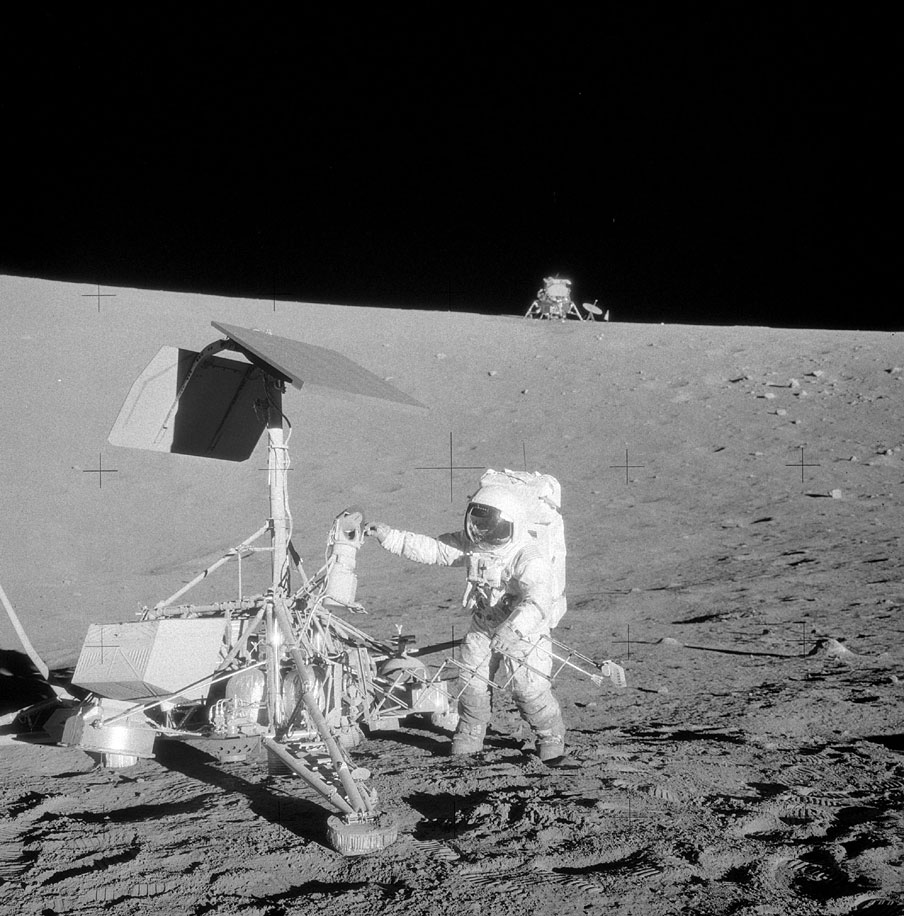
With Apollo 12, the story of Surveyor III came full circle and we got one of the coolest pictures ever taken from the lunar surface. Out of scientific and engineering interest, Apollo 12 landed in the same site as Surveyor III. Al Bean and Pete Conrad got to see the robot up close, which is how we have the image from earlier showing Surveyor sitting on the Moon. They took pictures, and even grabbed pieces of the robot to bring back home for analysis. Right now, the TV camera of Surveyor III sit in the Smithsonian, where you can visit and see actual hardware returned from the Moon. The Apollo astronauts also took what I think are some of the most incredible photographs from the history of exploration–human space explorers interacting directly with their robot counterparts.

Apollo astronaut Pete Conrad “jiggles” the spacecraft to see how firmly it’s rooted to the ground. Credit: NASA

CORRECTION 11/21/2024: The original version of this post identified the astronaut in the last picture as Alan Bean. It’s actually Pete Conrad, and Alan Bean is the one taking the photograph.

Subscribe for free:

Ways to support my work:


Footnotes:

  1. If you want to know more about this, Lunar Orbiter photography was the topic of my master’s thesis, which can be found in the about section. ↩︎
  2. There’s a famous story of how scientists feared the landing vehicle would sink into the soil, an idea that did come from a fairly well-known scientist. But many geologists at the time were pretty dismissive of his claims. There were other potential issues though, including ignorance of the electrostatic properties of the lunar material, which could have led to severe dust build-up on equipment. Bottom line: not a lot was known for sure about the nature of the surface. This was an issue if you wanted to land there. ↩︎
  3. For a description of lunar mapping efforts around this time, see Kopal and Carder, Mapping of the Moon. The difficulty of interpreting the photographs can be seen in a variety of scientific papers from the time. Examples can be found in Interpretation of Lunar Probe Data, ed. Jack Green, 1966. ↩︎
  4. Boeing was the primary contractor on Lunar Orbiter. Images and methods can be found in their contractor reports for NASA. ↩︎
  5. Detailed comments the relative priority of science on the Apollo Mission can be seen in A Review of Space Research, the document that came out of the 1962 Iowa Summer Study. ↩︎